.

Wednesday

The Lost Chickering Hall -- No. 130 Fifth Ave.


from the collection of the New York Public Library

During the turbulent Civil War years piano and organ dealers clustered along Broadway, mostly below Houston Street.  In 1860 there were no fewer than four piano showrooms along the block between Prince and Houston alone.  Among them was Chickering & Sons at No. 694 Broadway, a Boston-based firm renowned for its superb quality and design. 

In 1864 William Steinway jumped ahead of the piano district by erecting an elegant showroom building on East 14th Street near Fifth Avenue.  Well-heeled customers could browse among over 100 Steinway & Sons pianos here; away from the distraction of competitors’ showrooms.  Two years later Steinway scored a coup when he ingeniously constructed a concert hall to the rear of his building.  Now audiences who came to hear performances would get first-hand demonstrations of the Steinway instruments played by top musicians.

Steinway’s luck increased when Manhattan’s premier concert venue, the Academy of Music, burned down four days below Steinway Hall’s grand opening.

By 1874 Chickering was ready to meet the challenge posed by Steinway Hall.  The firm broke ranks with the Broadway piano merchants and signed a 25-year lease on the lot at the northwest corner of Fifth Avenue and 18th Street—a neighborhood that a generation earlier had been the city’s most exclusive residential district and included Frank Chickering’s own mansion at No. 5 Fifth Avenue.  Architect George B. Post was hired to design a structure that could house a vast piano showroom, music store, warehouse and—most importantly—a concert hall to rival Steinway’s.

Chickering’s planned move would instigate a migration of the piano and organ dealers.  Before the turn of the century Fifth Avenue and Union Square would see the construction of grand buildings of piano makers—the Sohmer Piano and Decker Brothers buildings among them.  But for now Chickering could claim Fifth Avenue.
Chickering invited "friends and the public" to the new structure -- The Sun, December 18, 1875 (copyright expired)

Post’s Chickering Hall was completed within six months of breaking ground.  The impressive structure cost $175,000—a substantial $3 million today.  At four stories tall, pretending to be two, it was a stocky red brick structure trimmed in marble and brownstone.  Immense arches, two stories tall, commanded attention; there were three along the Fifth Avenue façade, mimicked by five blind arches down 18th Street.  Post capped it all with a tiled hipped roof.

Chickering Hall sat among the mansions of a still-residential Fifth Avenue.  Note the smart carriage and footman to the left -- photographer unknown, from the collection of the Museum of the City of New York http://collections.mcny.org/C.aspx?VP3=SearchResult_VPage&VBID=24UAYWEPNPNP&SMLS=1&RW=1366&RH=579

The auditorium filled the second and third floors.  It was praised for its acoustics and could accommodate 1,500 patrons.  The hall was hastily opened on Monday evening, November 15, 1875 before the interior decorations were fully finished.  The rush to throw the doors open was the result of a one-time opportunity for Frank Chickering’s firm.

Internationally renowned pianist Hans Von Bulow had planned his American debut for November 1875 in New York City.  The eccentric musician was highly selective about the make of piano he would use and discussions had gone on for months.  Finally he settled on Steinway and Chickering as the only pianos he would play.  Von Bulow’s manager entered into negotiations with both firms.  Newspapers on both sides of the Atlantic reported that both Steinway and Chickering had offered $20,000 to land Von Bulow on their stages.
 

Frank Chickering was no doubt jubilant when Hans Von Bulow agreed to open at Chickering Hall.   The opening night of Chickering Hall was a stellar one.  Hans Von Bulow was backed up by Leopold Damrosch’s orchestra—which two years later became the New York Symphony Orchestra.  It was marketing gold when Von Bulow told the press “On other pianos, I have to play as the piano permits; on the Chickering I play just as I wish.”

Hans Von Bulow plays with Damrosch's orchestra on opening night -- from the collection of the New York Public Library
A journalist in the audience gave the performance a rave review, saying that “From the moment he touches the keys Bulow disappears, and nothing but the work…remains.”  He called the Chickering piano “the wonderful instrument which served Mr. von Bulow so faithfully, so obediently, so lovingly.”

The Von Bulow tour stretched on for weeks, both in New York at Chickering Hall, and on the road.  Chickering pianos followed the artist; but his intense dislike of commercialism repeatedly caused problems.   More than once the pianist kicked over the large signboard advertising Chickering Pianos; once sending it sailing behind the orchestra.  When Frank Chickering tried to solve the problem by stenciling the name Chickering in gold letters on the instrument, Von Bulow pulled out a penknife and scratched out the name.
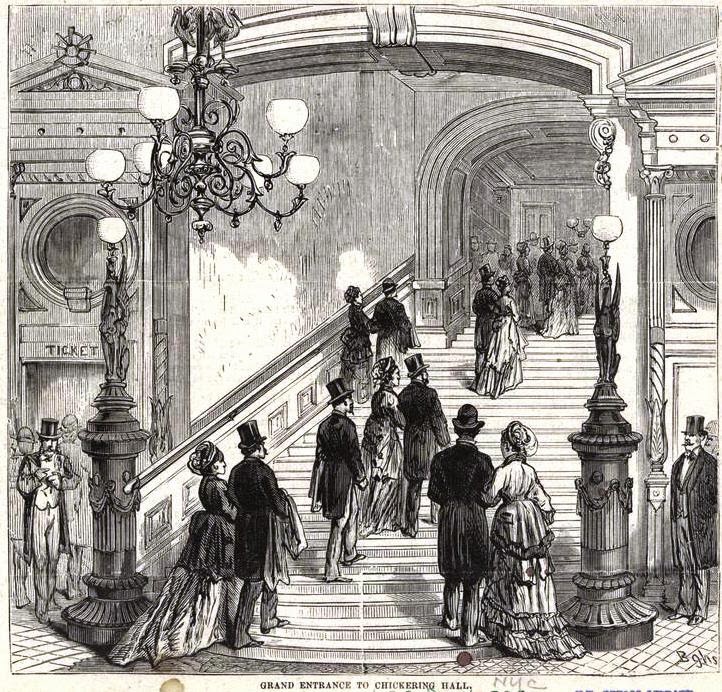
Elegantly-dressed patrons ascend the grand staircase to the concert hall on December 4, 1875 -- from the collection of the New York Public Library
Two months after its opening Chickering Hall received its $15,000 custom-built organ.  Constructed by Hilborne L. Roosevelt, The New York Times called it “a very successful achievement.”  The organ was premiered in a concert by organists Morgan Whitely, George and William Warren, S. Austen Pearce and Dudey Buck.  The newspaper noted that “Some of the effects…were uncommonly beautiful, and the voix celeste approximated so closely to the ideal of angels’ chants, that the assemblage broke out into rapturous applause almost before the sounds had died away.”

Von Bulow’s widely-publicized concerts that inaugurated Chickering Hall had pushed, at least for a while, Steinway Hall off the entertainment pages.  But while famed musical artists, orators and singers would go on to grace the boards of Chickering Hall; not all the performances would be critically-acclaimed. 

On December 12, 1876 a young Russian pianist made her American debut here.  Mlle. Theresa Jakonbovitsch disappointed the critic of the New-York Tribune.  He wrote “She promises more than she is as yet able to accomplish.”  Although he tried to be kind (“She seems to be intelligent; she certainly plays carefully”); he summed up her performance saying “But, as it seems to us, she ought rather to be studying than playing in public.”

The vast auditorium was not devoted only to music.  Other large assemblages used the hall including, surprisingly, the proceedings in what The New York Times called “the famous Forrest divorce suit” in April 1876; and Professor Huxley’s series of three lectures on The Theory of Evolution in September that same year.  The British scientist deftly presented his evidence of evolution while avoiding the bruising of some less broad-minded Victorian minds in the audience.

The following year, in May 1877, audiences were spellbound by a demonstration by Alexander Graham Bell of his new invention—the telephone.  Bell’s demonstration, unfortunately, was only partially successful.  The Times reported on several of the experiments.  In one case “Mr. Watson was asked to repeat some phrase loudly and slowly a number of times.  The phrase was announced to be ‘Do you understand what I say?’  What came from the boxes was, “Oo, boo, boobooboo, boo, boo, boo.’  Mr. Watson next tried to say ‘How do you do?’ but only succeeded in transmitting ‘boo,boo—boo,boo.’”

By the 1880s the mansion next door to Chickering hall had been converted for commercial purposes -- from the collection of the New York Public Library

In 1882 poet Oscar Wilde arrived in America for a lecture tour and on January 9 crowds filed into Chickering Hall to hear the famed English writer.  “Before 8 o’clock a placard setting forth that there was ‘standing room only’ within was displayed at the entrance.  A large portion of those who attended came in coaches, and there were many representatives of families conspicuous in the fashionable world,” reported The New York Times.  “Young men dressed as though for an opera night ranged themselves behind the rear row of seats and along the side aisles.  Ladies attired in rich costumes were numerous, and were prepared to level their opera-glasses at the lecturer upon his appearance.”

The newspaper was a much interested in Wilde’s appearance as in his subject, “English Renaissance.”  In detail it told its readers “His long and bushy hair crowded in front of his ears and nearly to his eyes, but it was brushed well off his forehead.  He wore a low-necked shirt with a turned-down collar and large white necktie, a black claw-hammer coat and white vest, knee-britches, long black stockings, and low shoes with bows.  A heavy gold seal hung to a watch-guard from a fob-pocket.  The poet had no flower in the lapel of his coat.  In his picturesque attire he was a study that seemed greatly to interest the audience.”

Having recapped the lecture, The Times concluded saying “At the finish of the lecture the poet was vigorously applauded, and when he retired from the stage he blushed like a school-girl.”

One-by-one the mansions along Fifth Avenue were converted for business purposes.  photograph by Adolph Witteman, from the collection of the Museum of the City of New York http://collections.mcny.org/C.aspx?VP3=SearchResult_VPage&VBID=24UAYWEPNPNP&SMLS=1&RW=1366&RH=579

In 1901 Chickering’s lease with the Mason estate elapsed.  The New York Times reported that “Some time before the expiration of the ground lease, it became known that the Chickering concern would not retain the property.”  By now the entertainment district, along with the piano companies, were already moving northward. 

The building of another piano manufacturer, Mason and Hamlin, had replaced the church behind Chickering Hall by the turn of the century -- photographer unknown, from the collection of the Museum of the City of New York http://collections.mcny.org/C.aspx?VP3=SearchResult_VPage&VBID=24UAYWEPNPNP&SMLS=1&RW=1366&RH=579

On December 4, 1901 Alliance Realty Company purchased the property for about $575,000.  Four days later The Times reported that “A new mercantile structure will soon rise on the site of Chickering Hall.”  The days of the magnificent structure where New Yorkers heard the world’s foremost musicians, inventors, singers and lecturers had come to an end.

Within months Chickering Hall was demolished and the foundation for an 11-story business building was dug.  It was the scene of tragedy on May 27, 1902 when a crowd of excited viewers crammed the area of the construction site as a parade marched up Fifth Avenue.  The temporary sidewalk erected in front of the deep pit gave way, plunging about 100 persons into the excavation pit.  One man died instantly and “at least fifty were so seriously injured that they either had to receive medical attention on the spot or else were driven away in carriages,” said the police report.

The limestone and brick-clad building that replaced Chickering Hall still survives; obliterating any memory of the once-famous concert hall that stood there before it.

(photograph by the author)

Queen Anne Sisters at Nos. 251-255 W. 70th Street


In the last two decades of the 19th century, developers on the Upper West Side grabbed up long rows of property and erected speculative rowhouses.  Quite often their architects created enclaves of harmonious structures that flowed together almost as a unit—each standing on its own merit; but architecturally similar to its neighbors.  In 1885 architect W. H. W. Youngs would go a step further.

Developer E. Stanton Riker commissioned Youngs to design three rowhouses on West 70th Street, Nos. 251 through 255.  The playful Queen Anne style had caught on among those daring enough to step out of the more formal residential box; and Youngs turned to this style for the houses.  His design resulted in the three residences pretending to be one grand home.

Completed in 1886 the brick, brownstone and terra cotta houses rather surprisingly rejected the asymmetry associated with Queen Anne.  Youngs liberally splashed Romanesque Revival into the design in the form of hefty arches at the parlor floor (including the great span that served as the entrance for No. 253) and a gaping arch below the central, terra cotta-filled gable.  He successfully created the illusion of a single, imposing mansion.


The three houses became home to upscale, respectable families.  By 1895 when Michael Giblin sold No. 251 to John Noble Golding, the Rev. Claudius M. Roome and his wife lived next door and Harvard graduate John O. Powers lived in No. 255.

John Noble Golding was a highly respected real estate broker with an office at No. 9 Pine Street far downtown.  Educated at Trinity School, he was a member of the Lawyers’, Army and Navy, Colonial, New York Yacht and the New York Athletic Clubs.  Golding was also a member of the American Geographical and Numismatic Societies.

Not only was Golding responsible for massive real estate deals like the Equitable Company’s purchase of its Nassau and Liberty Street site; the sale of the Roman Catholic Orphan Asylum on Fifth Avenue for $125 million, and the New York Yacht Club’s property; he sold sites to some of Manhattan’s wealthiest citizens for their mansions.  Included in his client list were Edward Berwin, Charles T. Yerkes, Howard Gould, Stuyvesant Fish, Perry Belmont, George Baker, Joseph Pulitzer and Thoams F. Ryan to name just a few.

As was the case with all the wives of moneyed businessmen, Mabel Golding busied herself with charities.  One of her favorites was the House of Refuge for Women, at Hudson, New York.  The children of these impoverished women were often overlooked and in 1898 Mabel sent off eight bibs, books, wagons and other toys to the House of Refuge.

The year before her donation, Claudius M. Roome, living next door, had been appointed the new curate of Christ Church, then standing at the corner of the Boulevard (later renamed Broadway) and 71stStreet.  Born into a prominent old Dutch family, he graduated from Columbia College and Columbia Law School.  Having practiced law for a few years, he gave it up to enter the General Theological Seminary.

Roome’s father had been an important businessman and it was most likely the family's wealth rather than his church salary that enabled him to live in the upscale home.

The outwardly-serene home life of the Goldings, with their daughter Mabel, was shattered in 1904 when John Golding moved out.  Finally, in 1910, Mabel filed a separation suit to ensure her financial survival.  The New-York Tribune published the scandalous headline “Wife Sues J. N. Golding.  Manager of Astor Estate Defendant in Separation Suit.”

Millionaire real estate man John N. Golding would tire of his wife.  The Successful American, January 1903 (copyright expired)
Unexpectedly at the time, the title of the 70thStreet home was in John’s name, not his wife’s.  Mabel, with no legal expectations of income, testified that John Golding had $3 million in real and personal property.  The terms of the separation required him to convey the title to Mable and to continue paying off the $15,000 mortgage.

The unsuspecting Mabel Golding was no doubt shocked and humiliated when, in 1918, the house was sold at auction for $14,000—less than the mortgage which her husband had decided not to pay.  She took her husband to court again, suing for the $15,000 (about $220,000 today).

Her millionaire husband apparently came through and Mabel and her daughter retained possession of the house.  She would remain in the house another two years before selling it in April 1920.  Although the new owner, Taylor Holmes, promised he “would occupy,” he resold it a month later.

Hiding under the vines that crawl up the facade, the pressed metal bay can be seen in autumn.  http://www.luxurynewyorkcondominium.com/condo/251-west-70th-street-new-york

By now Rev. Roome had moved on and F. K. Kraetzer, Jr. owned No. 253.  Mrs. R. A. Du Foureq was leasing it at the time that Mabel Golding moved away.  A year earlier No. 255 had fallen victim to a trend that was sweeping over the Upper West Side.  In 1919 real estate operators Houghton Company announced that the house was “being altered into small suites.”

That year The Cornell Alumni News reported that Ensign William F. Tufts had been released from active service in the Naval Reserve and “is now with the McCandless plant of the Westinghouse Lamp Company.”  He was among the first tenants in the newly-converted house.   Another resident held a related job.  M. H. Naigles, XV worked in the installation department of Western Electric Co. “on the automatic phones.”

Nos. 251 and 253 held out as single family homes for a few more years.  In 1937 the former Golding house was home to Mr. and Mrs. Frank Seitz.  The couple had met a colorful acquaintance through a mutual friend around 1930.  Mrs. Muriel Du Pont Bergman told them she was the illegitimate daughter of Delaware Senator T. Coleman Du Pont. 

Now, following the senator’s death, Mrs. Bergman appeared with a letter showing that she had inherited about $40 million from the estate.  Happy and excited, she asked the Seitz couple if they would loan her $15,000.  If so, she would generously repay them with $1 million from the inheritance.

The couple turned over their entire life’s savings to Muriel Bergman.  On August 28, 1937 the 50-year old con artist was arrested in Portland, Oregon on charges of forging the inheritance letter.

Two years later the Seitzes were gone and the house was sold at auction.  It was won by Gus Trachtenburg for $5,700—a fraction of the $17,000 assessed value.  It was converted in 1941 to two apartments in the basement, three furnished rooms on the first floor, and four furnished rooms on each floor above.  In 1945 No. 253 was divided into apartments; two per floor except the third floor which had four furnished rooms.

At least one relic of Mabel Golding's house survives.  http://olshan.com/property.php?id=6557
By the 21st century Youngs’s brilliant design had been viciously abused.  Only a few of the stained glass panels survive, a regrettable picture window was installed on the third floor of No. 255, and the stoops of the end houses were removed.  Nos. 251 and 253, still apartment buildings, were joined internally in 1978.


Despite it all, W. H. W. Youngs’s arresting triple residence still manages to catch the eye.

non-credited photographs taken by the author

The World Trade Center Survivor -- Fritz Koenig's "The Sphere"

The Sphere, rededicated as a memorial to the victims of The World Trade Center - photo by Alice Lum
From the earliest conception of The World Trade Center, art was to play an integral part. Works by esteemed artists Louise Nevelson, Joan Miro, James Rosati, Masayuki Nagare, Alexander Calder, Roy Lichtenstein, Cynthia Mailman, Germaine Keller, Romare Bearden, and Kenneth Snelson were displayed in the two soaring silver towers. In addition to the works commissioned for the buildings, the Cantor Fitzgerald offices housed some 300 sculptures and drawings by Auguste Rodin.

In the plaza, a fountain by Elyn Zimmerman served as a memorial to the victims of the 1993 World Trade Center bombing.

The World Trade Center buildings were not only a place of business, but a place of beauty and art.

On the morning of September 11, 2001 it all came to an end.

In the five-acre plaza, prior to that morning, there stood an abstract sculpture by Bavarian artist Fritz Koenig titled “Kugelkaryatide” or “Great Spherical Caryatid.” The Port Authority of New York and New Jersey, owner of the World Trade Center, commissioned the piece five years before the buildings were completed.

Koenig cast the 25-foot high bronze and steel piece in 52 segments. He intended for the 45,000-pound sphere to symbolize world peace through world trade. Ironically, when finished it was installed amid a circle of fountains designed by Minoru Yamasaki, simulating the Grand Mosque of Mecca with the Kugelkaryatide standing in place of the Kaaba.

The Sphere as it appeared before the morning of September 11, 2001

Over the years World Trade Center workers who gathered around the sculpture to eat lunch or relax gave the sculpture the unofficial name “The Sphere.”

On the morning of September 11 when the enormous Trade Towers fell, the artwork inside and around them was obliterated. Of the priceless bronze Rodins on the 104th Floor, nothing remained. Masayuki Nagare’s black granite sculpture “Cloud Fortress” and James Rosati’s stainless steel “Ideogram” were reduced to unidentifiable particles. “Commuter Landscape,” “Path Mural,” and “Fan Dancing with the Birds,” three decorative murals by Cynthia Mailman, Germaine Keller and Hunt Slonem, respectively, were lost forever.

But amazingly, as workers slowly removed tons of rubble and twisted steel beams, Fritz Koenig’s Sphere began to emerge. Although damaged, the sculpture that was meant to symbolize world peace had survived.

Inside a gaping hole ripped open at the top of the sphere, workers found a Bible, an airliner seat and documents from one of the upper floor offices. Koenig said later “It became its own cemetery.”

The Sphere was carefully dismantled and sent to storage near JFK International Airport. Almost immediately, the prospect of re-erecting the sculpture as a memorial was discussed. The artist was opposed. It was, he said, “a beautiful corpse.”

Yet as it was the only remainder of the World Trade Centers left essentially intact, Koenig relented. He personally supervised the re-erection of the sculpture in Battery Park. Fifteen iron workers and four engineers worked to create a new base for the Sphere. Six months to the day after the barbaric attacks on the Towers, The Sphere was rededicated on March 11, 2002.

Koenig remarked, “It was a sculpture, now it’s a monument. It now has a different beauty, one I could never imagine. It has its own life – different from the one I gave to it.” An eternal flame was lit on September 11, 2002 to the victims of the attack.

Upon completion of the National September 11 Memorial at Ground Zero, The Sphere will go home again.

New Pomona College Science Building to Open in 2015

All images courtesy of Pomona College

Construction of Pomona College's new 75,000 square-foot Millikan Science Hall is ahead of schedule, with the building slated for completion in mid-2015.  The project, imagined as a new local landmark, was originally scheduled to open next Fall.  When complete, the low-rise structure will house the school's astronomy, mathematics and physics departments.

Copper panels are currently being added to the exterior of the building's planetarium dome, while ceramic tiles and windows are being installed on other parts of the facility.

Millikan Hall, designed by San Francisco-based architecture firm EHDD, will include: a domed digital planetarium; an outdoor physics lab; a two-story atrium; a remote observation room for Pomona's one-meter telescope at NASA's JPL Table Mountain facility; machine, wood and metal shops; a colloquium room with eating for 80 to 100 people; a 50-seat classroom and 16 physics teaching and research labs, in addition to classrooms and study spaces.  Matt Construction is the contractor for the project, which also entails a renovation of the adjacent Andrews Science Hall.


The project involves a full replacement of the 1958 Millikan Laboratory building.  Like its predecessor and neighboring structures, the new Millikan building will employ cast-in-place concrete, masonry design elements, textured plaster, a red tile roof and an entrance patio.  South-facing clerestory windows will bring natural light in from the second floor to the first via open light shafts.  Grading along the south side of the building will allow for windows into the basement, while the north side will remain windowless for experiments which require complete darkness.

The digital planetarium, visible from College Avenue and Sixth Street, will provide a panoramic, immersive view of the night sky and will allow for seasonal adjustments.  It will also give the College a means to reach out to the larger community, through special events and astronomy classes for local schools and organizations

The new Millikan is being built to meet the U.S. Green Building Council's LEED Gold Certification, with the possibility for additional design features which could push the building to Platinum Level Certification.


Tuesday

West Valley Doubles Down on Mixed-Use Developments

6912 Reseda Boulevard, looking north

Reseda Boulevard, long an auto-dominated corridor, has gradually come to the forefront of the push for walkable urbanity in the West San Fernando Valley.  The latest installment in this saga, a proposed residential-retail complex, would replace a brief stretch of automobile repair shops and drive-thru restaurants.

According to plans submitted to the city earlier this month, the proposed development at 6912 Reseda Boulevard calls for a six-story building, comprised of 170 residential units and 15,000 square feet of ground-floor retail and restaurant space.  The project would span across an approximately 1.5-acre site, occupying the majority of a city block between Basset and Hart Streets.

6912 Reseda is the second mixed-use development to emerge on Reseda Boulevard during the past year.  In September, renderings surfaced for the WaterMark, a 254-unit apartment complex from Metric Holdings Corporation and the Albert Group Architects.  The project, which was recently profiled in the Wall Street Journal, would feature landscaped terraces and open space along a potentially restored section of the Los Angeles River.

Metric Holdings may have started a trend in the West Valley.  A new case filing from the Department of City Planning indicates that another development is proposed northwest along the concrete-laden waterway.  The project at 18840 W. Sherman Way would consist of 49 apartments above slightly over 700 square feet of street-fronting commercial space.

18840 Sherman Way (L) and 6912 Reseda Boulevard (R)