.

Showing posts with label Fifth Avenue. Show all posts

Wednesday

The Lost Chickering Hall -- No. 130 Fifth Ave.


from the collection of the New York Public Library

During the turbulent Civil War years piano and organ dealers clustered along Broadway, mostly below Houston Street.  In 1860 there were no fewer than four piano showrooms along the block between Prince and Houston alone.  Among them was Chickering & Sons at No. 694 Broadway, a Boston-based firm renowned for its superb quality and design. 

In 1864 William Steinway jumped ahead of the piano district by erecting an elegant showroom building on East 14th Street near Fifth Avenue.  Well-heeled customers could browse among over 100 Steinway & Sons pianos here; away from the distraction of competitors’ showrooms.  Two years later Steinway scored a coup when he ingeniously constructed a concert hall to the rear of his building.  Now audiences who came to hear performances would get first-hand demonstrations of the Steinway instruments played by top musicians.

Steinway’s luck increased when Manhattan’s premier concert venue, the Academy of Music, burned down four days below Steinway Hall’s grand opening.

By 1874 Chickering was ready to meet the challenge posed by Steinway Hall.  The firm broke ranks with the Broadway piano merchants and signed a 25-year lease on the lot at the northwest corner of Fifth Avenue and 18th Street—a neighborhood that a generation earlier had been the city’s most exclusive residential district and included Frank Chickering’s own mansion at No. 5 Fifth Avenue.  Architect George B. Post was hired to design a structure that could house a vast piano showroom, music store, warehouse and—most importantly—a concert hall to rival Steinway’s.

Chickering’s planned move would instigate a migration of the piano and organ dealers.  Before the turn of the century Fifth Avenue and Union Square would see the construction of grand buildings of piano makers—the Sohmer Piano and Decker Brothers buildings among them.  But for now Chickering could claim Fifth Avenue.
Chickering invited "friends and the public" to the new structure -- The Sun, December 18, 1875 (copyright expired)

Post’s Chickering Hall was completed within six months of breaking ground.  The impressive structure cost $175,000—a substantial $3 million today.  At four stories tall, pretending to be two, it was a stocky red brick structure trimmed in marble and brownstone.  Immense arches, two stories tall, commanded attention; there were three along the Fifth Avenue façade, mimicked by five blind arches down 18th Street.  Post capped it all with a tiled hipped roof.

Chickering Hall sat among the mansions of a still-residential Fifth Avenue.  Note the smart carriage and footman to the left -- photographer unknown, from the collection of the Museum of the City of New York http://collections.mcny.org/C.aspx?VP3=SearchResult_VPage&VBID=24UAYWEPNPNP&SMLS=1&RW=1366&RH=579

The auditorium filled the second and third floors.  It was praised for its acoustics and could accommodate 1,500 patrons.  The hall was hastily opened on Monday evening, November 15, 1875 before the interior decorations were fully finished.  The rush to throw the doors open was the result of a one-time opportunity for Frank Chickering’s firm.

Internationally renowned pianist Hans Von Bulow had planned his American debut for November 1875 in New York City.  The eccentric musician was highly selective about the make of piano he would use and discussions had gone on for months.  Finally he settled on Steinway and Chickering as the only pianos he would play.  Von Bulow’s manager entered into negotiations with both firms.  Newspapers on both sides of the Atlantic reported that both Steinway and Chickering had offered $20,000 to land Von Bulow on their stages.
 

Frank Chickering was no doubt jubilant when Hans Von Bulow agreed to open at Chickering Hall.   The opening night of Chickering Hall was a stellar one.  Hans Von Bulow was backed up by Leopold Damrosch’s orchestra—which two years later became the New York Symphony Orchestra.  It was marketing gold when Von Bulow told the press “On other pianos, I have to play as the piano permits; on the Chickering I play just as I wish.”

Hans Von Bulow plays with Damrosch's orchestra on opening night -- from the collection of the New York Public Library
A journalist in the audience gave the performance a rave review, saying that “From the moment he touches the keys Bulow disappears, and nothing but the work…remains.”  He called the Chickering piano “the wonderful instrument which served Mr. von Bulow so faithfully, so obediently, so lovingly.”

The Von Bulow tour stretched on for weeks, both in New York at Chickering Hall, and on the road.  Chickering pianos followed the artist; but his intense dislike of commercialism repeatedly caused problems.   More than once the pianist kicked over the large signboard advertising Chickering Pianos; once sending it sailing behind the orchestra.  When Frank Chickering tried to solve the problem by stenciling the name Chickering in gold letters on the instrument, Von Bulow pulled out a penknife and scratched out the name.
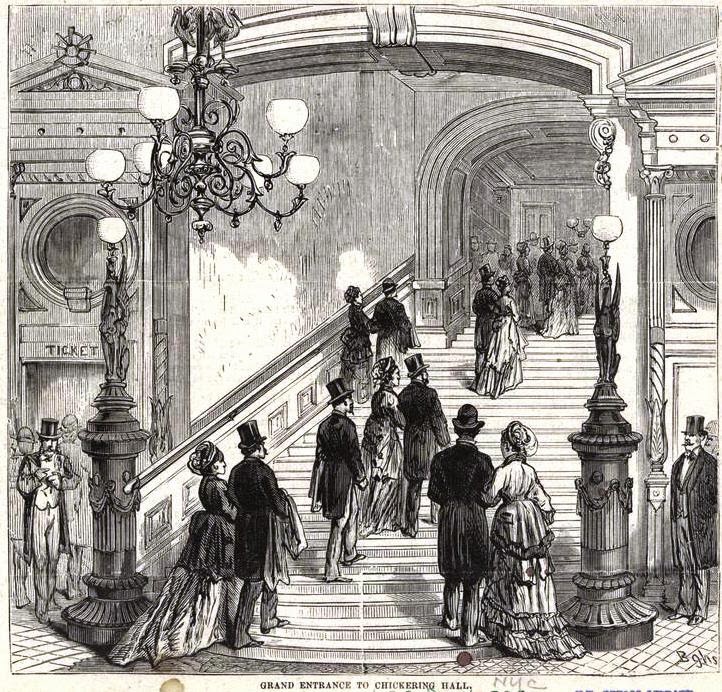
Elegantly-dressed patrons ascend the grand staircase to the concert hall on December 4, 1875 -- from the collection of the New York Public Library
Two months after its opening Chickering Hall received its $15,000 custom-built organ.  Constructed by Hilborne L. Roosevelt, The New York Times called it “a very successful achievement.”  The organ was premiered in a concert by organists Morgan Whitely, George and William Warren, S. Austen Pearce and Dudey Buck.  The newspaper noted that “Some of the effects…were uncommonly beautiful, and the voix celeste approximated so closely to the ideal of angels’ chants, that the assemblage broke out into rapturous applause almost before the sounds had died away.”

Von Bulow’s widely-publicized concerts that inaugurated Chickering Hall had pushed, at least for a while, Steinway Hall off the entertainment pages.  But while famed musical artists, orators and singers would go on to grace the boards of Chickering Hall; not all the performances would be critically-acclaimed. 

On December 12, 1876 a young Russian pianist made her American debut here.  Mlle. Theresa Jakonbovitsch disappointed the critic of the New-York Tribune.  He wrote “She promises more than she is as yet able to accomplish.”  Although he tried to be kind (“She seems to be intelligent; she certainly plays carefully”); he summed up her performance saying “But, as it seems to us, she ought rather to be studying than playing in public.”

The vast auditorium was not devoted only to music.  Other large assemblages used the hall including, surprisingly, the proceedings in what The New York Times called “the famous Forrest divorce suit” in April 1876; and Professor Huxley’s series of three lectures on The Theory of Evolution in September that same year.  The British scientist deftly presented his evidence of evolution while avoiding the bruising of some less broad-minded Victorian minds in the audience.

The following year, in May 1877, audiences were spellbound by a demonstration by Alexander Graham Bell of his new invention—the telephone.  Bell’s demonstration, unfortunately, was only partially successful.  The Times reported on several of the experiments.  In one case “Mr. Watson was asked to repeat some phrase loudly and slowly a number of times.  The phrase was announced to be ‘Do you understand what I say?’  What came from the boxes was, “Oo, boo, boobooboo, boo, boo, boo.’  Mr. Watson next tried to say ‘How do you do?’ but only succeeded in transmitting ‘boo,boo—boo,boo.’”

By the 1880s the mansion next door to Chickering hall had been converted for commercial purposes -- from the collection of the New York Public Library

In 1882 poet Oscar Wilde arrived in America for a lecture tour and on January 9 crowds filed into Chickering Hall to hear the famed English writer.  “Before 8 o’clock a placard setting forth that there was ‘standing room only’ within was displayed at the entrance.  A large portion of those who attended came in coaches, and there were many representatives of families conspicuous in the fashionable world,” reported The New York Times.  “Young men dressed as though for an opera night ranged themselves behind the rear row of seats and along the side aisles.  Ladies attired in rich costumes were numerous, and were prepared to level their opera-glasses at the lecturer upon his appearance.”

The newspaper was a much interested in Wilde’s appearance as in his subject, “English Renaissance.”  In detail it told its readers “His long and bushy hair crowded in front of his ears and nearly to his eyes, but it was brushed well off his forehead.  He wore a low-necked shirt with a turned-down collar and large white necktie, a black claw-hammer coat and white vest, knee-britches, long black stockings, and low shoes with bows.  A heavy gold seal hung to a watch-guard from a fob-pocket.  The poet had no flower in the lapel of his coat.  In his picturesque attire he was a study that seemed greatly to interest the audience.”

Having recapped the lecture, The Times concluded saying “At the finish of the lecture the poet was vigorously applauded, and when he retired from the stage he blushed like a school-girl.”

One-by-one the mansions along Fifth Avenue were converted for business purposes.  photograph by Adolph Witteman, from the collection of the Museum of the City of New York http://collections.mcny.org/C.aspx?VP3=SearchResult_VPage&VBID=24UAYWEPNPNP&SMLS=1&RW=1366&RH=579

In 1901 Chickering’s lease with the Mason estate elapsed.  The New York Times reported that “Some time before the expiration of the ground lease, it became known that the Chickering concern would not retain the property.”  By now the entertainment district, along with the piano companies, were already moving northward. 

The building of another piano manufacturer, Mason and Hamlin, had replaced the church behind Chickering Hall by the turn of the century -- photographer unknown, from the collection of the Museum of the City of New York http://collections.mcny.org/C.aspx?VP3=SearchResult_VPage&VBID=24UAYWEPNPNP&SMLS=1&RW=1366&RH=579

On December 4, 1901 Alliance Realty Company purchased the property for about $575,000.  Four days later The Times reported that “A new mercantile structure will soon rise on the site of Chickering Hall.”  The days of the magnificent structure where New Yorkers heard the world’s foremost musicians, inventors, singers and lecturers had come to an end.

Within months Chickering Hall was demolished and the foundation for an 11-story business building was dug.  It was the scene of tragedy on May 27, 1902 when a crowd of excited viewers crammed the area of the construction site as a parade marched up Fifth Avenue.  The temporary sidewalk erected in front of the deep pit gave way, plunging about 100 persons into the excavation pit.  One man died instantly and “at least fifty were so seriously injured that they either had to receive medical attention on the spot or else were driven away in carriages,” said the police report.

The limestone and brick-clad building that replaced Chickering Hall still survives; obliterating any memory of the once-famous concert hall that stood there before it.

(photograph by the author)

Tuesday

The Lost Anson R. Flower Mansion -- No. 601 5th Avenue

The elegant renovations to No. 603 (left) and the Flower mansion were completed in 1902 -- photo "Collins' Both Sides of Fifth Avenue"  1910 (copyright expired)

Around 9:00 on the evening of October 5, 1891 Governor Roswell Pettibone Flower and his wife left the brownstone mansion at No. 601 Fifth Avenue.  They walked, unescorted, a block north to the Democratic Club where Flower was guest of honor at a glittering reception.   The house where the Flowers were staying was the home of Emma A. Schley, wife of millionaire lawyer William Schley and the sister of the Governor’s wife.

Perhaps less powerful but no less wealthy were Flower’s brothers, partners in the banking firm of Flower & Co.  Frederick Flower lived near Emma Schley at No. 615 Fifth Avenue, while Anson Ranney Flower’s mansion was at No. 500 Madison Avenue. 

Like most wealthy New Yorkers at the time, Anson Flower was involved in more than his banking firm.  He was a Director in the Brooklyn Rapid Transit Railroad Co.; Chicago and Eastern Illinois Railroad Co.; the Chicago, Rock Island and Pacific Railroad Co.; the Colonial Trust Co.; Federal Steel Co. and at least at dozen other corporations.

photograph by Alwan & Co, from the collection of the Museum of the City of New York http://collections.mcny.org/Collection/%5bAnson-R.-Flower.%5d-24UAKVA9H8F.html 

The Successful American said in 1899 “The firm of Flower & Co. is well known to the banking houses of the world as one of the most solid financial institutions in America, and also as one of the most daring and successful in speculation.”    The entire Flower family was well-respected and The Successful American said of Anson, “The family traits are faithfully preserved in Mr. Flower and he represents the best qualities of the stock.”

When Emma Schley died in 1900 she left an estate of “several millions of dollars.”   Her generosity extended even to her favorite clerks at B. Altman’s Department Store.  Mrs. Nagle, a clerk in “the white underwear department” there received $5,000 as did another clerk, Mrs. Flanagan.   The handsome inheritances would equal nearly $145,000 today.

The New York Times reported on July 1, 1900 that Emma’s daughter, Emma G. Halsey, received the largest bequest.  “To her Mrs. Schley leaves her home at 601 Fifth Avenue, with all it contains.”  Emma Schley had earlier purchased the house next door, No. 603; and Roswell P. Flower by now owned the two flanking houses at Nos. 599 and 605.

On January 6, 1901 the New-York Tribune reported that Anson R. Flower had purchased Nos. 601 and 603 from Emma Schley’s estate.    According to the Real Estate Record & Builders’ Guide, Flower paid $150,000 for No. 601 and $110,000 for No. 603.  The newspaper described them as “two four story and basement brownstone dwelling houses” and proposed that “Mr. Flower may unite the two houses into one for his own use.”
Both No. 603 (left) and No. 601 were about to get remarkable make-overs -- New-York Tribune, January 6, 1901 (copyright expired)

The Tribune’s supposition was not far off the mark.  At the turn of the century Manhattan’s millionaires were quickly razing or remodeling outdated brownstones into modern American basement showplaces (American basement homes were entered at street level, eliminating the high stoops).

But instead of joining the two houses, Flower quickly sold No. 603 to real estate operator Jeremiah C. Lyons, making a quick $20,000 profit.  Both Flower and Lyons remodeled the two residences and within the year they were unrecognizable.   Similar in style, they rose five stories to steep copper-clad mansard roofs.   While the Flower mansion was clad in red brick in contrast to the limestone front of No. 603; it made up for it in opulence.  Near matching six-foot iron fencing protected the areaways of both mansions.  The architect carried the material up to the entrance of the Flower mansion, having the elaborate door grills in cast iron rather than bronze.

The Record & Guide used the entrance doors as an example of fine cast iron work  August 8, 1908 (copyright expired)

Both houses were completed in 1902 and Lyons sold No. 603 to James B. Clemens for $200,000.   

The Times remarked on the Flower mansion. “The house is handsomely furnished, the tapestries and furniture having been imported for Mrs. Flower.”

While construction on the Flower residence was continuing, Anson Flower had added one more item to his resume.  In June 1901 he was elected President of the Amalgamated Copper Company, filling the position vacated by Standard Oil Company executive H. H. Rogers’s resignation.  Rogers appears to have gotten out of the copper business just in time.

It was a time when multimillionaires with names like Carnegie, Rockefeller and Vanderbilt were feeling attacked by the government, which was seeking to break the monopolistic empires the moguls had worked so hard to build.  Summonses to appear were often met with cold defiance.

Five months later, on November 24, 1901, the New-York Tribune reported that “Several of New-York’s wealthy and well known men have been summoned to appear before Judge Lacome, in the United States Circuit Court, on November 29, to show cause why the judge should not commit them to jail or fine them, or otherwise punish them at his discretion, for contempt of court.”  Anson R. Flower was among those “wealthy and well known men.”

Six days later The New York Times ran the headline “Anson R. Flower in Custody.”  Judge Lacome found the stubborn tycoon “guilty of contempt of court” after he refused to testify.  The judge committed him “to the custody of United States Marshall Henkel until he shall consent to appear and testify in an action brought against the company in the Montana courts.”

While the tempest played out, Ida Flower continued her charitable works and entertaining.  Eventually the scandal passed and life at No. 601 Fifth Avenue returned to normal.   Anson and Ida, who had no children, maintained a country estate in Watertown, New York.  When the summer season of 1908 drew to a close, the Flowers remained upstate after Anson’s heart condition took a serious turn.

On November 17 a Watertown newspaper reported “Anson R. Flower of the banking firm of Flower & Co., New York, was so ill at his home in this city yesterday that prayers were offered for his recovery in the Episcopal Church.”   But family members assured the reporter that the millionaire was resting “more comfortably and was apparently upon the road to recovery.”

As it turned out, there would be no road to recovery.   Anson Ranney Flower died in the Watertown house less than two months later, on January 3, 1909.   The ugly court case of 1901 was forgotten in his obituary.  Instead his vast charities, including the co-founding of Flower Hospital with his brothers, and his magnanimous contributions to the Stonywold Sanitarium in the Adirondacks; along with his vestryman position with St. Thomas’s Episcopal Church were remembered.

Ida remained in Watertown, leasing the mansion on Fifth Avenue to Washington B. Thomas, President of the American Sugar Refining Company.   On September 20, 1909 the New-York Daily Tribune noted “it is rented, fully furnished, as a temporary home for Mr. Thomas.”  The following year it was leased to Mrs. C. H. Mellon “of Morristown, New York,” according to The Times.

By now commerce had engulfed the Fifth Avenue neighborhood around the Flower mansion.  Although its handsome renovations were only 10 years old, The New York Times called the house “the old Anson R. Flower residence” when Ida leased it in June 1911 “on a long term for business.”

The “long term” lease lasted less than a year.   On March 24, 1912 The New York Timesreported “Within the next month one of the fine old residences on Fifth Avenue above Forty-eighth Street will be torn down, giving way to a five-story business structure…The old residence has been the town home of Mrs. Anson Flower for about twelve years.”  An auction of the artwork, tapestries, and imported furniture was held inside the house on April 10.  Within five months the new building, designed by Albert Joseph Bodker, was completed.

The upper floors of the Clemmons mansion, next door, survive nearly intact.  photo by the author

Monday

A Brutalized Marble Commercial Villa at No. 572 5th Ave.


In 1915 the Budd haberdashery was surrounded by equally high-end shops -- photo collection of the Museum of the City of New York
As the first years of the 20th century unfolded, Fifth Avenue above 42nd Street was changing.  While a few staunch millionaires remained in their brownstone mansions, most by now had moved north along Central Park, leaving their homes to be razed or remodeled beyond recognition into commercial structures.

Between 46th and 47th Streets on the east side of the avenue, the elaborate Beaux Arts style Windsor Arcade engulfed the block front.  On the west side the Chevalier mansion at No. 574 had been transformed in 1903 into a Northern Renaissance fantasy to house upscale retail shops.  Its next door neighbor at No. 572 had also become a commercial building.

In 1906 the area was called by The New York Times “the gilt-edged section of Fifth Avenue.”   Once the most exclusive residential neighborhood in Manhattan, it was now home to the most exclusive retail stores—jewelers, fine art dealers and high-end clothiers.  That year Henry A. Budd purchased the building at No. 572 for $350,000.

Budd was a partner in his father’s haberdashery, Samuel Budd—more familiarly known as “Budd.”  Samuel had come to New York City in 1861 at the age of 26 from New Paltz, New York, to start a men’s clothing business.    The store remained on Fifth Avenue at 24thStreet for 45 years, earning a reputation as one of New York’s most respected men’s outfitters.  But now, with high-end retailers entrenching themselves further up Fifth Avenue, Henry Budd intended to establish a second store.

Budd patiently waited for the lease, held by confectioners Charles A. Dean, to expire in 1907.  In the meantime he commissioned architect Augustus N. Allen to draw up plans to renovate the structure.  The Timesreported that Budd intended to “remodel it and open it as a branch store.”

And remodel it he did.

Drawing inspiration from Southern Italian villas Allen created a white marble façade under a red-tiled Mediterranean sloped roof.  A three-story arcade rose gracefully to the fifth floor where three openings were separated by Corinthian pilasters, simulating a loggia.   A frieze of carved shields and the name “Budd” surmounted the impressive bronze store front fabricated by Estey Bros. Company.

The elegant men's store featured a bronze storefront -- Architectural Record June 1916 (copyright expired)
The new Budd store opened for business in 1907, catering to the same wealthy New Yorkers who had lived in the neighborhood a generation earlier.    The store was widely- known for its custom-made cravats which ranged in price from $1.00 to $6.00—upwards to $110 in today’s dollars.  An advertisement in the New-York Tribune touted “All the cravats sold by Samuel Budd are made in his own workrooms; the styles are original and the silks used in their manufacture are woven expressly in exceptional qualities under the supervision of his agents.  The patterns are the work of expert designers.”

Budd leased space above ground level to other high-end retailers.  K. E. Hanley Company was among the first tenants, sellers of women’s apparel.   On January 13, 1907 the store advertised a clearance sale of women’s suits “made up completed of foreign materials in fancy velveteens, in colors, and French Broadcloth.  The models are particularly exclusive and the workmanship throughout bears our well known stamp of superiority,” promised the ad.  The prices hinted at the wealth of the store’s clientele.  On sale some of the suits were priced at $62.50—about $1,100 today.

Shoppers on Fifth Avenue are dressed against the chill in 1915 -- photo collection of the Museum of the City of New York
Men’s tailors Schneider & Schmittlapp was leasing space on an upper floor by 1915.

Samuel Budd died in 1912 at the age of 77 after half a century of outfitting moneyed gentlemen.  Henry A. Budd continued the family business until 1933 when the Great Depression took its toll.   On June 7, 1933 the Mutual Life Insurance Company foreclosed on the building.  It would be the first of a rapid-fire string of turn overs of ownership.    In May 1943 Clarke G. Dailey purchased the property, selling it four months later to Frederick Brown.   Brown quickly turned a profit, selling the building a few weeks later, in November 1945.

The area remained the “Queen of Avenues” for several decades—the very term “Fifth Avenue” being synonymous world-wide with high-priced jewelry, clothing and artwork.   But by the end of the 20th century more tawdry businesses elbowed their way onto the Avenue and several airlines headquarters took over former retail buildings—often brutalizing the architecture with their modernizations.  And such was the case with No. 572 Fifth Avenue.   In the 1960s Irish International Airlines moved in, to be replaced by a two-story bookstore in 1971.  The upper floors were renovated to offices at the time.
The delicate panel carvings, the rope-twist detailing and the slender white marble columns hint at the lost elegance--photo by Alice Lum
Allen’s graceful Mediterranean villa lost its red tiled roof and the fifth floor windows were elongated, thereby losing the carved panels in the process that had created the loggia-effect.

The surviving traces of the Budd Building could indignantly be called "ruins." -- photo by Alice Lum
But the greatest insult occurred in July 2010 when a two-story storefront of polished black stone and blue neon was installed.   Today only traces of the Budd Building remain.  What was once a graceful white marble villa with a bronze storefront is the victim of brutal architectural vandalism masquerading as “improvement.”

The 1894 Scribner's Sons Building -- No. 155 Fifth Avenue


1846 was at a time when quiet evenings were spent with a bound book and one’s level of sophistication could be measured by his personal library.  That year Charles Scribner and Isaac D. Baker formed the publishing firm “Baker & Scribner” which, after Baker’s death, became Charles Scribner Company.
Having started out in part of a chapel of an old brick church at the corner of Nassau Street and Park Row, the growing company moved in 1856 to 377-379 Broadway; then to 124 Grand Street in 1858; and later to 654 Broadway. In 1875 it moved again to 743-745 Broadway.  But by 1892 the firm would need to expand yet again.

Charles Scribner, Sr., had died in 1871 but his firm, now known as Charles Scribner’s Sons, continued its distinguished reputation as a publisher of theological, historical and philosophical books.  Scribner’s published the first American edition of the Encyclopedia Britannica, started a subscriptions department, and expanded into magazine publishing with highly popular periodicals like Scribner’s Monthly, Century Magazine, and the children’s St. Nicholas Magazine.

The firm purchased the Glenham Hotel on Fifth Avenue between 21st and 22nd Streets for about $250,000 (approximately $5.5 million today).  The New York Timesannounced on August 3, 1893 that “an office building will be erected on the site.”

The “office building” would be designed by the well-respected architect Ernest Flagg.  At the time social reform was gaining steam; and Flagg was already recognized for his concern with adequate light and ventilation, sanitary conditions and zoning laws regulating the height of buildings and setbacks.  The architect was a major proponent of the Beaux Arts style, and the new Scribner’s Sons Building would be a fine example.

Flanking the central dormer, the dates of the firm's founding and the construction of the new building were carved.
Flagg looked to France for inspiration, as evidenced in the similarities between Edmond Guillaume’s 1880 Maison Commerciale at 3 rue d’Uzes and Flagg's designs for Scribner’s.  His resultant limestone-clad structure, completed in 1894, rose six stories to a mansard roof.  An elegant glass marquee sheltered patrons arriving at the first floor retail space.  Below ground was the packing department, offices took up the second floor, and the upper floors housed the subscription-book, surplus stock, magazine and mailing departments.

Ernest Flagg’s minute attention to the functional aspects of his designs extended to the bookshelves in the new building.  The New York Times noted that “at the suggestion of Ernest Flagg, the architect, they had their entire store…refitted with glass shelves.  Mr. Flagg originated the idea, having observed that wood and iron shelving, whether smooth or covered with cloth, had the effect of wearing the bindings of books.”

The heavy, pricey shelves were custom-made in France in two sizes and thicknesses—the larger being three-quarters of an inch and the smaller half an inch thick with rounded edges.  “This glass for one thing is perfectly inflexible,” explained the newspaper, “which gives it an advantage over wood.  Its strength also has been abundantly proved.  It is not only more cleanly looking than anything else in the way of shelving, but it in fact easier to keep clean.”

The Times said “The Messrs. Scribner are enthusiastic in praise of glass shelving, and all who examine it are impressed with it value in the preservation of books.”

Exquisite carvings surround the plaque that originally announced Scribner's Sons.

By May 25, 1894 the move into the new building, deemed byThe Times as “built of white limestone and graceful with classic simplicity,” was nearly completed.  Over 300,000 volumes had been carefully packed and moved over a period of a month.  The newspaper was astounded that there had been no damage to the inventory.  “Of all the delicately beautiful volumes which were transferred from the old building to the new—missals, books of hours, incunabula, bindings of the old masters, and of Cobden-Sanderson, new editions in covers fresh as the lilacs o May—not one was even imperceptibly damaged.  Not one!”

Well-dressed women window shop in front of the bookstore in 1895 -- King's Photographic Views of New York (copyright expired)
The Times estimated the cost of the new building by using the taxes and interest on the property as a guide.  It arrived at a figure of “more than $500,000.”

A clever cover illustration depicts women gazing into the store window of the new Scribner bookstore in November 1894 -- from the collection of the New York Public Library
Scribner’s Sons was not the only large publishing house and bookstore to move that year.  Dodd, Mead & Co. established itself right next door at the corner of Fifth Avenue and 21st Street, and D. Appleton & Co. moved into its new building at Fifth Avenue and 13th Street.  A journalist noted in December 1894 that “The growing literary taste of the public is being shown by the publishers who are moving into enlarged quarters to meet the demands of their customers.”

A white marble staircase led to additional retail space.  Note the interesting gas lights encircling the columns -- King's Photographic Views of New York 1895 (copyright expired)

The writer made note of Scribner’s retail area.  “Inside the new building of Charles Scribner’s Sons there is the appearance of a large public library, with a wonderful collection of books, fresh and new, and in beautiful bindings of many kinds.  Book shelves run up into a second story, and in the rear there is a top light of glass so large that there is not a dim nook or corner to be found.”

Scribner’s was fortunate to have published The Sherman Letters that year—a 50-year compilation of correspondence between brothers General William Tecumseh Sherman and Senator John Sherman dating from 1837 to 1891.  The firm also published Frances Hodgson Burnett’s newest children’s book Piccino that year; the latest in a series that included the popular Little Lord Fauntleroy.

Meticulous in its choice of authors, Scribner would introduce and represent over the years Edith Wharton, Henry James, Robert Louis Stevenson, Rudyard Kipling and George Santayana among many others.

In honor of Theodore Roosevelt's return from his African safari in 1910, Scribner's is framed in bunting and a two-story picture of Roosevelt is decorated with two large flags -- photograph by Byron Company, from the collection of the Museum of the City of New York http://collections.mcny.org/C.aspx?VP3=SearchResult_VPage&VBID=24UAYWE01010&SMLS=1&RW=1366&RH=667

Scribner’s Sons tradition of uptown moves continued.  After just two decades in its handsome headquarters, the firm called back Ernest Flagg to design another, larger, office building and bookstore further uptown in 1913. 

The Scribner family retained ownership of the old property, however.  In January 1934 it leased the building to the 153 Fifth Avenue Corporation which announced plans to remodel “with stores on the first floor and lofts above, at a cost of about $40,000.”  Architect Arthur Weiser made the renovations and it was possibly at this time that the marvelous glass marquee was removed.

The store level was modernized again in 1969; yet the beautiful French detailing of Ernest Flagg was mostly preserved.  By now the Scribner family no longer owned the building, having sold it in 1951.
Lacy cast iron spandrels trace the shape of the original glass marquee. 

In 1973 the United Synagogue of America purchased the former bookstore/publishing building.  Organized the same year that Scribner left the building—in 1913—its goal was to establish a middle-ground between the Reform and Orthodox communities. The group dubbed the building "Rapaport House."

The organization of 700 affiliated congregations used the building until 2007 when it was sold to Philips International Holding Corp. for $26.5 million.  A year later the company resold it to the Eretz Group for $38 million.

Ernest Flagg’s handsome and restrained Beaux Arts building survives essentially intact—a reminder of a time when publishing houses populated Fifth Avenue south of 23rd Street, and when families settled in at night with a book.

Snarling lions adorn the brackets upholding the carved balcony at the third floor.

photographs taken by the author