.

Showing posts with label William Ralph Emerson. Show all posts

Tuesday

From Saving Cash to Saving Souls, the 19th Ward Bank -- 152 East 34th Street


In 1906 the 19th Ward Bank was experiencing an encouraging boom in business. To meet the needs of its depositors, William Ralph Emerson (a cousin of poet Ralph Waldo Emerson) was commissioned to build a branch bank uptown at 180 East 72nd Street.

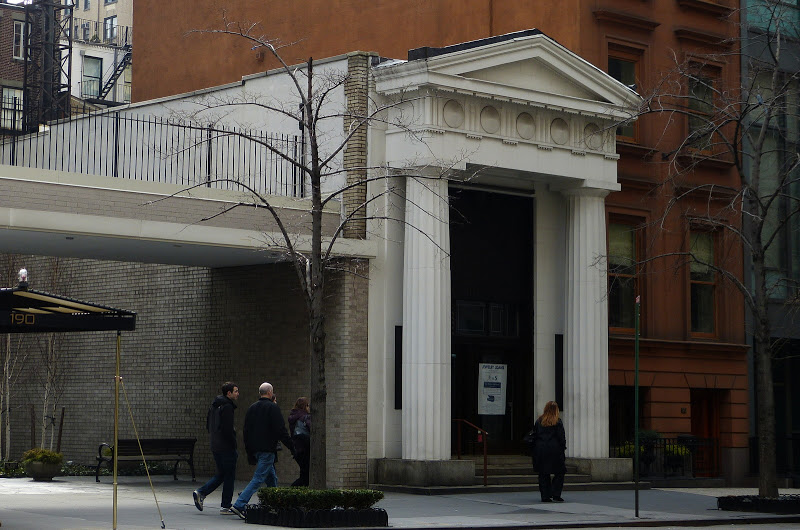
Emerson created on the narrow plot a dignified Greek temple with a classic portico supported by two heroic columns. Despite the restrictions of the skinny lot, the architect produced an attractive bank that exuded solidity and confidence.

Apparently the bank officers approved of his design because a year later he was re-hired to design the firm’s fifth branch – this one on East 34th Street between Lexington and Third Avenues. The wide and impressive home of Dr. Arthur H. Cilley, an expert on tuberculosis, was razed and in its place rose another Greek temple to banking. The dimensions of this lot, however, allowed for classic dimensions that resulted in a much more impressive structure.

Although it was a small bank building, its presence was grand. Four imposing fluted Doric columns supported the closed pediment. The overall sense was as much temple as bank.

Construction was begun in February 1907. The bank was expanding and its outlook was promising. In the past four years deposits had increased from $1.5 million to $5 million. But the road for the 19th Ward Bank was soon to turn rocky.

In October there was a run on the banks that had lent money in a failed scheme to corner the market on United Copper Company stock. Before long panic spread to affiliated banks. A week later the Knickerbocker Trust Company, the third largest trust in New York City, failed. The Financial Panic of 1907 was well under way.

The 19th Ward Bank, along with the 12th Ward Bank, came under the control of the Van Norden Trust Company. Two years later the Carnegie Trust Company formed a syndicate that absorbed them all, saving the institutions from failure and securing the interests of the depositors.

Before long, however, the little branch on East 34th Street would no longer be needed.

In the meantime what had been a tiny Armenian population in New York was burgeoning. Persecution in Turkey – resulting in massacres at times – drove more and more Armenians to the United States around the turn of the century.

The Armenian Evangelical Church of New York started out in 1881 holding services in the home of Reverand Garabed Nergararian and, by the time the 19th Ward Bank was sitting empty, had been borrowing space in the Adams Memorial Presbyterian Church on East 30th Street.

In 1921 the church purchased the bank building and, after two years of renovations, dedicated it on Christmas Sunday 1923. Where teller cages and transaction counters once stood were now pews. The deep, long space lent itself handsomely to use as a house of worship.


Old brownstone structures still abutted the church in 1928 -- photo NYPL Collection

A year later an exquisite stained glass memorial was dedicated, the work of Armenian artist Hovsep Pushman and a Skinner pipe organ was installed.


The woodwork was carefully styled to harmonize with the Greek Revival interiors -- photo nycago.com
The little Greek temple building continues to quietly serve the Armenian community on bustling East 34th Street. In 1985 the church sold its air rights to an apartment building developer and, with the resultant funds, initiated a restoration and renovation of the structure.

A decade later the now-historic Skinner organ was restored by the J. G. Saenger Instruments firm of Topton, Pennsylvania.

Over the decades, William Ralph Emerson’s classic Greek bank building has been dwarfed by surrounding skyscrapers. Yet it still manages to emanate a sense of tranquility and charm amid the raucous 34th Street traffic.

Non credited photographs taken by the author
Friday

The 1906 19th Ward Bank -- No. 180 E. 72nd Street


photo by Alice Lum
The Charity Organization Society noticed, in 1892, that unscrupulous pawn brokers were taking advantage of the city’s poorest citizens who, having nothing to serve as collateral for loans, brought their meager possessions to the pawn sharks to pay rent or buy food.  A special committee of the Society recommended the formation of an institution “to lend money at reasonable rates to the poor upon pledge of personal property.”

In simple terms, the committee was suggesting a government-approved pawn shop for the indigent.

The idea gained momentum the following year when the Financial Panic of 1893 devastated the nation.  The ten-year depression—the worst until the Great Depression of 1929—hit New York’s poorest citizens the hardest.  Seth Low, chairman of the Mayor’s Relief Committee, pushed for the passage by legislature of the incorporation of the Provident Loan Society of New York on May 21, 1894.

J. Pierpont Morgan, William E. Dodge, August Belmont, Cornelius Vanderbilt and other millionaires barely affected by the depression donated a total of $100,000 to get the institution off the ground.

Starting out in a rented room and employing a “practical pawnbroker” as the first manager, the Loan Society made 14,234 loans the first year.   The loans that year averaged about $16 and borrowers were charged one percent interest.   Yet the outlook for the fledgling institution was grim:  of the $299,155.50 in loans given that initial year, just $84.174.50 was repaid.

But with the end of the depression the Provident Loan Society gained its foothold.  President James Spreyer told The Churchman magazine that in 1898 “The results achieved by our society since its organization justify the statement that it has now passed the experimental period and that its usefulness ought to be expanded wisely and conservatively.”

As the financial rebuilding took place at the turn of the century, other institutions were growing as well.   In 1906 the business of the 19thWard Bank was so encouraging that an uptown branch was planned.  The narrow, four-story apartment building at No. 180 East 72nd Street was purchased from Marie A. Snow in July of that year.  Architect William Ralph Emerson (cousin of Ralph Waldo Emerson) was given the commission to design a bank that, in the wake of the recent panic, would exude permanence and solidity.
photo by Alice Lum
Despite the problems posed by the skinny lot, Emerson produced a delightful miniature Greek temple with two monumental fluted columns upholding a heavy entablature and classic pediment.   The bank directors apparently approved of the design; for a year later he was re-hired to design the firm’s fifth branch, this one on East 34th Street—a grown up version of the 72nd Street building.

Emerson's subsequent commission, a year later, was an enlarged version of No. 180 E. 72nd -- photo by the author
Trouble was on the horizon, however.    A failed scheme to corner the market on United Copper Company stock led to a run on the banks that had lent money for the endeavor.   Public panic spread and within a week the Knickerbocker Trust Company, the third largest in New York City, failed.  A new Financial Panic was born.

The 19th Ward Bank came under the control of the Van Norden Trust Company and by 1910 the former branches of the 19th Ward Bank were no longer needed.  Just four years after moving in the bank closed the doors of its 72nd Street branch.

In the meantime the Provident Loan Society had been leasing several buildings throughout the city.    In 1908 it laid plans for its first permanent headquarters and within two years would have a total of six buildings in the city.  Munsey’s Magazine, in 1910, called the Society the “biggest private pawnbroking institution in the world,” and praised its cause to “relieve pawnbroking of the stigma that unscrupulous followers of that vocation have brought upon it.”

On January 2, 1913 the Society moved into the former bank building on East 72nd Street.


photo by Alice Lum
As the 20th century progressed, the Provident Loan Society gave up most of its buildings and closed most of its branches.  Yet the East 72ndStreet branch remains to this day, a pristine little temple serving the Society’s original cause; “to create conditions whereby self-respecting men and women in time of need, may take advantage of the opportunities offered by the society’s offices.”