The sometimes feisty woman had more luck in finances than in love. In 1905 the New-York Tribune would recount “Mrs. Todd’s first husband was a Mr. Weatherford. After his death she was married to a man named Andrews, and later to Louis L. Todd, from whom she was divorced several years ago.”
Aggressive and headstrong in her business affairs, she took her son-in-law, William Marchand, as a partner in the Café Francis. When he fell behind on payments to her in 1901, she and her daughter barricaded the restaurant to prevent his entry. She also had the manager, Otto Busse, arrested. Busse later sued Margaretta for $50,000 for false arrest, but the case was tossed out.
Margaretta Todd lived in the Von Hoffman Apartments at No. 29 West 26th Street; sometimes called the Von Hoffman Arms. She had begun plans for it in 1893 at a time when the residential neighborhood was seeing the appearance of commercial structures. On April 15, 1893 the Real Estate Record and Builders’ Guide reported that she intended to built a “hotel;” but apparently her plans were not quite complete.
Reporting that her architect would be George Keister, the Guide said “Mrs. M. Todd will build a seven or nine-story apartment hotel.” She decided on seven.
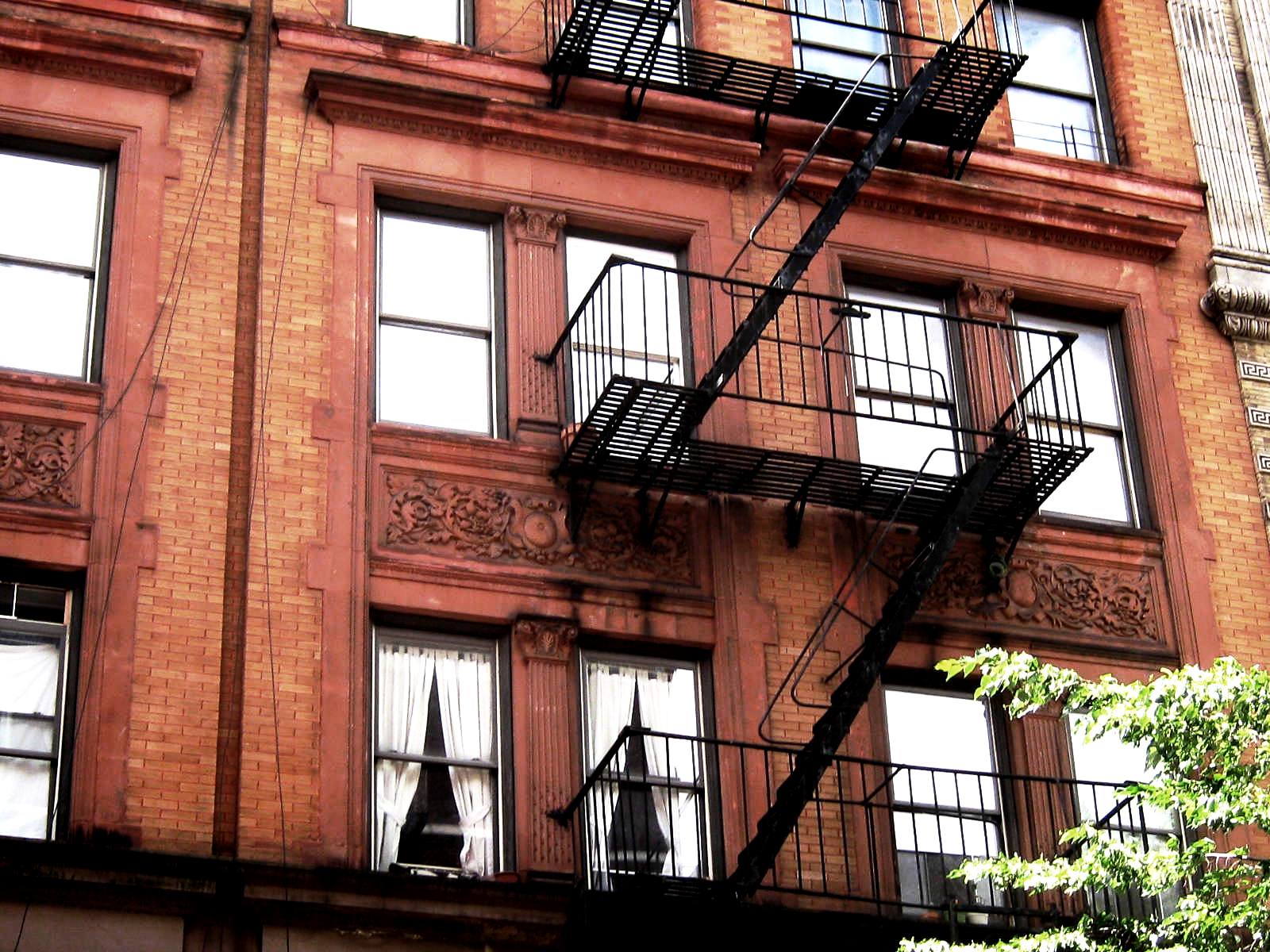
Completed a year later, Keister’s exceedingly handsome structure melded buff-colored brick and terra cotta to create a Renaissance Revival eye-catcher. The six upper stories sat on a stone base where elaborate carvings embellished the entranceway. Above the doorway’s transom the building’s name, Von Hoffman, was carved.

Keister managed to encrust the façade with elaborate decoration—terra cotta bands and panels, three-story Ionic columns, intricate lintels, and bracketed cornices—while retaining a refined appearance. The recessed openings of the sixth floor were separated by paired Corinthian columns.
The Von Hoffman appears to have quickly filled with tenants. On February 22, 1895 an advertisement in The Evening World announced “Only a few of those handsome apartments in The Von Hoffman left; 2 & 3 rooms & bath.”
The tenant list was varied. Despite the building’s location in the often disreputable Tenderloin District, it attracted respectable residents like Dr. Malcolm McLean who lived here in 1895. That year the doctor testified in the murder case of Francis J. Lindner. When asked during the trial “What do you think was the cause of his death,” McLean testified “The nearest I can come to it, expressing an opinion, is that the patient died from some narcotic poison.”
At a time when theatrical types were often shunned, the not-always-conventional Margaretta Todd leased an apartment to the actress Kate Dale. Kate had turned to the stage to support herself after her husband, an iron broker, died in 1895. She died in her apartment here in September 1898.
 |
| photo Fort Wayne Journal-Gazette August 29, 1915 (copyright expired) |
Margaretta Todd established herself in the new building. The New-York Tribune wrote “her apartments in the Von Hoffman, it is said, were furnished with almost Oriental lavishness.” As she aged, her hair had lost its color so she wore a wig. Age did not slow Margaretta Todd down. The New York Times described her as “holding her little court in her apartments. Often sitting in bed with her red wig and elaborately-laced clothes on, she received her circle of courtiers, including several women and four or five more than middle-aged men. Many times, it is said, she demanded that they kneel and kiss her hand, after the ancient style.”
Among Margaretta’s most trusted associates were her maid, Jennie M. Paine (who was apparently as much her friend as servant); her long-time lawyer, Ingersoll Lockwood who enjoyed an apartment rent-free; her doctor, Albert G. Weed; and the Von Hoffman manager, George Amory. They all would become just a few of the players in a scandalous mystery, the seeds of which were planted in 1902.
That year Margaretta Todd completed her will. In it she gave her lawyer, Ingersoll Lockwood, proprietorship of the Von Hoffman upon her death. Other friends were to receive cash amounts of around $1,500. Margaretta’s daughter would receive the rest of the significant estate. All parties, including lawyer Lockwood and Jennie Paine, were pleased with the contents of the will.
Later that year a bizarre incident occurred while Margaretta was out of town. On December 2 her good friend Anna Haight showed up at the door. Jennie Paine explained that Margaretta was away; but knowing the woman, allowed her to stay.
Two days later, according to The New York Times, “Mrs. Payne [sic] said her visitor began to act queerly, so she sent for a physician, but before he arrived Mrs. Haight suddenly ran to a window partially open, screaming at the top of her voice: ‘Let me out of here! Let me out!’ and leaped into the street.”
The newspaper said “In the leap Mrs. Haight received a fracture of the right let, several severe scalp wounds, and a number of bad bruises to the body. Her outer skirt was caught as she jumped from the window sill and torn loose, thus breaking somewhat the force of her fall.”
Within a few months after the peculiar incident, Margaretta Todd seems to have begun losing trust in her attorney. In 1903 she rewrote her will, naming her daughter, Mrs. Frank Tousey executrix, instead of Lockwood. And she hinted that there could be yet a third will forthcoming.
According to people close to Margaretta, Lockwood began laying plans to regain his grip on her fortune. In May 1905, after Margaretta’s daughter sailed for Paris, Jennie Paine began suggesting to Dr. Weed that her mistress had gone insane.
“This woman,” said lawyer George Gordon Hastings later, “egged on by others interested, having no desire that a new will should be made, went to Dr. Albert G. Weed, who had been Mrs. Todd’s physician for years, saying that their ‘dear old friend’ was acting strangely and that she certainly must be out of her head. Wouldn’t it be better if she were put in an asylum? That was energetically discouraged by Dr. Weed, who said that he thought she could take care of herself very well indeed.”
What Lockwood did not expect was that the Von Hoffman’s manager, Amory, would inform Margaretta. “She was furious,” said Hastings, “Lockwood’s effects were put out of the place. A few days later Jennie Paine was discharged.”
In May, Margaretta told George Armory that her 1903 will had been stolen from her rooms. She seems to have suspected Ingersoll Lockwood.
A letter the 78-year old woman wrote to Amory on July 29 reflected her fury. “L[ockwood] has played me false. He has tried to make trouble with my daughter and me, but he cannot do it. Now he can go back to his little hall bedroom at $3 per week and make his tea on the gas. I am through with him forever.”
A month later she made her feelings about her once-faithful servant known as well. “He [Lockwood] will never have a foothold in my house again, or Miss P[aine]. I have them sized right up and know their game. They have laid plans which will fall through just like themselves.”
On Thursday night, October 26, 1905, Margaretta informed her new lawyer, George Gordon Hastings, that she written her new will. The two made arrangements to meet the following day to sign it. That morning, according to J. P. Carter in his 1911 book In the Cave of Aladdin, she “declared prophetically, ‘I often compare myself to Mr. Rice, and fear I shall meet his fate!” The “Rice” she referred to was millionaire William March Rice, murdered in 1902 to access his estate through a forged will.
There would never be a new will. The New York Times reported that later that day “Mrs. Todd, wearing valuable jewelry, a wig, and a striking gown, left the Von Hoffman to visit some town in New Jersey.” Margaretta Todd would never return.
George Amory had brought Margaretta a letter postmarked Bridgeburg, a suburb of Philadelphia. According to her new maid, Marie Goddard, Margaretta told her she was going to get some fresh air, and removed a bundle of private papers from her strong box “which she put into the bosom of her dress.”
Within a few hours Margaretta Todd’s mutilated body was found on the railroad tracks near Philadelphia by a Philadelphia & Reading railroad flagman. Her head was crushed and both legs were severed below the knees. According to The Evening World she still wore $20,000 worth of diamonds.
Police were quick to rule out suicide and an autopsy showed that Margaretta had most likely been brutally murdered and poisoned elsewhere, then her body positioned on the tracks to resemble an accident. Three days later The Evening World announced “The police now believe she was lured from the city before she could sign the will, and that the finding of her mangled body on the railroad tracks…was the culminating incident in what is destined to become a will mystery.”
It was just the beginning of several years of a court battle and murder mystery that would rivet the nation. Within hours of her death, Ingersoll Lockwood filed the 1902 will and insisted that George Amory give him the key to Margaretta’s apartment. He did not gain access to her rooms; but he retook his old apartment and hired a force of private detectives to enforce his control of the Von Hoffman.
When Margaretta’s daughter returned to New York, she barricaded herself in her mother’s apartment, hired her own team of detectives and forced Lockwood out. The long court battle over the missing will, the estate, and who killed Margaretta Todd was covered by newspapers nationwide.
And then the deaths began. One by one the major players in the Todd case died, giving Edwardian journalists a new angle—a curse. On Sunday, October 24, 1909 the Fort-Worth Star-Telegram quoted attorney Theodore Davis. “In addition to the five principal[s] and two lawyers who have already died, two of the other parties involved are now critically ill. It is no exaggeration to say that there seemed to be a hoodoo that I believe would wipe away all those who figure in the case before the courts could finally settle the disputes.”
One of the deceased was Margaretta’s daughter, Rosalie Tousey Hastings. In yet another odd twist, she had married her mother’s new attorney. On December 30, 1906 The Sun reported that she had died in Nice. The Von Hoffman passed to George Gordon Hastings. Margaretta’s murder, incidentally, would never be solved.

The respectable apartment hotel received a black eye of sorts a month later. On January 30, 1907 The Sun reported that detectives raided “an alleged gambling place on the fifth floor of the Von Hoffman Arms apartment house…late last night. The detectives were carried up to the ‘club’ door in the elevator. There was some delay in admitting them when those inside learned their mission, but finally the doors were opened without any battering.”
Inside, the cops found “seven highly indignant men,” along with a roulette wheel, two faro tables and “a lot of chips and cards.”
By 1918 real estate dealer Joseph Ajello lived here. The 55-year old suffered from vertigo and when his housekeeper, Jennie Jackson, arrived on August 23, she could not get into the apartment. She summoned a police officer who forced the door. Ajello was found dead slumped over the gas range; asphyxiated from illuminating gas.
“In his hand was a hot water bottle that he had evidently been attempting to fill when he was overcome,” said The Sun.
Meanwhile, the retail space at street level was home to the fur shop of Pines & Co. Around 9:00 on the morning of November 25 three armed men entered the store and ordered 23-year old Roma Pines to put up his hands. Instead of complying, he gave out a yell and leaped at one of the gunmen.
It was not a good idea. The hold-up man fired two bullets into the clerk’s abdomen and one into his right thigh. “As he fell his assailants beat him over the head with their revolver butts, stepped over his body and ran out each with an armful of seal and fox skins,” reported the New-York Tribune.
The robbers threw the several thousand dollars worth of furs into a get-away car and fled. Pines was taken to Bellevue Hospital in critical condition.
On October 4, 1919 the Real Estate Record & Builders’ Guide reported that Hastings had commissioned architect John H. Scheier to convert the Von Hoffman into lofts and offices. The conversion, somewhat unexpectedly, did not alter the façade in the least.
By now the building was firmly engulfed by the Garment District and in 1920, when it reopened, the tenant list was almost exclusively apparel-related firms. Pines & Co. renewed its lease and in January Goldstein & Wallace moved in, as did Joseph Bros. A month later Hellman& Wharton; Hyman Davis; and Tessler & Scheier signed leases. In April fur manufacturers Hecht & Smith took half of the fifth floor and a few weeks later Weinberg Brothers leased the third floor. The same year Sherman & Portugal, another fur dealer, moved in.
 |
| The entrance, other than replacement doors, is surprisingly intact. |
Throughout the 20th century the building continued to house apparel and other light manufacturing firms. The retail space has been altered and replacement doors and windows, as would be expected, have been installed. Yet overall Margaretta Todd’s imperious Von Hoffman is astoundingly intact; the scene of one of the nation’s most shocking mysteries.
photographs by the author
photographs by the author