.

Showing posts with label john quincy adams ward. Show all posts

Monday

The 1885 Wm. E. Dodge Statue - Bryant Park


photo by Alice Lum
 William E. Dodge was, by all accounts, a good man.   The problem for many following his death in 1883 was that he was not a great man.

The Connecticut-born millionaire made a fortune when he and his father-in-law, Anson Greene Phelps, founded the mining company of Phelps, Dodge and Company in 1833.  It grew to become one of the country’s largest mining firms.  His business interests went on to include the establishment, with partners, of the Macon and Brunswick Railroad.  But the accumulation of wealth was perhaps secondary to Dodge’s idealistic and heart-felt humanitarian and social interests.

His compassionate ideals were formed early in life.  His father, David Low Dodge, founded the New York Peace Society, a pacifist organization.  The peaceful and caring atmosphere of home would affect Dodge’s numerous adult interests.

As the Civil War approached he was an outspoken abolitionist and for the rest of his life he would finance schools for black students.    Following the war, he turned his focus to the plight of the American Indian.  In 1868, with Peter Cooper, he established the United States Indian Commission and worked with Ulysses S. Grant on the Peace Policy with the Native Americans.

Dodge was one of the Commissioners who traveled West to meet with representatives of the Arapaho, Kiowa and Cheyenne nations to explain and discuss Government policy regarding Native Americans.

William Earl Dodge
When the United States Calvary slaughtered 173 Blackfeet in Montana in 1870—an event that became known as the Marias Massacre—William E. Dodge fought for the prosecution of the commanders in charge.   He went on to campaign for an Indian Affairs cabinet department.

Dodge was an ardent supporter of the Young Men’s Christian Association and, all the while, served as President of the National Temperance Society.   The Society strongly felt that demon alcohol was the source of domestic violence, ruined homes and lives, crime, poverty and other social ills.  One means of fighting the scourge of alcohol was the erection of temperance fountains in large cities.   The availability of clean, pure water, it was felt, would deter the taking of strong drink.

Less than a month after Dodge’s death on February 9, 1883 a movement began, initiated by the Chamber of Commerce of which he had been President for several years, to erect a statue in his honor.   A committee was appointed on March 3 “to consider and devise a plan which would most fittingly meet the wishes of the public,” as explained by the Chamber of Commerce later.  The committee included some of New York’s most respected names in business; Samuel Sloan, John A. Stewart, William H. Fogg and Samuel D. Babcock among them.

380 private donors contributed and eminent sculptor John Quincy Adams Ward was given the project.  To support the statue, prominent architect Richard Morris Hunt was commissioned to design the pedestal, which appropriately was to include a temperance fountain.  

Two years later the Academy of Arts examined the finished sculpture.  In a letter to the Parks Commissioners, it proposed the site, saying “it is a fine piece of work, and should be erected in the square at Thirty-fifth-street, Sixth-avenue, and Broadway.”  Not everyone was pleased.

The New York Times immediately lashed out, saying that if the approval for the spot by the Parks Commissioners had been given, “it has been improvidently given, and should be withdrawn.  If it has not been given, it should be withheld.”

The Editor was vehement that the statue to Dodge should not take up public space.  Dodge was a good man.  But he was not a great man.

“We have no wish at all to detract from the private virtues of Mr. Dodge, which were without doubt such as to entitle him to the affectionate veneration of his descendants and to account for the amiable exaggeration of his public importance which prompts the proposition for the erection of a statue of him in a public park.”

The Editor went on to say that the statue would be entirely appropriate as an ornament to Dodge’s tomb, or attached to the headquarters of any one of the charitable institutions he founded or supported.  But public statues, it argued, were not for good men.  They were for great men.

“This is an honor which ought to be reserved for men whose standing as public men or whose acts as public benefactors have given them an unquestionable title to the broadest recognition.  Now, it is perfectly plain that Mr. Dodge was not a man of this public importance, and that a public statue of him would be an absurdity.”  Even Dodge’s best friends, the Editor argued, “would not think of calling him a great man, and the honors of public statuary ought to be reserved for men about whose greatness there is no question.”

The editorial warned that if the Dodge statue were to be erected on public ground, it would open the floodgates for statues of any person of good moral character whose friends or family could afford to pay for one.

The newspaper would not get its wish.

On October 22, 1885 the statue was unveiled in Herald Square.   Ward had depicted William E. Dodge in the realistic portraiture style for which he was best known.    The millionaire businessman and philanthropist leaned casually on a pedestal atop Hunt’s monumental granite base.   In tribute to Dodge’s life-long dedication to the avoidance of alcohol, a temperance fountain flowed from the mouth of a lion into a carved basin.  The statue was partly enclosed by a semicircular granite bench.

Perhaps to counter the opposition of the city newspapers, the pamphlet accompanying the unveiling noted the such an honor “has hitherto been paid chiefly to those who were eminent in arms or in statesmanship, in science or in letters.  But a genius for doing good would seem to be as worthy of posthumous gratitude as a genius for wilding the sword or the pen or the eloquent tongue.  Deeds of unselfish benevolence deserve a monument as truly as deeds of patriotism, or the achievements of distinguished statesmanship and intellectual culture.”

The statue and fountain can be seen in front of the New York Herald Building shortly after its dedication -- NYPL Collection
The following day The New York Times gave a tepid review of the 2,200 pound statue.  “It represents Mr. Dodge in street costume, bareheaded, leaning on some books, which are on top of a column.”  The Evening World would be even less enthusiastic later when it said “It monopolizes the finest site for a statue in the city.”

The pamphlet of the unveiling ceremonies included the above photograph --copyright expired.
Biographer William Carlos Martyn, however, liked both the statue and the spot.   In his 1890 book “William E. Dodge: the Christian Merchant,” he wrote “The Christian merchant stands in an easy attitude on a massive pedestal, the water he so stanchly advocated trickling at his feet, the brow uncovered and uplifted, an expression of resolute goodness on his noble face—like a benediction embodied in bronze.  As the hurrying throngs pass and repass, in the morning, at noon, or when the evening shadows begin to build a vault above the noisy thoroughfares that here converge, many are the eyes that rest lovingly upon that form.”


photo nycgovparks.org
After more than half a century standing in Herald Square William E. Dodge was kicked out.  The humiliation was a result of the movement to erect a monument to the Herald’s publisher James Gordon Bennett.  In 1939 as preparations for the Bennett memorial began, the Dodge statue was dismantled, crated and stored away.  In the process, Richard Morris Hunt’s imposing pedestal was purposely destroyed.

On January 27, 1941 The New York Times reported on the installation of two flagpoles at the New York Public Library as a memorial to former Mayor John Purroy Mitchel.  The article ended by parenthetically noting “It was also announced that the bronze statue of William Earle Dodge, president of the State Chamber of Commerce from 1865 to 1875…has been moved to Bryant Park at the rear of the library.”

photo by Alice Lum
The newspaper clearly misspelled Dodge’s middle name, adding an “E” at the end.   But the mistake could nearly be excused when the new, bland granite base was examined.

Here, too, Dodge’s middle name was spelled EARLE.   Chiseled deeply into the base, the superfluous E could not be rectified, so today each of the other letters is gilded with the hope that the unadorned E will blend into the stone.

The William Earl Dodge statue stands proudly in Bryant Park despite its several embarrassments, a monument not to a great man, but to a good one.

Pigeon droppings are perhaps the least of the indignities Dodge's likeness has endured over the years -- photo by Alice Lum

Saturday

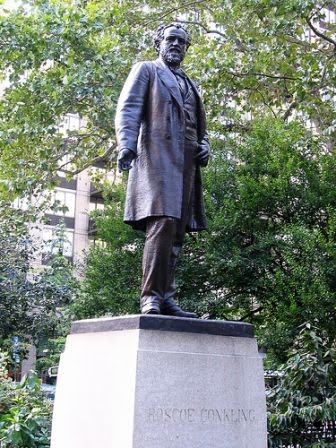
Killed by a Snowstorm -- The Roscoe Conkling Statue in Madison Square

At the southeast corner of Madison Square Park is the statue of Roscoe Conkling.

Who?

Roscoe Conkling. Another historical figure, memorialized in bronze, whom nobody remembers. Conkling did a lot in his 58 years. Born in Albany, he was a lawyer, a district attorney, and a member of both the United States Senate and the House of Representatives. At one point he was the uncontested leader of the Republican Party in New York State.

Despite his political successes and failures, the married Conkling became widely known for his philandering. The New York Times gleefully reported on his extramarital affairs, most notably with Kate Chase Sprague. Kate was the wife of Senator William Sprague IV and the daughter of Chief Justice Salmon P. Chase. The Times printed the scandalous story of Senator Sprague discovering the couple in his Rhode Island summer residence, then chasing Conkling with a shotgun.

Although supporters wrote letters to the Editor of The New York Times supporting Conkling, denouncing the stories as false and calling the Times’ journalism disreputable and irresponsible; the public hung onto every printed word.

On March 12, The Great Blizzard of 1888 struck New York. The storm, also referred to as The White Hurricane, was one of the most severe in recorded history. Forty inches of snow was dumped on New York and sustained winds of 45 mph created snowdrifts up to 50 feet in height.

While the rest of New Yorkers hunkered down in their homes, Roscoe Conkling decided to walk from Wall Street to The New York Club on 25th Street. He lost his way in the blinding storm and suffered from exposure before reaching his destination.

Somewhat embarrassed by the newspaper accounts of his travails, Conkling trivialized the attention in a letter to a friend written from his bed a few days later:

“My dear sir, Bless your kind soul. You know one can’t step foot in the snow without stepping into the newspapers. I had an ugly tramp in the dark – the lights out, from Wall Street up, over drifts so high that my head bumped against the signs, and dug-outs opposite the store doors suddenly letting a wayfarer down a foot or two over snarled telegraph wires and slippery places, with a blizzard in front not easy to stand against, and so cold as to close the eyes with ice, and drifts were not packed enough to bear up, in which one sank to the waist. Bumps and falls, and strains and tugs made it quite an interesting excursion, but not one worth anyone’s while to talk about.”

Conkling neglected to mention that upon becoming lost in Union Square he spent nearly a half an hour trying to find his way. The entire ordeal lasted over two hours. While he initially seemed to recover, working on his legal papers and other business, doctors noticed he was talking incoherently a few days later. On the sixth day after the storm, Roscoe Conkling was dead.

The scandals that had surrounded the politician were seemingly forgotten. Following his elaborate funeral funds were raised to erect a statue to him. The esteemed artist John Quincy Adams Ward, later referred to as “The dean of American sculptors,” received the commission. Mrs. Conkling requested that he depict her husband speaking before the Senate. The statue, completed in 1893, captures Conkling with his thumb jauntily stuffed in his pants pocket.

Supporters petitioned to have the memorial placed in Union Square where Conkling had suffered so.

The Parks Commission, however, was less than enthusiastic. Union Square, it was felt, should be reserved for statues of “great Americans” such as the equestrian statue of George Washington and the sculpture of Abraham Lincoln.

On June 1 of that year the Parks Commission met and agreed to the suggestion by Parks Landscape Architect Calvert Vaux to place Roscoe Conkling in Madison Square – the second most prestigious spot. With no formal ceremony, as requested by Conkling’s family, the eight-foot, 1,200-pound statue was placed on its granite pedestal in December, 1893.

During World War II all the bronze statuary in Madison Square Park was painted brown – reportedly to prevent the figures from being scrapped as part of the war effort.

In the summer of 2000 the Conkling statue was moved 20 feet and a year later it received a full restoration as part of the Citywide Monuments Conservation Program. At a cost of $12,000 it was chemically re-patened to its historically correct color and tone, and cleaned of dirt and corrosion.

The restoration did not, however, help anyone to remember who the unfortunate Roscoe Conkling was.

John Quincy Adams Ward's "The Citizen Soldier"--Central Park


photo by Alice Lum
Twenty-three years after the last shot was fired in the American Revolutionary War, tension between Britain and the newly formed United States was still strong.  When the British sailed into New York Bay in 1806 claiming the right to seize and search all American vessels, New Yorkers were outraged.  The Seventh Regiment of New York was organized as a state defense force in response.

The regiment would see action during the War of 1812; but it was the Astor Place Riots of 1849 that changed the complexion of the unit.  When 20,000 working class demonstrators mobbed the exclusive residential neighborhood around the Astor Place Opera House, the Seventh Regiment responded.  The grateful upper class would not forget their champions.  The sons of Manhattan’s millionaires enlisted in force over the decades, resulting in the group’s popular names “The Silk Stocking Regiment” and “The Dandy Seventh.”

When President Abraham Lincoln called for additional troops on April 15, 1861 the Seventh Regiment responded.  Four days later the men left their Tompkins Market armory wearing grey uniforms and a sky-blue overcoat.  The Third Annual Report of the Bureau of Military Statistics of the State of New Yorklater recalled “New Yorkers cheered and applauded as the Silk Stocking Regiment marched through the city…Thousands upon thousands lined the sidewalks.

“The regiment marched not as on festival days—not as on the reception of the Prince of Wales—but nobly and sternly, as men who were going to the war…And so along Broadway and through Cortland street, under its almost countless flags, the gallant Seventh regiment left the city.”

Although the lower classes complained violently that the wealthiest New Yorkers had bought their sons’ exemption from military conscription; the Civil War historian Frederick Phisterer, in 1911, said that did not apply to the Seventh.  “The best blood and most honored names in New York City were prominent in its ranks…Veterans now hail it as the highest type of the citizen soldiers who went to the front.”

The men of the 7th Regiment pose in Washington DC in April 1861--The Photographic History of the Civil War, 1911 (copyright expired)

Although the unit was originally mustered into service for three months; it would repeatedly return the South throughout the next two years.  During its service the regiment would supply 606 officers to the Union army and according to Phisterer the Seventh lost 185 men in combat—15 officers and 170 enlisted men “of whom 7 enlisted men died in the hands of the enemy.”

New Yorkers welcomed their favorite sons home and a mere year after the end of the war the Monumental Association was organized to erect a statue in memory of those who had given their lives.  But things did not go smoothly.

Not only was the Association’s planned memorial, in the opinion of the Regiment, too garish; but after a few years the project seemed to have ground to a halt.  “In their opinion, the design for the base was extravagant in its proportions, and in the expenditure required; the site in the Park which had been accepted was too distant from the city, and was otherwise objectionable; and, finally, the Regiment, having contributed nearly all the money raised for this purpose, was dissatisfied that operations had been entirely suspended, and that there was no prospect of the completion of the work,” according to Colonel Emmons Clark in 1889.

The Regiment launched a coup in 1872 to take over the Association by nudging out members who “had long since ceased to take any active part in the matter, and to fill their places with members who fully represented their views and interests.  This was accordingly done, and at its quarterly meeting in October the Monumental Association was captured, and a new executive committee, controlled by active and prominent officers of the Regiment, was appointed, with full power as to site, base, funds, etc.” remembered Clark.

The first plan of action was to redesign the “extravagant” base.  Clark wrote “a new design for the base by Mr. [Richard Morris] Hunt, the architect, was approved; and, within six months from the first meeting of the committee, contracts were signed for the construction of the base and the completion of the entire work.”

Esteemed sculptor John Quincy Adams Ward would be responsible for the bronze statue upon Hunt’s granite base.  Victorians were accustomed to the bronze and marble likenesses of statesmen and military heroes in grand, formal poses.  But Ward headed in the opposite direction.  He chose to depict the common soldier in all his humanness. 

photo by Alice Lum
The figure was not of an officer, but a lone sentry.  The Evening World said “It is in the form of a soldier boy in full regimentals on picket duty.”  He vigilantly gazes off while leaning on his rifle.  The relaxed pose would influence countless Civil War monuments and town squares throughout the country would erect their own versions of the standing soldier and rifle.

On June 22, 1874 the statue, entitled “The Citizen Soldier,” was ready for its unveiling.  The Civil War veterans assembled at the armory at 3:00 and the current members of the Seventh Regiment arrived there an hour later.  The two groups paraded to Central Park on separate routes, meeting up at Eighth Avenue and 69th Street to enter the Park.  “During the march of the regiment the drives upon its route are to be kept clear of carriages and pedestrians,” The New York Times warned readers that morning.

Although the ceremony would be carried out with the expected pomp of a Victorian event—the Seventh Regiment Band played and two stands were erected for “the accommodation of the distinguished military and civic guests,” it was a relatively understated ceremony.  Harper’s Weekly called it “simple and impressive.”  Nevertheless the Herald would say the following day “There was never seen at the Central Park at any time since it has become one of our great public resorts, such an immense crowd as was gathered there yesterday afternoon to witness the unveiling of the memorial statue of the Seventh Regiment.”

Harper's Weekly depicted the throngs attending the unveiling.  July 11, 1874 (copyright expired)
There were 100 invitations to the press and “Through the courtesy of the Park Commission, 300 reserved seats were provided expressly for ladies,” noted The New York Times.  The sculptor himself unveiled the statue

The following morning the Herald wrote “The sight was indeed one that must have left an impression of utter wonderment upon everybody who beheld it.  In fact, the Park never before had been witness of anything at once so novel—the dazzle of the muskets and the golden uniforms blending with the varied colors of the dresses and attires of the assembled thousands of civilians, rendering the scene positively enchanting.”

New Yorkers were understandably offended and outraged when eight years later thieves pried the valuable bronze medallions off the base of the statue.  The men were caught and tried separately.  One of them, Louis Sigmund, was convicted on August 18, 1882 and sentenced to six months in the penitentiary.

 A 19th century stereopticon view captures a workman pausing before the memorial.

Defacing of a less serious nature came the following year.  On June 7, 1883 the New-York Tribune reported “The 7th Regiment Memorial Statue in Central Park has been made a nesting place by a pair of sparrows.  Under the bronze cape of the soldier the birds were weaving long blades of dry grass yesterday, and the effect was both ornamental and comical.”

The monument would be the yearly pilgrimage site of the Seventh Regiment veterans every Memorial Day.  On May 31 1895 The Sun described that year’s ceremony, saying the Veteran Corps “commemorated the memory of their comrades who fell in the civil war with appropriate exercises…The monument was almost hidden from sight by wreaths and flowers, as was the ground at its foot.”

Time passes, veterans die, and memories fade.  By 1923 when the statue was rededicated it was more of a Victorian curiosity than a revered memorial.  Then in 1927 the dramatic and emotional World War I monument to the Seventh Regiment, now designated the 107thInfantry, was dedicated.  John Quincy Adams Ward’s moving 19th century tribute to the citizen soldier became a footnote.

130 years after the first birds nested in the statue, a new family finds a home.  photo by Alice Lum
But not everyone overlooks the statue.  As they did in 1883, birds happily construct their nests today under the bronze cape of the Civil War sentry.

Thursday

The Contentious 1890 Alexander Lyman Holley Memorial

Few relatively minor public artworks have sparked as much controversy from their inception as the Alexander Lyman Holley monument in Washington Square Park.  Yet today, ask any of the dozens of joggers, dog walkers, chess players or musicians who frequent the Park who Alexander Holley was and not a one will have an answer.
An undeniably brillant man, Holley was born in Lakeville, Connecticut in 1832.  The first engineering graduate from Brown University, he learned of the English engineer Sir Henry Bessemer's new process of manufacturing steel.  The method was not only cheaper, it could turn out vast quantities.  Holley traveled to Britain in 1863, securing the U.S. rights for the Bessemer process.  Upon his return he built the Bessemer Steel Works in Troy, New York between 1864 and 1865.

Holley's engineering mind was unrivaled and he pinpointed several areas in which the process could be improved and designed immense manufacturing machines to handle the production.  Of the 15 patents he received in his lifetime, two-thirds were for improvements to the Bessemer process.  What this all meant for the U.S. was rapid-fire growth of railroads, bridge construction, ship building and economic strength.

At the age of 49 he died in his Brooklyn Heights home from, according to The New York Times obituary on January 30, 1882, "peritonitis, due to a complication of diseases" after becoming sick in Europe.  Henry Ward Beecher, popular pastor of the day and father of Harriet Beecher Stowe, officiated at his funeral.

International fund raising for a memorial started almost immediately, spearheaded by three professional groups in which he had been active:  The American Society of Civil Engineers (he had been a vice president), The American Society of Mechanical Engineers (he had been a founder), and The Institute of Mining, Metallurgical and Petroleum Engineers (he had been a president). 

And almost immediately the controversy began.

Grand monuments had, for the most part, been reserved for statesmen and military heroes.  Holley was not only an engineer, albeit a great one, he was essentially unknown to the general public.  Six months before the unveiling The New York Times complained in an April 24, 1890 article that public space was becoming too scarce to be wasted on statues of persons whom, for the most part, no one knew.  Editors from other newspapers echoed the sentiment.

Nevertheless the monument was completed.  The bronze bust was sculpted by John Quincy Adams Ward who, in 1882, had completed his masterful standing statue of George Washington downtown at Federal Hall.  The bust sits on a three-part Beaux Arts pedestal of Indiana limestone designed by Thomas Hastings who had recently left the architectural firm of McKim, Mead & White to go into partnership with John Carrere.
Photograph courtesy newyorkcitystatues.com

A small procession from 18th Street to the park kicked off the unveiling on October 2, 1890.  At the dedication ceremony, which was scheduled to coincide with an international convention of the iron and steel industry, James C. Bayles, chairman of the Institute of  Mining, Metallurgical and Petroleum Engineers, shot back at the critics.  "Our heroes are not alone those who have repelled invasion..." he argued, and then added with what would shock today's green-minded envinronmentalists, "...but in a better sense those who have made the great forest of nature subservient to our purpose..."

In an unveiled reproach, he compared the lofty effort to memorialize Holley with the less ideal activities of politicians.  "Perhaps its presence will not be without significance in a city where the petty struggles of parties and factions for brief and inglorious supremacy waste so many lives and occupy so large a share of our thoughts."

Once the monument was in place and dedicated, one would expect the controversy to subside.  And so it did for a while.  But then on August 6, 1901 The Times stirred the pot again; by now defending the memorial as artistic, but disparaging its placement.

"On a side-path," it wrote, "in Washington Square facing a vulgarly ornate frame cottage which has some purpose in connection with the administration of the park and the storage of lawn mowers, rakes wheelbarrows, and the like, stands the beautiful memorial bust of Alexander Lyman Holley, on a pedestal of unusual excellence.  In a modest way it is one of the most charming and attractive of the monuments of New York."

The editor went on to lament the condition of the memorial. "It is not well cared for.  The pedestal is marred and begrimed, and it gives every evidence of neglect.  The eyes, ears and corners of the mouth are occupied by the white coccoons of the caterpillars from the surrounding trees, giving it a grotesque appearance calculated to excite the passer-by to laughter."  

Not only did The Times object to the choice of Washington Square for its setting, but its placement in the park as well, directly across from the "bronze contortionist," the statue of Garibaldi.  "The beautiful Holley Memorial...suggests an orchid in a kitchen garden."

The editor accused the Park Commissioners for assigning the memorial a site as "inconspicious as possible, for the reason that they had no idea who Holley was and knew only that he had had no ostensible identification with Tammany."  The New York Times insisted on correcting the insult.  "The proper place for the Holley Memorial is in the grounds of Columbia University, perhaps in front of the beautiful library building."

The Times never got their wish.  The Holley Monument remains where it was placed in 1890.  The several swirling controversies around it died away.  In the middle of the 20th Century New York University students held an annual tug-of-war in the park that attracted thousands of onlookers.  The loser was doomed to kiss the bronze lips of Alexander Lyman Holley.

The memorial was restored in 1999, despite which no one in the park knows who Alexander Lyman Holley was.