.

Showing posts with label lost new york. Show all posts

Wednesday

The Lost Chickering Hall -- No. 130 Fifth Ave.


from the collection of the New York Public Library

During the turbulent Civil War years piano and organ dealers clustered along Broadway, mostly below Houston Street.  In 1860 there were no fewer than four piano showrooms along the block between Prince and Houston alone.  Among them was Chickering & Sons at No. 694 Broadway, a Boston-based firm renowned for its superb quality and design. 

In 1864 William Steinway jumped ahead of the piano district by erecting an elegant showroom building on East 14th Street near Fifth Avenue.  Well-heeled customers could browse among over 100 Steinway & Sons pianos here; away from the distraction of competitors’ showrooms.  Two years later Steinway scored a coup when he ingeniously constructed a concert hall to the rear of his building.  Now audiences who came to hear performances would get first-hand demonstrations of the Steinway instruments played by top musicians.

Steinway’s luck increased when Manhattan’s premier concert venue, the Academy of Music, burned down four days below Steinway Hall’s grand opening.

By 1874 Chickering was ready to meet the challenge posed by Steinway Hall.  The firm broke ranks with the Broadway piano merchants and signed a 25-year lease on the lot at the northwest corner of Fifth Avenue and 18th Street—a neighborhood that a generation earlier had been the city’s most exclusive residential district and included Frank Chickering’s own mansion at No. 5 Fifth Avenue.  Architect George B. Post was hired to design a structure that could house a vast piano showroom, music store, warehouse and—most importantly—a concert hall to rival Steinway’s.

Chickering’s planned move would instigate a migration of the piano and organ dealers.  Before the turn of the century Fifth Avenue and Union Square would see the construction of grand buildings of piano makers—the Sohmer Piano and Decker Brothers buildings among them.  But for now Chickering could claim Fifth Avenue.
Chickering invited "friends and the public" to the new structure -- The Sun, December 18, 1875 (copyright expired)

Post’s Chickering Hall was completed within six months of breaking ground.  The impressive structure cost $175,000—a substantial $3 million today.  At four stories tall, pretending to be two, it was a stocky red brick structure trimmed in marble and brownstone.  Immense arches, two stories tall, commanded attention; there were three along the Fifth Avenue façade, mimicked by five blind arches down 18th Street.  Post capped it all with a tiled hipped roof.

Chickering Hall sat among the mansions of a still-residential Fifth Avenue.  Note the smart carriage and footman to the left -- photographer unknown, from the collection of the Museum of the City of New York http://collections.mcny.org/C.aspx?VP3=SearchResult_VPage&VBID=24UAYWEPNPNP&SMLS=1&RW=1366&RH=579

The auditorium filled the second and third floors.  It was praised for its acoustics and could accommodate 1,500 patrons.  The hall was hastily opened on Monday evening, November 15, 1875 before the interior decorations were fully finished.  The rush to throw the doors open was the result of a one-time opportunity for Frank Chickering’s firm.

Internationally renowned pianist Hans Von Bulow had planned his American debut for November 1875 in New York City.  The eccentric musician was highly selective about the make of piano he would use and discussions had gone on for months.  Finally he settled on Steinway and Chickering as the only pianos he would play.  Von Bulow’s manager entered into negotiations with both firms.  Newspapers on both sides of the Atlantic reported that both Steinway and Chickering had offered $20,000 to land Von Bulow on their stages.
 

Frank Chickering was no doubt jubilant when Hans Von Bulow agreed to open at Chickering Hall.   The opening night of Chickering Hall was a stellar one.  Hans Von Bulow was backed up by Leopold Damrosch’s orchestra—which two years later became the New York Symphony Orchestra.  It was marketing gold when Von Bulow told the press “On other pianos, I have to play as the piano permits; on the Chickering I play just as I wish.”

Hans Von Bulow plays with Damrosch's orchestra on opening night -- from the collection of the New York Public Library
A journalist in the audience gave the performance a rave review, saying that “From the moment he touches the keys Bulow disappears, and nothing but the work…remains.”  He called the Chickering piano “the wonderful instrument which served Mr. von Bulow so faithfully, so obediently, so lovingly.”

The Von Bulow tour stretched on for weeks, both in New York at Chickering Hall, and on the road.  Chickering pianos followed the artist; but his intense dislike of commercialism repeatedly caused problems.   More than once the pianist kicked over the large signboard advertising Chickering Pianos; once sending it sailing behind the orchestra.  When Frank Chickering tried to solve the problem by stenciling the name Chickering in gold letters on the instrument, Von Bulow pulled out a penknife and scratched out the name.
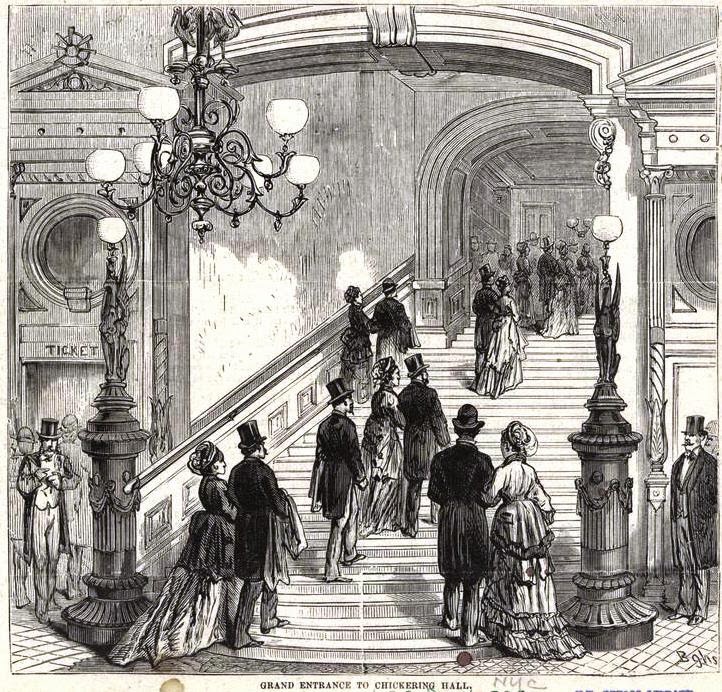
Elegantly-dressed patrons ascend the grand staircase to the concert hall on December 4, 1875 -- from the collection of the New York Public Library
Two months after its opening Chickering Hall received its $15,000 custom-built organ.  Constructed by Hilborne L. Roosevelt, The New York Times called it “a very successful achievement.”  The organ was premiered in a concert by organists Morgan Whitely, George and William Warren, S. Austen Pearce and Dudey Buck.  The newspaper noted that “Some of the effects…were uncommonly beautiful, and the voix celeste approximated so closely to the ideal of angels’ chants, that the assemblage broke out into rapturous applause almost before the sounds had died away.”

Von Bulow’s widely-publicized concerts that inaugurated Chickering Hall had pushed, at least for a while, Steinway Hall off the entertainment pages.  But while famed musical artists, orators and singers would go on to grace the boards of Chickering Hall; not all the performances would be critically-acclaimed. 

On December 12, 1876 a young Russian pianist made her American debut here.  Mlle. Theresa Jakonbovitsch disappointed the critic of the New-York Tribune.  He wrote “She promises more than she is as yet able to accomplish.”  Although he tried to be kind (“She seems to be intelligent; she certainly plays carefully”); he summed up her performance saying “But, as it seems to us, she ought rather to be studying than playing in public.”

The vast auditorium was not devoted only to music.  Other large assemblages used the hall including, surprisingly, the proceedings in what The New York Times called “the famous Forrest divorce suit” in April 1876; and Professor Huxley’s series of three lectures on The Theory of Evolution in September that same year.  The British scientist deftly presented his evidence of evolution while avoiding the bruising of some less broad-minded Victorian minds in the audience.

The following year, in May 1877, audiences were spellbound by a demonstration by Alexander Graham Bell of his new invention—the telephone.  Bell’s demonstration, unfortunately, was only partially successful.  The Times reported on several of the experiments.  In one case “Mr. Watson was asked to repeat some phrase loudly and slowly a number of times.  The phrase was announced to be ‘Do you understand what I say?’  What came from the boxes was, “Oo, boo, boobooboo, boo, boo, boo.’  Mr. Watson next tried to say ‘How do you do?’ but only succeeded in transmitting ‘boo,boo—boo,boo.’”

By the 1880s the mansion next door to Chickering hall had been converted for commercial purposes -- from the collection of the New York Public Library

In 1882 poet Oscar Wilde arrived in America for a lecture tour and on January 9 crowds filed into Chickering Hall to hear the famed English writer.  “Before 8 o’clock a placard setting forth that there was ‘standing room only’ within was displayed at the entrance.  A large portion of those who attended came in coaches, and there were many representatives of families conspicuous in the fashionable world,” reported The New York Times.  “Young men dressed as though for an opera night ranged themselves behind the rear row of seats and along the side aisles.  Ladies attired in rich costumes were numerous, and were prepared to level their opera-glasses at the lecturer upon his appearance.”

The newspaper was a much interested in Wilde’s appearance as in his subject, “English Renaissance.”  In detail it told its readers “His long and bushy hair crowded in front of his ears and nearly to his eyes, but it was brushed well off his forehead.  He wore a low-necked shirt with a turned-down collar and large white necktie, a black claw-hammer coat and white vest, knee-britches, long black stockings, and low shoes with bows.  A heavy gold seal hung to a watch-guard from a fob-pocket.  The poet had no flower in the lapel of his coat.  In his picturesque attire he was a study that seemed greatly to interest the audience.”

Having recapped the lecture, The Times concluded saying “At the finish of the lecture the poet was vigorously applauded, and when he retired from the stage he blushed like a school-girl.”

One-by-one the mansions along Fifth Avenue were converted for business purposes.  photograph by Adolph Witteman, from the collection of the Museum of the City of New York http://collections.mcny.org/C.aspx?VP3=SearchResult_VPage&VBID=24UAYWEPNPNP&SMLS=1&RW=1366&RH=579

In 1901 Chickering’s lease with the Mason estate elapsed.  The New York Times reported that “Some time before the expiration of the ground lease, it became known that the Chickering concern would not retain the property.”  By now the entertainment district, along with the piano companies, were already moving northward. 

The building of another piano manufacturer, Mason and Hamlin, had replaced the church behind Chickering Hall by the turn of the century -- photographer unknown, from the collection of the Museum of the City of New York http://collections.mcny.org/C.aspx?VP3=SearchResult_VPage&VBID=24UAYWEPNPNP&SMLS=1&RW=1366&RH=579

On December 4, 1901 Alliance Realty Company purchased the property for about $575,000.  Four days later The Times reported that “A new mercantile structure will soon rise on the site of Chickering Hall.”  The days of the magnificent structure where New Yorkers heard the world’s foremost musicians, inventors, singers and lecturers had come to an end.

Within months Chickering Hall was demolished and the foundation for an 11-story business building was dug.  It was the scene of tragedy on May 27, 1902 when a crowd of excited viewers crammed the area of the construction site as a parade marched up Fifth Avenue.  The temporary sidewalk erected in front of the deep pit gave way, plunging about 100 persons into the excavation pit.  One man died instantly and “at least fifty were so seriously injured that they either had to receive medical attention on the spot or else were driven away in carriages,” said the police report.

The limestone and brick-clad building that replaced Chickering Hall still survives; obliterating any memory of the once-famous concert hall that stood there before it.

(photograph by the author)

Tuesday

The Lost Anson R. Flower Mansion -- No. 601 5th Avenue

The elegant renovations to No. 603 (left) and the Flower mansion were completed in 1902 -- photo "Collins' Both Sides of Fifth Avenue"  1910 (copyright expired)

Around 9:00 on the evening of October 5, 1891 Governor Roswell Pettibone Flower and his wife left the brownstone mansion at No. 601 Fifth Avenue.  They walked, unescorted, a block north to the Democratic Club where Flower was guest of honor at a glittering reception.   The house where the Flowers were staying was the home of Emma A. Schley, wife of millionaire lawyer William Schley and the sister of the Governor’s wife.

Perhaps less powerful but no less wealthy were Flower’s brothers, partners in the banking firm of Flower & Co.  Frederick Flower lived near Emma Schley at No. 615 Fifth Avenue, while Anson Ranney Flower’s mansion was at No. 500 Madison Avenue. 

Like most wealthy New Yorkers at the time, Anson Flower was involved in more than his banking firm.  He was a Director in the Brooklyn Rapid Transit Railroad Co.; Chicago and Eastern Illinois Railroad Co.; the Chicago, Rock Island and Pacific Railroad Co.; the Colonial Trust Co.; Federal Steel Co. and at least at dozen other corporations.

photograph by Alwan & Co, from the collection of the Museum of the City of New York http://collections.mcny.org/Collection/%5bAnson-R.-Flower.%5d-24UAKVA9H8F.html 

The Successful American said in 1899 “The firm of Flower & Co. is well known to the banking houses of the world as one of the most solid financial institutions in America, and also as one of the most daring and successful in speculation.”    The entire Flower family was well-respected and The Successful American said of Anson, “The family traits are faithfully preserved in Mr. Flower and he represents the best qualities of the stock.”

When Emma Schley died in 1900 she left an estate of “several millions of dollars.”   Her generosity extended even to her favorite clerks at B. Altman’s Department Store.  Mrs. Nagle, a clerk in “the white underwear department” there received $5,000 as did another clerk, Mrs. Flanagan.   The handsome inheritances would equal nearly $145,000 today.

The New York Times reported on July 1, 1900 that Emma’s daughter, Emma G. Halsey, received the largest bequest.  “To her Mrs. Schley leaves her home at 601 Fifth Avenue, with all it contains.”  Emma Schley had earlier purchased the house next door, No. 603; and Roswell P. Flower by now owned the two flanking houses at Nos. 599 and 605.

On January 6, 1901 the New-York Tribune reported that Anson R. Flower had purchased Nos. 601 and 603 from Emma Schley’s estate.    According to the Real Estate Record & Builders’ Guide, Flower paid $150,000 for No. 601 and $110,000 for No. 603.  The newspaper described them as “two four story and basement brownstone dwelling houses” and proposed that “Mr. Flower may unite the two houses into one for his own use.”
Both No. 603 (left) and No. 601 were about to get remarkable make-overs -- New-York Tribune, January 6, 1901 (copyright expired)

The Tribune’s supposition was not far off the mark.  At the turn of the century Manhattan’s millionaires were quickly razing or remodeling outdated brownstones into modern American basement showplaces (American basement homes were entered at street level, eliminating the high stoops).

But instead of joining the two houses, Flower quickly sold No. 603 to real estate operator Jeremiah C. Lyons, making a quick $20,000 profit.  Both Flower and Lyons remodeled the two residences and within the year they were unrecognizable.   Similar in style, they rose five stories to steep copper-clad mansard roofs.   While the Flower mansion was clad in red brick in contrast to the limestone front of No. 603; it made up for it in opulence.  Near matching six-foot iron fencing protected the areaways of both mansions.  The architect carried the material up to the entrance of the Flower mansion, having the elaborate door grills in cast iron rather than bronze.

The Record & Guide used the entrance doors as an example of fine cast iron work  August 8, 1908 (copyright expired)

Both houses were completed in 1902 and Lyons sold No. 603 to James B. Clemens for $200,000.   

The Times remarked on the Flower mansion. “The house is handsomely furnished, the tapestries and furniture having been imported for Mrs. Flower.”

While construction on the Flower residence was continuing, Anson Flower had added one more item to his resume.  In June 1901 he was elected President of the Amalgamated Copper Company, filling the position vacated by Standard Oil Company executive H. H. Rogers’s resignation.  Rogers appears to have gotten out of the copper business just in time.

It was a time when multimillionaires with names like Carnegie, Rockefeller and Vanderbilt were feeling attacked by the government, which was seeking to break the monopolistic empires the moguls had worked so hard to build.  Summonses to appear were often met with cold defiance.

Five months later, on November 24, 1901, the New-York Tribune reported that “Several of New-York’s wealthy and well known men have been summoned to appear before Judge Lacome, in the United States Circuit Court, on November 29, to show cause why the judge should not commit them to jail or fine them, or otherwise punish them at his discretion, for contempt of court.”  Anson R. Flower was among those “wealthy and well known men.”

Six days later The New York Times ran the headline “Anson R. Flower in Custody.”  Judge Lacome found the stubborn tycoon “guilty of contempt of court” after he refused to testify.  The judge committed him “to the custody of United States Marshall Henkel until he shall consent to appear and testify in an action brought against the company in the Montana courts.”

While the tempest played out, Ida Flower continued her charitable works and entertaining.  Eventually the scandal passed and life at No. 601 Fifth Avenue returned to normal.   Anson and Ida, who had no children, maintained a country estate in Watertown, New York.  When the summer season of 1908 drew to a close, the Flowers remained upstate after Anson’s heart condition took a serious turn.

On November 17 a Watertown newspaper reported “Anson R. Flower of the banking firm of Flower & Co., New York, was so ill at his home in this city yesterday that prayers were offered for his recovery in the Episcopal Church.”   But family members assured the reporter that the millionaire was resting “more comfortably and was apparently upon the road to recovery.”

As it turned out, there would be no road to recovery.   Anson Ranney Flower died in the Watertown house less than two months later, on January 3, 1909.   The ugly court case of 1901 was forgotten in his obituary.  Instead his vast charities, including the co-founding of Flower Hospital with his brothers, and his magnanimous contributions to the Stonywold Sanitarium in the Adirondacks; along with his vestryman position with St. Thomas’s Episcopal Church were remembered.

Ida remained in Watertown, leasing the mansion on Fifth Avenue to Washington B. Thomas, President of the American Sugar Refining Company.   On September 20, 1909 the New-York Daily Tribune noted “it is rented, fully furnished, as a temporary home for Mr. Thomas.”  The following year it was leased to Mrs. C. H. Mellon “of Morristown, New York,” according to The Times.

By now commerce had engulfed the Fifth Avenue neighborhood around the Flower mansion.  Although its handsome renovations were only 10 years old, The New York Times called the house “the old Anson R. Flower residence” when Ida leased it in June 1911 “on a long term for business.”

The “long term” lease lasted less than a year.   On March 24, 1912 The New York Timesreported “Within the next month one of the fine old residences on Fifth Avenue above Forty-eighth Street will be torn down, giving way to a five-story business structure…The old residence has been the town home of Mrs. Anson Flower for about twelve years.”  An auction of the artwork, tapestries, and imported furniture was held inside the house on April 10.  Within five months the new building, designed by Albert Joseph Bodker, was completed.

The upper floors of the Clemmons mansion, next door, survive nearly intact.  photo by the author

Saturday

The Lost 1856 House of Mansions - Nos. 487 to 491 Fifth Avenue

George Higgins advertised "moderate terms" for his eleven unified residences in 1856 -- NYPL Collection
The idea of a row of houses pretending to be one, unified structure was not new in 1856.  The British upper class had been living in such elegant homes like the Royal Crescent in Bath since the Regency Period.  In New York Seth Green had erected the elegant, marble LaGrange Terrace on Lafayette Place in 1833.

But carpet manufacturer George Higgins’ project would be somewhat different.

The highest point in Manhattan in 1855 was Murray Hill, named after the Murray family.  The Murrays were wealthy Quaker merchants and family head Robert Murray had erected a manor house in the area in the mid-18th century.  The estate stretched approximately from what would become 33rd to 39th Street and from Lexington Avenue to nearly Fifth Avenue.

Although Fifth Avenue was already laid out by the time Higgins purchased the land between 41st and 42nd Streets and the hulking Murray Hill distributing reservoir had been erected directly across the street more than a decade earlier; the area was still mostly undeveloped and essentially rural.

But the speculative Higgins envisioned a group of eleven fashionable homes that would lure potential buyers to an area yet untested for residential use, yet abounding with clean air and delightful views.  He commissioned the well-known architect Andrew Jackson Davis to design the homes. 

Davis had made his mark designing structures in historic revival styles and just a decade earlier had produced a row of 36 gracious Greek Revival mansions on 23rd Street for Clement Moore which, too, were disguised as a single edifice.    The eleven grand residences were completed in 1856.   Melding into a castle-like whole, they featured crenelated towers, lancet windows, and two-story oriel windows with Gothic tracery.

A corner of the massive Egyptian Revival Murray Hill Reservoir can be seen across Fifth avenue -- NYPL Collection
 "The pile is altogether unique in its character and plan," said Higgins' advertisement,  "the eleven dwellings being combined as in one palace, or massive edifice, thereby exhibiting a unity in mass not before attempted, though often desired by critics."

The homes sat back from the sidewalk allowing for ample lawns and the rooms were filled with an unusual amount of daylight for the time.    The views from the upper story windows looked across the reservoir "of Oriental magnificence" and the southerly views took in the whole of Manhattan.  Interior staircases were lit by skylights and a rear alley provided servants' access.

Higgins marketed his houses as “differing in size, price and amount of accommodation”  Jackson designed each with a unique exterior elevation and individual floor plans from twelve to eighteen rooms to ensure individuality for potential Victorian homeowners. 

He promoted the “durable fire-brick” and “cheerful tint of color and variegated architecture” and promised the most fastidious home-seeker would be satisfied.  The views from the windows, he insisted, were “unrivaled.”  He called his project “The House of Mansions.” 

Atop the massive Egyptian Revival Murray Hill Reservoir was a promenade which became etremely popular for Sunday strolls.  Directly behind the reservoir, since 1853, stood the Crystal Palace erected for the World’s Fair.  The Crystal Palace still attracted thousands of New Yorkers and tourists alike every day.  So despite its somewhat remote location, the House of Mansions seemed, at least to George Higgins, to be a profitable idea.

It wasn’t.

Higgins was just a few years too early in developing his block of Fifth Avenue.  Within twenty years the mansions of New York’s wealthiest citizens – the Vanderbilts and Astors among them—would be rising along this stretch of the avenue.  But for now it was too far north.

The House of Mansions, also referred to as The Spanish Row, was a failure.  Two years after its completion there was talk of converting it into a hotel; but the idea never came to fruition.  Instead it was purchased by the Rutgers Female Institute as its new campus in June of 1860.  The Institute was the first institution of higher learning for women in the city.

It was first opened in 1839 on Madison Street, on the former estate of Colonel Henry Rutgers, a Revolutionary War officer.   After two decades of instructing well-heeled young women in “the belles-lettres, history, mathematics and philosophy,” the institute needed larger accommodations.

The House of Mansions was purchased for $60,000—a little over $1.5 million by today’s standards.  The eleven houses were renovated for the institute’s needs  “They design,” reported The New York Times, “making extensive additions in the rear of the buildings fronting on the avenue, for the purposes of a chapel, laboratory, school-rooms, painting-gallery, and observatory.”  The newspaper mentioned that the observatory “will overlook the entire island” and “two thousand dollars have already been donated for the purchase of a telescope.”  Two thousand volumes were transported from the Madison Street facility to the new library.

photo NYPL Collection
Humphrey Phelps, in his “Phelps’ Strangers and Citizens’ Guide to New York City,” praised the school.  “It has a fine library, selected with great care and excellent philosophical apparatus for illustrating the subjects of astronomy, chemistry, and other branches of science.  Its course of instruction embraces history, general philosophy, mathematics, and belles letters, by which young ladies are thoroughly prepared for the pursuit of general knowledge, for the duties of teachers, and for that moral and intellectual power so necessary to be possessed by the mothers of our republic.”

There were those, whoever, who felt that the mothers of our republic had no place in school but should, instead, be home learning to sew, cook and clean.  President of the Institute, Heney M. Pierce, was often forced to defend the idea of a school for women.  “I am fully persuaded that the time is not far distant,” he said during commencement exercises in 1867, “when it will be thought almost incredible that the question of the inferiority of woman should ever had been seriously debated.”

“If,” Pierce argued, “it is best for the young man that by a liberal education, his memory should be strengthened, his reasoning powers disciplined, his judgment matured, his mind enlarged—why is it not best for the young woman also?”

By October 24, 1860 the new space was ready and dedication ceremonies were held in the chapel.  “The chapel, together with the lobbies and adjacent rooms, was crowded to excess, the larger portion of the audience being ladies,” reported The Times.  The new facility opened with 200 registered students.

In 1861 DeBow’s Review listed the costs to the students.  For $300 per year they received “Board, including fuel, lights, and washing, and instruction in English branches.”  The tuition and board were payable quarterly in advance.   Extra courses were available for additional fees.  French, German, Italian or Latin would cost $5.00.  Oil Painting and Pastel lessons were $10.00.  For $15 to $35 a budding musician received piano lessons and an additional $15 to $20 would provide Guitar instruction.

Graduation exercises were always extravagant affairs and on June 8, 1866 The Times reported that “The young lady pupils of the Institute were dressed with uniform beauty and simplicity in dresses of snow white illusion, wreathed with emerald tulle, and wearing coronals of vernal leaves, intertwined with flowers.”   The reporter noted that the room was “crowded some time before the exercises …with the elite of Fifth-avenue and that august neighborhood.”

By the last quarter of the 19th century Fifth Avenue was no longer pastures and open fields -- New York Historical Society
A year later detractors of the institution and female education as a whole were shocked when the State Legislature conferred “the powers and privileges of a college” upon Rutgers.    The name was changed to Rutgers Female College and, immediately, plans were made to enhance and enlarge the programs.  Donations amounting to $50,000 poured in for the addition of, among other things, a full Art Department.

The new status resulted in a remarkably quick growth and the Fifth Avenue building was suddenly too small.   Only a year later the “Documents of the Senate of the State of New York” noted that “These accommodations, however, are too limited for the wants of the college under its new organization, and a new and more ample location is very desirable.

"In view of the constant upward growth of the city, also, and of the fact that the present patronage of the college is largely in the upper portion of the city, and even towards Harlem, etc., it has been deemed advisable to prepare decidedly for a removal, in the course of a few years, to some place where ample buildings may be erected, surrounded by a certain amount of grounds.”

The “course of a few years” came in June 1870 when Californian James P. Pierce, the brother of President Franklin Pierce, purchased the school property for $117,000.  Pierce held the property for only three years before turning it over to Jacob B. Tallman for $120,000.  Tallman was a trustee of the college and his involvement with the property would later result in the school suing him unsuccessfully.

By February, 1882 when Tallman sold the old House of Mansions to August Pottier for $180,000 Fifth Avenue had drastically changed.   The once-pastoral area George Higgins chose for his eleven unique homes had become the most fashionable residential neighborhood in the city and, now, was seeing the encroachment of commercial buildings. 

The French-born Pottier had established the Pottier & Stymus Manufacturing Company in 1855.  In August 1883 he obtained a $200,000 advance on the property which he used to demolish the buildings to erect what The Times would call “the present fine building thereupon” for his firm.

John Donoghue, in his 1977 “Alexander Jackson Davis, Romantic Architect, 1803-1893” was less congratulatory about the loss of the unique and charming House of Mansions, saying  “it was destroyed to make way for the ubiquitous, featureless office buildings and stores that line Fifth Avenue today.”

Thursday

The Lost Windsor Hotel -- 5th Avenue and 46th Street


Baggage entered the 46th Street side (right) and guests entered on Fifth Avenue.  The arrangement avoided "cluttering."  -- photo Library of Congress
Fifth Avenue above 42nd Street had just begun seeing the arrival of grand mansions in 1869.   The former mayor, George Opdyke completed his sumptuous brownstone residence on the corner of 47th Street that year—later to be home to Jay Gould and his family.  The block to the south of the Opdyke mansion contained a small skating pond.  It would be another decade before the white marble St. Patrick’s Cathedral was completed at the corner of 50thStreet and the great Egyptian Revival-style Croton Reservoir at 42ndStreet was still a Sunday afternoon’s carriage drive uptown for most.

But the completion of the new Grand Central Depot that year, just two blocks from Fifth Avenue, meant that scores of travelers would be arriving on 42nd Street with the need for accommodations.   In 1871 construction began on the Windsor Hotel on Fifth Avenue where the little skating pond had been.  Stretching the entire block from 46th to 47thStreet it opened its doors two years later.  Owner John T. Daly took advantage of the now-exclusive neighborhood to market his seven-story hotel to wealthy guests—both transient and permanent.   Nay-sayers warned Daly that his new hotel was too far uptown to succeed; not to mention that it sat squarely within a residential neighborhood making it inconvenient to traveling businessmen or female visitors with shopping on their agendas.

Daly needed a veteran hotelier to run his new endeavor and he found one in Gardner Wetherbee.  Wetherbee had helped manage the grand Fifth Avenue Hotel from 1859 to 1867, and had most recently run the Revere and Tremont Houses in Boston.   In accepting Daly’s offer to manage the Windsor Hotel, Wetherbee went into partnership with Samuel Hawk, creating the business of Hawk & Wetherbee.  Years later “America’s Successful Men of Affairs” would remember “This was a new and exceedingly handsome hotel, situated in the heart of the fashionable residence section of the city, requiring skillful management, but promising good returns to a firm, competent to conduct one of the finest public houses in the metropolis in a proper manner.”

Gardner Wetherbee, along with Samuel Hawk, would make The Windsor Hotel a smashing success -- "America's Successful Men of Affairs" 1895 (copyright expired)
The book added that the Windsor was “at that time, the most luxurious and aristocratic hostelry in New York.”   The New York Times remarked on the lavish appointments on opening day.  It found the main hall, 52 feet wide and 140 feet deep “with a high ceiling, tastefully decorated.”   Nothing was left out: “The barber’s shop, which is to be fitted up at a cost of some $10,000; the bathrooms attached, the grocery and general storerooms, the vegetable kitchen, and pantries innumerable with linenrooms and bootrooms, are also situated in the basement.”

The main dining room was on the second floor and deemed by the newspaper to be “splendid” with its frescoed ceiling.   So that guests would not be annoyed by interruptions to their meals, there were other, smaller, dining rooms “for the accommodation of late diners.”  Children, of course, dined separately in the children’s dining rooms—“one for those attended by white servants, and the other for such as have colored servants waiting on them.”

An early stereoscope view of the Main Dining Room shows the frescoed ceiling and sumptuous chandelier.
Servants’ accommodations and restrooms were in the basement.

The management was pleased with the precautions against fire.  Throughout the mile and a quarter of hallways there were seven miles of water pipes.  “On every floor are four water plugs in connection with the telegraph alarm, from which a floor could be flooded in case of fire in a few minutes.  There are fire-escapes in the rear at both ends of the building,” reported The Times.  The precautions, eventually, would not be enough.

The new Windsor Hotel was a marvel in modern conveniences.  There were 139 bathrooms and every suite had a private bath—a rare luxury in 1873.  The suites also boasted “clothes presses and closets, and every room has a fireplace in it,” according to The Times.

It was all reflected in the rent that Hawk & Wetherbee agreed to pay to Daly.  The lease for the first ten years demanded payment of $75,000 per year—around $1.3 million today.   Hawk & Wetherbee proved their expertise and the hotel that was too far uptown was a nearly-immediate success.

Three years later The New York Times still raved.  On December 12, 1876 it wrote  “This hotel is fortunate in having a very large patronage of ladies.  This is due to the elegance and refinement which pervade all the departments of this magnificent establishment.  The grand entrance and rotunda are of such magnitude as to afford abundance of room for many hundreds to assemble.  The same may be said of the large drawing-room, the two adjoining parlors, and the elegant octagon room.”

James D. McCabe in his “New York by Gaslight” called the appointments “palatial.”  The Times spoke of its 500 rooms and “the tallest and roomiest corridors and entrance hallways of any hotel in the city.”

A payment envelope reminded guests "All Bills Payable Weekly" -- NYPL Collection
That same year the Spanish pretender to the throne, Don Carlos, stayed at the Windsor for several weeks.  The New York Evening Mail reported on August 1, 1876 “He is so well pleased with all he sees, and particularly with the comforts of the Windsor, that he has prolonged his stay much beyond the time intended.  He expresses wonder that the cuisine and service of the Windsor should be even better than at any hotel in Europe, and often compliments the management upon the quiet and order of that large and magnificent establishment.”

Despite the financial success of the hotel, the original outlay was too much for John T. Daly.  The land was owned by Goelet estate and he owed the family a $200,000 mortgage.  By 1877 his debts, including numerous builders’ liens, amounted to about $400,000.  When he failed to make interest payments on the mortgage, the Goelet estate began foreclosure proceedings.  “His trouble unbalanced his mind,” reported The New York Times, “and he took his life by hanging himself in a barn on Long Island.”

A stereoscope view of the hotel shows the Gould Mansion on 47th Street (far left)
For years New York’s financial wheelers and dealers had made the Fifth Avenue Hotel their unofficial headquarters.   But little-by-little the Windsor became home to the late night meetings and plots.  In 1880 Jay Gould had moved into the Opdyke mansion across 47th Street from the hotel and William H. Vanderbilt was living at the corner of 40thStreet.

In 1881 Andrew Carnegie shared a plush suite with his mother here.  Carnegie was then around 35 years old and it was during a meeting in the hotel that year that he became partners with Henry Frick in the coke trade.  

There was another person haunting the public rooms of the Windsor Hotel that year.  For about six weeks in late Spring a man whom The Times described as “shabby in dress and erratic in manner” came and went.  Although he never took a room, he invariably asked the clerk “Any letters for me today?”  There were never any letters for the man whose calling card read “Charles Guiteau, Illinois.”

The Times reported later that “He became well known to the clerks, who came to look upon him as a sort of nuisance, and ridiculed him not a little.  They described him as a man of slight build, whose actions were of a most peculiar character and conveyed the impression that he was mentally unsound.”

On July 2, 1881 the man who skulked around in the hallways of the Windsor Hotel fired two bullets into the body of President James A. Garfield who died of his wounds eleven weeks later.

Windsor employees felt that the man haunting its hallways in 1881 was unsound.  Weeks later he would assassinate the President.
In 1884 a rumor was spread by Democrats that Jay Gould had used the Western Union telegraph to falsify the returns in the Cleveland-Blaine Presidential election.   Gould got word that an angry mob was on its way uptown singing “We’ll hang Jay Gould to a sour apple tree.”  He rushed across the street and hid out in rooms on the top floor of the Windsor for several days until things cooled down.

By now Samuel Hawk had died and his nephew, also named Samuel Hawk, had taken his place alongside Wetherbee in running the hotel.   It became the choice of the world’s most important and most celebrated names.  Opera diva Nelly Melba always stayed at the Windsor during her New York stays, as did soprano Adelina Patti.  The Times noted in 1899 that Patti “always stopped there when in this city and occupied the same suite of rooms on the third floor looking out upon Forty-seventh Street.  She had a private billiard table and was very fond of knocking the ivories about, as also was her second husband, Nicolini."

Heads of state stayed in the Windsor.  The Emperor of Brazil, Dom Pedro; President Diaz of Mexico; and Presidents McKinley and Arthur were guests here. 

On the afternoon of March 17, 1899 thousands of people crowded Fifth Avenue as the annual St. Patrick’s Day Parade filed past the Windsor Hotel.  Around 3:00 a guest lit a cigar in an upstairs hallway and tossed the still-lit match which accidentally caught a curtain ablaze.  Panicking, the man rushed out of the hotel without summoning help.

The fire intensified with unbelievable speed, roaring up stairways and trapping guests in their rooms.  The New-York Tribune the following day said “But the fact remains that the fire could scarcely have burned with more rapidity had the building been constructed with an eye to making one grand bonfire out of it.”  The street below, moments before the scene of carefree celebration, was suddenly one of terror and horror.

In the first minutes of the fire a painting is handed down from the second floor.  Before long the pavement would be littered with bodies. -- photo Museum of the City of New York
Dora Gray Duncan was conducting her dance class of forty boys and girls, aged 5 to 7, including her daughter Isadora Duncan.  The maids of the children sat patiently by watching the class.  Just past 3:00 Mrs. Duncan went to a window to raise the shade.  According to The Sun “As she did so the body of a man flashed past the window.  Then the bodies of two women went dashing down.”

A maid who had just arrived to pick up one of the children, quietly whispered to Mrs. Duncan that the hotel was on fire.  By maintaining calm, Mrs. Duncan managed to safely lead all of the children out onto the street.  Others were not so lucky.

The first of the firefighters arrived around 3:20 and by now guests were throwing themselves from their windows to their deaths on the concrete, amid the horrified St. Patrick’s Day revelers.   The firemen got as many guests and employees as possible out before the heat made it impossible to be inside.  The Times reported that “the heads of panic-stricken people protruded from the hotel windows, turning now toward the flames and now toward the sidewalk, and calling for help in tones that made the hearers sick.”

photo Museum of the City of New York
Two more alarms were sounded.  Firefighters, many of them still wearing their parade dress uniforms, hosed down the surrounding mansions to keep the fire from spreading.  Included was the house of Helen Gould, who opened her parlor as a triage center.  The Fellowes mansion at No. 570 Fifth Avenue had already begun burning.

Within an hour and a half, the grand hotel was gone -- photo Museum of the City of New York
Around 4:00, just one hour after the insignificant match was lighted, the central section of the hotel fell in and twenty minutes later the 46th Street wall collapsed.   It would be days before the ruins were cool enough to dig for human remains.  In the end at least 90 people were dead and for over a year the block-long plot of scarred ground—called by The New York Times “the dreary void”—was a reminder to the surrounding wealthy residents of the horrific catastrophe of St. Patrick’s Day 1899.
Workmen sift through the smoking rubble on March 18, 1899 -- photo Museum of the City of New York
On the site in 1901 rose the ebullient Windsor Arcade—a high-class, early 20th century version of the shopping mall named with respect to the grand and tragic hotel.

Many thanks to reader Allen Kaufman for suggesting this post

Wednesday

The Lost Proctor's Theatre -- Nos. 139-145 W. 23rd Street


photograph by Byron Company, from the collection of the Museum of the City of New York http://collections.mcny.org/C.aspx?VP3=SearchResult_VPage&VBID=24UAYW6WGQ3&SMLS=1&RW=1280&RH=894
In 1883 Manhattan’s entertainment district ran along West 23rdStreet.  The thoroughfare was dotted with music halls and theaters between Fifth and Eighth Avenues.  Some were quite grand like the white marble Grand Opera House on the northwest corner of Eighth Avenue and Booth’s Shakespearean Theatre at the southeast corner of Sixth Avenue; others were noisier and robust like Koster & Bial’s Music Hall.  But when Salmi Morse tried to get into the act, he was met with stern opposition.

Morse purchased “the Armory,” an old structure previous used a “Dr. Sause’s church, on the north side of 23rd Street, between Sixth and Seventh Avenues, and set to work converting it to a theater.  His intention—a quite lofty one in his mind—was to stage a Passion Play here.  As rehearsals and $70,000 renovations continued, he applied for a license for run his theater.

Mayor William Russell Grace was the founder of W. R. Grace & Company and the city’s first Roman Catholic mayor.  He denied Morse’s application because, according to The New York Times, he “thought the play sacrilegious.”  Witnesses at a subsequent hearing were confused—testifying that rehearsals proved that the play was simply a reenactment of the life of Christ.  (It is quite possible that the religious mayor was offended by a church building being used as a place of entertainment; or possibly it had something to do with Samuel Morse’s real name being Solomon Moses.)

When Grace’s term ran out Morse reapplied to the new mayor, Franklin Edson, who also denied the license on the grounds that the play was sacrilegious.  The producer pressed on, continuing rehearsals in February 1883 in his Temple Theatre.  When police arrived to make sure he was not operating without a license, an offended Morse replied “My object is too dignified for me to try to bring out the Passion surreptitiously or to evade the law.”

Morse tried another tactic.  He planned a full dress rehearsal and issued invitations to prominent citizens.  The publicity of the several hearings regarding the supposedly irreverent play worked to Morse’s advantage.  According to newspapers, no fewer than 2,000 people crowded into the Temple Theatre.

“Gentlemen whose clothes and air were clerical mingled in the throng; the Hebraic element was noticeable, and there were many actors and actresses whose successes, such as they were, were made years and years ago.  Sealskins and diamonds were as plentiful as at a Wallack or Union-Square matinee, and everybody seemed to expect an evening of uninterrupted pleasure,” reported The New York Times.

An uninterrupted evening was not to be. The audience was thoroughly enjoying the lavish production when suddenly the producer’s attorney stepped in front of the footlights.  “He emphatically expressed his regret that in the midst of beautiful concerted sacred music Mr. Morse had been arrested by the Police.  A storm of hisses filled the house, and cries of ‘Shame! Shame!‘ were heard in the balcony and orchestra.”

Ironically, Morse received his license within a few months—public outcry no doubt having much to do with the decision—then died under suspicious circumstances (he drowned in a bathtub) a year later. 

The Temple Theatre was purchased by the Gospel Tabernacle and reopened as the Twenty-third-Street Tabernacle.  While it was supposedly a house of worship, the first thing the Tabernacle did was stage “Othello.”  On April 10, 1884 The Times reviewed the play, approving black actors on stage rather than whites in black face.  Heretofore there “were the minstrels and the ham-fat men, to be sure, but no self-respecting colored man would give countenance to such low-down imitations of white trash foolishness.  It has long been felt that no person in the upper circles of colored society could as much as think of a race theatre until one of Shakespeare’s best tragedies had been placed upon the boards by colored actors and actresses of undoubted ability.”

The Tabernacle Theatre did not survive and on June 21, 1888The Times reported that “The walls of the old church in Twenty-third-street just west of Sixth-avenue, which afterward became Salmi Morse’s theatre when the unfortunate manager undertook to produce the Passion Play, have been leveled to the ground, and work on the new theatre which is to rise on the site is being rapidly pushed.”

Impresario Frederick Francis Proctor built an impressive structure in the latest architectural rage—Flemish Revival.  The brick-clad theater, which quaintly recalled Manhattan’s Dutch heritage, featured a central and flanking stepped gables, picturesque capped dormers and a wide exterior balcony.  Large brass letters were embedded into the sidewalk spelling out PROCTOR’S.

Inside patrons were dazzled by electric lighting (although, as was customary, gas fixtures were available should the often-unreliable electricity fail).  The 1,550-seat auditorium featured gilded railings, velvet draperies and a gray-blue ceiling above red-toned walls.

While Proctor, at least initially, offered legitimate theater; he sought out innovative means to lure audiences.  On December 2, 1890 The Times wrote a critique of the afternoon performance the day before—during which bird-imitator Mable Stephenson shared the program with a one-act play “Barbara” and an exhibition of the new-fangled phonograph.

The newspaper (while noting the “not very numerous audience”) thought Mable “a remarkable mimic;” panned “Barbara” as “an early work and bears the impress of juvenility, and is based on a mock sentimental idea such as might occur to a very young person who had read too many books of fiction and not seen much of the world;” and had mixed thoughts about the phonograph.

“The exhibition was startling, but not pleasing.  The phonograph emphasizes defects and blemishes as the camera used to before photographers became artists.  A cornet is distressing enough at any time.  When its notes are treasured up on the phonograph cylinder and ground out by electricity the result is almost maddening.”

That same year David Belasco and Henry DeMille produced Men and Women here, a drama that dealt with the political and business life in America.  Later DeMille staged his last play, The Lost Paradise, at Proctor’s before his sudden death.

In 1892 Proctor switched from legitimate plays to vaudeville, becoming the first such venue in New York.  He offered continuous performances from noon to midnight six days a week.  For the price of admission a patron could stay all day and New Yorkers became familiar with his marketing slogan “After Breakfast Go to Proctor’s, After Proctor’s Go to Bed.”

In November that year Annie Eva Fay took the stage to conduct a séance before an audience of 1,500.   Although Fay was internationally famous as a medium and mentalist, The Times was not impressed.  “There was nothing in the performance given by Miss Fay last evening that was remarkable,” it said and added “It was the usual old cabinet performance, in which a lot of tambourines, banjos, guitars, and bells played the principal roles.”

The newspaper, as it would turn out years later, was correct.  Annie Fay was later exposed as a fraud.

Proctor managed to draw a wide variety of talent to the Twenty-third Street Theatre.  During the 1890s Ruth St. Denis landed an engagement here, dancing twice a day.  Her artistic talent, however, was in stark contrast to the sometimes-plebian vaudeville acts.  When the wealthy Mrs. Orlando Rouland saw St. Denis’s “hindoo” dance drama one afternoon, she was taken with the dancer; but appalled at the monkey act that followed.  She offered to sponsor St. Denis in a “proper uptown theatre;” the dancer’s first real break.

A newspaper at the time complained about the theater’s admission prices.  “At Proctor’s one has to pay fifteen cents to roost ‘among the gods,’ and the prices range as high as $1 for ‘a seat in a box.’”  But Proctor countered explaining it was “a first-class place of amusement at reasonable prices, that will combine the comforts and privileges of a ladies’ club with the entertainment of a select and carefully-managed theatre, where comic opera, the cream of the vaudeville stage, with musical sketches and crisp, bright comedy will be presented.”

Proctor was proud of his innovative “ladies’ club.”  Women of the 1890s were necessarily careful about their reputations and the theater was a perfect place to lose them.  On January 10, 1893 The Times noted that “The ‘ladies’ club’ idea is one that the management wants particularly to emphasize.  According to the announcement the ‘features include cozy parlors, dressing and toilet rooms, decorated and furnished artistically and luxuriously, where ladies may enjoy the same degree of privacy and comfort that they would if at home.’  This ‘ladies’ club’ idea is rather indistinct at present, but may develop.  The management reserves the right to exclude objectionable characters.”

A sign above the entrance announces "Moving Pictures" in 1895 -- King's Photographic Views of New York City, 1895 (copyright expired)
Proctor kept his theaters current with changes in public taste and technology.  By 1895 he was showing "moving pictures" and in 1899 he formed a relationship with filmmaker William Paley, screening his first kalatechnoscope projected motion picture at Proctor’s on October 9, 1899.

By the turn of the century F. F. Proctor had opened his second vaudeville venue, the Pleasure Palace on East 58th Street.  He added a third, the former Fifth Avenue Theatre, in 1900.  Somewhat confusingly, he would call all three “Proctor’s Theatre.”

Along with the vaudeville acts were plays staged by the Proctor Stock Company.  In May 1901 the group produced the two act musical comedy Cinderella at School; preceded and followed by “high-class varieties and novelties” including Lillie Western, “the musical artiste;” comediennes the Doherty Sisters; vocalist Kathryn Pearl; and Tegge and Daniels, “Dutch comedy.”

Variety acts included the Cycle Whirl in 1901 -- photograph by Byron Company, from the collection of the Museum of the City of New York http://collections.mcny.org/C.aspx?VP3=SearchResult_VPage&VBID=24UAYW6WGQ3&SMLS=1&RW=1280&RH=894

Buster Keaton appeared here with his family, The Three Keatons; and in 1903 the former boxer James J. Corbett took the stage in a one-man show telling audiences “some of the funny things that happen to a champion pugilist.”  That year audiences would be amused by the low-brow humor of the comic acts like Mooney and Holbein, and Barton and Wakefield.

“Did you ever hear the peacock story?”
“No. What is it?”
“Oh, it’s a beautiful tale.”

One quick joke would be followed rapid-fire by another.

“Did you know my sister who worked in the rubber factory?”
“Yes, What of her?”
“Well, she got bounced.”

Audiences were treated to more upscale humor when Will Rogers signed on on July 1, 1905 at $150 per week for two performances a day.  Sharing the bill was comedienne-singer Edna Wallace Hopper (who got top billing over Rogers), actor Charles Grapewin, the Elinore Sisters, To-To The Mysterious Musician, The Esmeralda Sisters and the Four Flower Girls among others.

Roger’s salary was nothing when compared to the amount Proctor was willing to pay for big names that would attract his audiences.  On March 17, 1905—when the average American worker was earning between $200 and $400 per year--he offered the famous actor Joseph Jefferson $5,000 a week for twelve weeks, “twenty-five minutes twice a day for six days a week.”  That would translate into about $95,000 a week in today’s dollars.

Jefferson turned down Proctor; but a few months later the famous Lillian Russell accepted.  “Many managers have tried to get Lillian Russell to go into vaudeville,” reported The New York Times on August 1, 1905, “and now F. F. Proctor has succeeded.  She has consented to appear in the Proctor theatres at a weekly salary which is said to be somewhere near the $4,000-mark.”

The theater is plastered with signs announcing the appearance of the great Lillian Russell in 1905 -- photograph by Byron Company, from the collection of the Museum of the City of New York http://collections.mcny.org/C.aspx?VP3=SearchResult_VPage&VBID=24UAYW6WGQ3&SMLS=1&RW=1280&RH=894
The star started her tour at the 23rd Street theater in October, staying for several weeks.  The Times said “She will sing new songs and some of the old ones familiar to the vaudeville audiences of years gone by  She is going to get the handsomest gowns, the press agent says, that were ever seen on the stage.”

The days of live shows at Proctor’s Twenty-third Street Theatre were quickly drawing to a close.  Motion pictures were the new rage and on December 6, 1907 Moving Picture World announced that the theater would become a motion picture theater exclusively.  “Admittance will be five cents and ten cents.”  The magazine noted “With the change in style of amusement, the theater’s name will also be changed.  Thenceforth it will be the Bijou Dream.”

In the spring of 1929 F. F. Proctor retired.  On May 14 the Radio-Keith Orpheum Corporation purchased his four New York City theaters, including the 23rd Street venue.  RKO screened motion pictures in the Flemish Revival building for only about seven years.  On March 7, 1937 a devastating fire swept through the theater.

RKO moved its theater into the former Grand Opera House on Eighth Avenue.  Before long only the brass letters in the sidewalk announcing PROCTOR’S would remind passersby of the long-gone 23rd Street entertainment district.  Those, two, disappeared in the 1970s.

When the unexciting brick building was constructed in the second half of the 20th century the brass letters PROCTOR'S inlaid into the sidewalk were lost.


non-credited photographs taken by the author