.

Showing posts with label east 4th street. Show all posts

Wednesday

The 1845 Skidmore House -- No. 37 E 4th Street


The Bond Street neighborhood in 1844 was already well established as an affluent residential enclave.  Nearby on Lafayette Place was the white marble LaGrange Terrace, where wealthy homeowners like John Jacob Astor lived.  Over a decade earlier the handsome Federal style mansion of Seabury Tredwell had been erected on East Fourth Street.

Now Tredwell’s cousin, Samuel Tredwell Skidmore began construction of his own mansion, just three lots east of his cousin’s.  He commissioned newly-arrived English architects Thomas Thomas and Son to design the upscale home.  Unlike Tredwell’s Federal style mansion, the Skidmore home would be in the recently popular Greek Revival style.  Red brick contrasted with the brownstone details.  An especially elegant portico featured free-standing fluted Ionic columns.  The entrance, with its sidelights and transom, was marked by a highly unusual paneled door which pretended to be double doors.

Thomas Thomas and Sons' original 1844 watercolor and ink drawing is in The Winterthur Library in Winterthur, Delaware.

The house at No. 369 Fourth Street (later renumbered 37 East Fourth) was completed in 1845.  The Greek Revival style eliminated the peaked, dormered attic in favor of a low-ceilinged full floor with small windows.  Here the Skidmore servants would live, including Mary Ann Banks.  The nurse, who came to live with the family in 1830 after having worked for Skidmore’s good friend, attorney John R. Townsend, would have her hands full.  Skidmore and his wife Angelina had eight children.

The same year that construction began on the Skidmore house, William Sloane opened his carpet store at No. 245 Broadway.  From its opening, Sloane’s shop catered to the carriage trade and it appears his was the first to offer Persian rugs in New York City.  Two of the luxurious carpets would end up in the Skidmore house.  In 1845 Samuel Skidmore purchased two Persian rugs from Sloane for $25 each – in the neighborhood of $750 each today.

Skidmore was the head of Skidmore & Co., a wholesale drug firm at No. 58 Cedar Street. His friend, John R. Townsend had been Judge of the Superior Court in 1844.  So well respected was he that when he died two years later the members of the bar wore mourning for 30 days.  The Townsend family recognized Skidmore's integrity and astute business sense and put the significant estate in Skidmore’s hands.

The extent of Skidmore’s own fortune was evidence on September 18, 1860 when he came to the financial aid of the City.  New York City was $3 million in debt and on August 11, 1860 the Common Council passed an ordinance whereby private citizens and companies could buy city stock.  Called “The Floating Debt Fund Stock of the City of New-York,” it was hoped to liquidate the city’s debt.  Skidmore purchased $2,000 worth of stocks—more in the neighborhood of $55,000 today.

By now the Skidmore children were maturing and a nurse was unnecessary.  But the Irish-born Mary Ann Banks was elderly and, according to The New York Times, was “looked upon as one of the truest and most faithful friends of the family.”  Samuel Skidmore told Banks she could stay on in the house as long as she pleased.

Although Samuel Skidmore was active in Trinity Church and since 1845 had been a vestryman there, Mary chose St. Ann’s Church and was confirmed there in 1860.  Around a year later Mary’s brother arrived to visit.  He calculated that his sister’s age at the time was around 83 years old.  “In regard to her age, Mr. Skidmore said that she had always insisted that she was born a short time before the Declaration of Independence,” said The Times.  Mary Ann Banks was fond of retelling the story of the day she had shaken hands with General George Washington, and said that she frequently would see Martha Washington on the street.

Fearing she would be a financial burden, the aged woman was concerned that she would have enough money to pay for her own funeral expenses.  She took $100 to the Bleecker Street Savings Bank and deposited it as her nest egg for when the time came.

Skidmore’s business and fortune continued to grow.  By 1871 he was President of the Howard Insurance Company of New-York and would become a trustee of the U. S. Trust Company.

Skidmore's insurance company suffered heavy losses in the Great Chicago Fire of 1871 -- New-York Tribune, October 12, 1871 (copyright expired)

In October 1875 the Skidmore’s faithful servant, Mary Ann Banks suffered a stroke which left her paralyzed.   Her mental faculties were unimpaired, however, and she wanted desperately to see the Centennial Exhibition being planned for 1876 in Philadelphia.  It would not be.

On June 27, 1876 The New York Times reported “Mrs. Mary Ann Banks, who had lived with the family of Mr. Samuel T. Skidmore, of No. 37 East Fourth street, for over forty-five years, and who has said to be more than one hundred years old, died at his residence yesterday morning.”  Mary’s concerns about her funeral expenses were unfounded.  The $100 she had left in the bank years earlier had grown to $250.

Her funeral was held in St. Ann’s church on June 27 at 10:00 a.m.; after which she was buried in the Skidmore family lot in Greenwood Cemetery.

Skidmore himself was aging and within the year he requested to be relieved from his duties of the Townsend estate “on account of his feeble health and his advanced age,” as explained by The Times on March 16, 1877.  The family refused to have an accounting of the estate, saying that Skidmore’s flawless ethics made it unnecessary.

Townsend’s son, John D. Townsend, told the court, “More than 30 years ago Mr. Skidmore accepted at the hands of my dying father the trust which he is to-day prepared to resign…Yet from that day to this he has, without one cent of remuneration, and with a fidelity to the memory of his old friend, and faithfulness to his widow and children unsurpassed, continued to exercise his trust until now.  He leaves it increased in value, and bears with him in his later days the affectionate regards of those to whom he has been thus devoted.”

Samuel T. Skidmore lived for another four years, dying in the house on November 8, 1881.  By now the once-elegant neighborhood was falling victim to commerce.  The wealthiest families had long ago moved northward and the spinster Tredwell sisters at No. 29 and Angelina Skidmore were among the last of the private homeowners on the block.  Angelina stayed on in the house for just two more years, selling it in 1883.

The portico and entrance reflected the wealth and social position of the Skidmore family
It appears that by 1893 the Skidmore residence was being operated as a boarding house.  In 1892 a teen-aged Lillian Payne met Arthur Payne.  The New York Times would describe her as “a daughter of the tenement house, but is as pretty and as attractive a young woman as could be found in a day’s march.”

In order to make a living the girl learned “skirt dancing” and the newspaper said on July 10, 1893 “it was then she met Arthur Payne, an electrician about twenty-eight years old.  He is a handsome fellow, and the two were married about twelve months ago.”

The couple moved into No. 37 East 4th Street; but the honeymoon was soon over.  Payne shortly neglected Lillian “and her friends say that she was obliged to go back to skirt dancing to pay the rent for their little home and buy food.”  Eventually Payne “tired of her” and the couple separated, Payne remaining in the 4th Street apartment.

Although Lillian had her husband arrested around March 1893, her witnesses failed to show up and the case was dropped.  He convinced her to move back with him at the beginning of July, saying he would support her so she would not have to continue dancing.

The night of Saturday, July 8 was Lillian Payne’s last night of skirt dancing.  She left the theatre in Jersey City and reached home around 2:00 in the morning.  She found her irate husband waiting for her.

Arthur Payne demanded to know where Lillian had been, and when she explained she had come straight from the theater he retorted, according to The Times, “Don’t give me any bluffs.  You know you’re lying.”

Before Lillian could reply Payne seized her by the throat and threw her against a wall.  When she pleaded with him, he “gave her a terrible kick in the abdomen,” said the newspaper.  Severely injured, the teen made it out of the apartment and onto the street; but she lost consciousness in front of No. 85 East 4th Street.

It was not until around 3:00 that morning that Policeman Wichman found Lillian unconscious on the rain-wet pavement.  She was taken into the home of Dr. C. E. Hirsch where she finally regained consciousness and told the policeman what happened.

“Dr. Hirsch administered opiates, and then the policeman arrested Payne,” said The Times.  In court he denied assaulting his wife and said she came home intoxicated.  The judge held him without bail.

In the meantime, Lillian was taken back to the apartment.  The New York Times said “In a small bedroom at 37 East Fourth Street yesterday Lillian Payne, a young wife not yet out of her teens, lay suffering great agony in spite of all that medical science could do to alleviate her pain.”  The newspaper hinted that the girl could die.  “There is a grave possibility that the husband may have to answer to a serious charge.”

While the once proud home continued to house renters, the rear of the building was used as a factory by 1895.  That year the Annual Report on Factory Inspection listed Harry T. Kremer’s artificial flower factory here, employing seven men and one female.  In 1901 the space was used by Spitz & Co., manufacturers of “muff linings.”  Spitz’s small operation employed three men and eight women and, like Kremer, surprisingly hired no one under the age of 16.

Hannah Rosenberg purchased the house in 1936 and would hold onto the property for more than three decades.  In 1966 Ralph H. Holmes bought it from Rosenberg, paying $35,000.  He announced his plans to convert it to “three apartments, a duplex for himself, and two rental units on the upper floors.”

The new owner’s admirable plans and the subsequent landmark designation in 1970 would seem to have guaranteed the structure’s future.  Nothing could be farther from the truth. 

The house survived relatively intact through the 1970s.  In 1973 Barbara Hirschl opened Touchstone on the first floor, an art gallery “for artists who’ve never had a New York gallery show.”  New York Magazine said on April 30, 1973 that to see the artwork “in this long room with its two fireplaces, elegant white walls, high ceilings and hand-carved pine windows and doors, is to know just why  Barbara did it.”

A year later The New York Times art critic John Russell agreed.  In reporting on the opening of Otello Guardacci’s exhibition here, he said “This is one of the prettiest houses in town, built in 1845 and still blessed with its original carved doorways and window frames.”

But when Sol Goldman took possession of the vintage building, things declined rapidly.  Once the largest private landlord in New York City, Goldman died in 1987.  Little by little the landmarked house was allowed to disintegrate.  Landmarks Preservation Commission Chairman Robert B. Tierney issued a statement saying “We tried for years to get them to do the right thing by this building, but the owners refused.”  A building inspection in 1995 noted that it was “open to the elements.”

In 2010 the AIA Guide to New York City lamented “with each edition of this Guide less remained [of the house].”  The Samuel T. Skidmore mansion was near collapse.  In 2002 the roof had caved in.  Within the previous few years, according to Margaret Halsey Gardiner, executive director of the Merchant’s House Museum (the old Seabury Tredwell house), “with each passing year and each fire and each wall collapse” more of the original elements—shutters, doorknobs, the stairway newel post—were spirited away .

Finally the Landmarks Preservation Commission sued the estate of Sol Goldman.  Tierney said “after it became clear to us that they had no intention of taking care of this historically significant building, we sued.” 

Justice Walter B. Tolub of the State Supreme Court issued his ruling in December 2004.  The owners were ordered to “permanently repair and restore the exterior.”  Tierney hoped the ruling would send “a clear message that demolition by neglect will not be tolerated.”

The Atlantic Development Group leased the abandoned house, the windows of which were by now bricked up.  Working with the Landmarks Preservation Commission and conservationists, the firm of Gerner Kronick & Valcarcel Architects studied period houses and Thomas Thomas & Son’s original drawings.

When this photograph was taken in the late 20th century, the house was just beginning to show neglect -- from the collection of the Museum of the City of New York http://collections.mcny.org/C.aspx?VP3=SearchResult_VPage&VBID=24UAYWHBP5W4&SMLS=1&RW=1366&RH=631

Although the original details evident when Touchstone gallery was here had been ripped out or lost through fire and decay; the exterior was intact although highly abused.  By November 2010 the $4 million restoration and conversion to apartments was completed. 


Amazingly, the Skidmore house—snatched from devastation at its final hour—is reborn.  A reproduction cast iron fence approximates the original and six-over-six windows fill the openings, once bricked shut.  The sidelights and transoms of the entry have been restored and, most miraculous, the original door survives.

photographs taken by the author

Friday

Aschenbroedel Verein -- No. 74 East 4th Street

photo by Alice Lum
By 1855 New York City had the third largest German population in the world—outranked only by Vienna and Berlin.  The New York Times, forty years later, would explain “The revolution of 1848-1849 in Germany caused many a brave German to leave his beloved Fatherland and seek refuge within the borders of the United States.  These refugees brought with them the habits and customs of the land of their birth, and shortly after their arrival on American soil they banded themselves together in organizations similar to those they so dearly loved in the Old World.”

By midcentury German bier gartens, music halls, and social halls provided the residents entertainment and diversion. In 1860 the Aschenbroedel Verein, or Cinderella Club, was founded by professional orchestral musicians in a “little public house at Broome and Mott streets,” as described by The Sun later.  It was not only a social and musical club, but was involved in philanthropic works as well.  Along with the Arion Society and the Liederkranz Club, it would grow to become one of the leading German musical-based institutions of New York.

Six years later the club was large (and financially stable) enough to purchase the property at No. 74 East 4th Street in the heart of Little Germany.  The group initially used the existing structure and in 1870 was successful in petitioning the city for improvements.  The minutes of the Common Council on Monday, September 12, 1870 noted “Resolved, That two street-lamps be placed and lighted in front of No. 74 East Fourth street.”

But before long the building was demolished and German-born architect August H. Blankenstein was hired to design a permanent clubhouse.  The four-story brick-clad building was completed by the fall of 1873, and on November 7 The New York Times reported “The Aschenbroedel Verein, an association of musicians organized for social and benevolent purposes, inaugurated its new club-house at No. 74 East Fourth street last night, by an entertainment of music and social festivities.”

Among the members were several highly-esteemed musicians, including Theodore Thomas (who headed the highly-popular Theodore Thomas Orchestra), Carl Bergmann, and Walter Damrosch. 

Damrosch was born into a musical family.  His mother was the opera singer Helene von Heimburg; and his father the conductor Leopold Damrosch.   Walter Damrosch studied at the Dresden Conservatory before arriving in New York with his parents in 1871. 

Damrosch’s father would found the New York Symphony Society in 1878, a fierce competitor to the older New York Philharmonic Society of New York, organized in 1842.  Despite the Damrosch ties, it was the Philharmonic Society that shared space in the clubhouse.  In 1880 A Dictionary of Music and Musicians noted that the headquarters of the Philharmonic Society of New York “are at Aschenbroedel’s Club-house, No. 74 East 4th Street.  Its large and comprehensive library is kept at No. 333 Eat 18th st.”

By 1888 there were 600 members of the Aschenbroedel Verein.  The organization gave concerts to raise money for its charitable causes .  One such event was held on September 21 to aid sick or invalid members or their families.  “Seven thousand people fond of music and sure of hearing the best were packed and jammed into Washington Park, Sixty-ninth street and Eastern Boulevard, last evening at the great concert given by the Aschenbroedel Society in aid of its relief fund,” reported The Sun the following day.

Three hundred members comprised the orchestra and the newspaper reported that “The announcement that Theodore Thomas was to be the conductor, that Miss Emma Juch and Messrs, Theo. Toedt, Geo. Prehn, and Rafael Joseffy were to contribute their services, together with the moderate entrance fees of 50 cents and $1. brought an immense crowd.”  Following the concert around midnight, the Jones Wood Coliseum next door was opened for dancing.  The society netted $3,000 for its relief fund—an significant $71,000 by today’s measure.

Within three years the four-story clubhouse had become too small for the still-growing association, now numbering 700.  The Sun reported “Some time ago, however, the members concluded that they needed a bigger house, and that it would be pleasanter to have it up town.  Very soon thereafter steps were taken to secure such a house.”  On May 16, 1891 an advertisement appeared in the Record & Guideoffering “A very fine piece of property, known as Aschenbrodel Club House, 74 East 4th st.”  The property was offered at $56,000.

On April 27, 1892 the members “and several thousand friends” were on hand for the laying of the club’s new headquarters on 86thStreet near Lexington Avenue.  The Sunsomewhat sarcastically called the planned clubhouse “Cinderella’s Palace.”

A month later the sale of the 4th Street property to the Schillerbund Gesangverein  was completed.  One of the city’s oldest German singing societies, it had been meeting nearby at No. 62 East 4thStreet.  Now it commissioned German-born architects Kurtzer & Rohl to revamp the building as its own.  Frederick William Kurtzer and Richard O. L. Rohl transformed the exterior with ambitious cast iron ornamentation pretending to be stone.  Combing neo-Grec and German Renaissance Revival elements, they ran quoins up the sides, crowned the windows in Renaissance-inspired pediments, and placed the busts of three composers over the second floor openings.

Cast iron mimicked stone against the brick facade and a dramatic broken pediment above sat like a tiara -- photo by Alice Lum
Six months later the renovations were complete and on November 15, 1892 the club formally opened its new $45,000 home.  Unfortunately, a bad rain storm put the damper on many of the planned festivities.  “It had been intended to have a procession from the old building to the new, but the rain stopped that and also the fireworks,” reported The New York Times the following morning.  The newspaper noted that the Schillerbund had had the clubhouse “almost entirely rebuilt and refitted.”

The musicians' busts steal attention from the intricate cast iron designs -- photo by Alice Lum
“The new home is a well-fitted and handsome four-story structure.  On the ground floor are fine blowing alleys, the kitchen and restaurant.  The second floor is used for assembly and meeting rooms, the third for lodge rooms, and the top of the house is occupied by the tenant.”

The Schillerbund had been founded on January 3, 1850 when a group of men assembled “at Louis Rippel’s Hall, 47 Rose Street, for the purpose of forming a singing society,” according to The Times on July 14, 1895.  “So heartily did the German element of this city respond, that before the close of January a permanent organization was formed.”

By now the membership was about 400.  The Times ranked the remodeled clubhouse as “one of the best Maennerchor clubhouses in that section of the city.”  But within only a few years the choral group moved on.  By the turn of the century the building was briefly used as a Polish social club, called Krywaczy’s Hall.

On September 6, 1901 anarchist Leon Czolgosz shot and fatally wounded President William McKinley.  The members of Krywaczy’s Hall were quick to react.  On September 12 The New York Times reported “Czolgosz will be denounced and a message of sympathy sent to President McKinley by the Poles of this city.  They are to have a mass meeting at 8 o’clock tomorrow night in Krywaczy’s Hall, 74 East fourth Street, and sixty different Polish societies will be represented by delegates.”

Denunciation of the assassin was not enough, apparently.  Krywaczy’s Hall was given the new name of McKinley Hall.

The Hall was sold in 1904 and became a popular venue for political and labor meetings.  “There was the liveliest sort of a row last night at a McKinley Hall…by the residents of the lower East Side who have been trying to perfect an organization to fight the landlords’ raise in their rents,” reported The Times on April 11 that year.

In reporting on the same meeting, the New-York Tribune made clear its support of the New-York Rent Protective Association.  “A meeting to protest against the rent raising of the East Side landlords and consider ways and means further to outwit them in their extortions will be held at McKinley Hall, No. 74 East Fourth-st., to-night.”

A year later Minster Realty Company purchased the building and before long it was leased to a most unexpected tenant.  On December 2, 1905 The Sun reported “A scheme known as the Newsboys’ Athletic Club is just getting into working order in Fourth street near the Bowery.  The scheme involves a gymnasium, a reading room and a club with newsboy membership.  If the story told is straight—and it sounds straight as a die—the scheme has very unusual backing.  Jack Sullivan, a newsboy, is practically alone as founder, manager and backer.”

Jack Sullivan was known across the city as the “King of the Newsboys.”  He had organized the rag-tag group of boys and they successfully carried out a strike for better wages.  The enterprising young man studied the workings of men's social clubs and had envisioned a refuge for the newsboys.  Starting with his own money, he was able to get financial support from businessmen and reform workers.

By December 1905 about $5,000 in renovations had been done.  Sullivan showed a reporter from The Sun the layout on December 1.  The former dance hall on the first floor was now the gymnasium, outfitted with rings, bars, trapezes, two punching bags, horses and a basketball hoop.   “It is a first class outfit and a full one,” said the newspaper.  The second floor had Jack’s office and a reading room, decorated with photographs of “poets and Presidents.”  There were also showers, lockers and a dormitory on the top floor with cots where “over seventy-five homeless waifs may find shelter during the Winter,” according to The Times.

Sullivan’s endeavor was not just to create a club for the boys—he intended to improve them.  For ten cents a week the newsboys, ranging in age from seven to 20 years, could use Newsboys’ Hall; but in order to make use of the gymnasium, for instance, they were required to study.  “Spelling, reading, writing, and geography being the curriculum that Sullivan deems of sufficient importance just at present,” said The Times.

Jack Sullivan’s unique project caught the eye of the nation.  On the day of the opening there were letters of congratulations from President Theodore Roosevelt, Helen Gould and millionaire H. McKay Twombly.  Instead of cake and speeches, the opening of the club was an unscripted free-for-all in the gym.  The New York Times said the gymnasium “was alive with bag punchers, impromptu wrestlers, and basket ball enthusiasts.”

The club was a success and benefits were held throughout the years to keep it going.  On March 3, 1907 a vaudeville entertainment was staged at the Academy of Music, netting the club $5,000.  Sullivan’s determination that the boys would better themselves was reflected in lectures and courses presented in the hall, like the six-part Course on First Aid to the Injured in 1909.

A group of newsboys pose near the Brooklyn Bridge in 1908 -- photograph Library of Congress
Work with Boys magazine reported in January 1912 that “In May 1911, the lease on the 4th Street property expired.  As the Club had outgrown the capacity of the building, it was decided to secure a larger place.”  That turned out to be the former New York Historical Society at Second Avenue and 11th Street.
photo by Alice Lum
Newsboys’ Hall returned to its life as a political and labor hall; now called Floral Garden.  On the first floor was a restaurant run by Nathan Hirsch.  By now the world was terrorized by anarchist groups like the Black Hand and the Industrial Workers of the World.  Problems came for Hirsch when he accepted a $3 deposit for the dining room of Floral Hall from Vincenzo Fabbrocino in May 1914.  Fabbrocino was a printer and he told the proprietor that he needed the hall for a meeting of the typographical union.

Before the day of the meeting a week later, Hirsch discovered that instead, the meeting was of IWW officers.   The New York Times reported that according to circulars “the meeting in Floral Garden was to have been ‘an international mass meeting in the matter of Augusto Masetti, the Italian Anti-Militarist who shot his Colonel when he was ordered to shoot his fellow-workers.'”

On May 24, when the members began arriving, Nathan Hirsch blocked their entrance.  “More agitators arrived and demanded admittance.  Hirsch was obdurate, and by 2:30 o’clock, the time for which the meeting was scheduled, a large crowd was before the hall, asserting that it would break its way in, and threatening violent.”

The Evening World reported “A riot followed, in which the police were forced to fight back the I. W. W. crowd, which began a bombardment of paving stones.”  As the melee played out on in the street, a wedding was scheduled to take place on the second floor of the hall.  The bride and the flower girls “arrived just in time to follow the police in through the crowds outside,” said The Times.  “They were alarmed at the loud noise and fled up the steps.”

In 1916 part of the upper portion of the building was being used by messenger boys as their headquarters.  Taking their lead from Jack Sullivan’s successful newsboy strike several years earlier, they went on strike against the Western Union and Postal Telegraph Companies, who employed 2,500 messenger boys.

In the days before the internet, faxes and widespread telephone service, message boys scurried up and down New York City’s streets carrying hand-written messages.  The boys knew that if they stopped working, there would be a disastrous effect on business.  On November 2, 1916 The Evening World said “The boys appear to be taking things easy with the assurance that they will win in the end.  They know of the scarcity of boys in the city and feel confident their places cannot be filled.  They content themselves with hanging around headquarters at No. 74 East Fourth Street, shooting craps and smoking cigarettes, after returning from selling newspapers.”

The boys had three demands:  “For nightly workers, a wage of $12 a week, with a seventy-hour week and a day off every other week; for day workers a wage of $1.50 a day, ten hour day and a day off every two weeks, and a half-hour for lunch; and for boys who worked on commission, a flat rate of 3 cents for delivery a telegram.”

Throughout the rest of the 20th century, until 1967, the building saw a variety of uses.  There were apartments upstairs in the 1920s; and the lower levels housed a meatpacking plant and a laundry at different times. 

In 1961 Ellen Stewart rented a theater in the basement of nearby No. 321 East 9th Street and established Café La MaMa.  After moving three times, she found No. 74 East 4th Street.  In 1967 she received grants from the Ford and Rockefeller Foundations, enabling her to renovate the building.  Since that time La MaMa Experimental Theatre Club has been a vibrant venue for live theater in the Lower East Side. 

Only the decorated cast iron supports of the ground floor remain.  It appears that architectural attractiveness was not on the list of renovation requirements.  photo by Alice Lum
Although the ground floor has been sadly obliterated, the upper floors of this historic structure are mostly intact since Kurtzer & Rohl’s 1892 renovations—a handsome reminder of a time when German, not English, was the predominant language of the neighborhood.

Sunday

The 1890 Eckstein Bldg -- No. 62 East 4th Street


photo by Alice Lum
By 1889 the neighborhood of East 4th Street between the Bowery and Second Avenue was squarely in the midst of Kleindeutschland, or Little Germany.  The area, a few blocks south of Astor Place, had been an elegant residential enclave through the Civil War years.  Now it bustled with German-speaking immigrants who lived mostly in tenement buildings and converted homes.

On May 29, 1880 Jacobina Hinckel leased the house at No. 64 East 4th Street to Victor Eckstein.  The five-year contract called for $3,000 a year rent—around $5,500 per month today.  Eckstein established his restaurant in the converted house and nine years later he was ready to expand.  He purchased the old building next door at No. 62 and on March 1, 1889 architect Max Schroff filed plans for a new structure.

The following day the Real Estate Record & Builders’ Guide described the proposed building as “five-story brick and iron restaurant, lodge room and dwelling” with a tin roof.  Eckstein’s structure would cost him about $35,000.

Somewhat grand and certainly unusual, it was completed early in 1890.  Brick pilasters framed the entrance of the first floor where Eckstein’s Restaurant operated (it extended into the basement as well).  The second and third floors—large assembly halls that were rented for various gatherings like political meetings and social functions—were distinguished by two sets of French windows on the second floor and oversized arched openings at the third.  A rather peculiar arrangement of stone-framed windows shouldering an open, classical loggia formed the third story.  Above a stone cornice the Ecksteins’ living quarters featured a row of Romanesque arched openings.

photo by Alice Lum

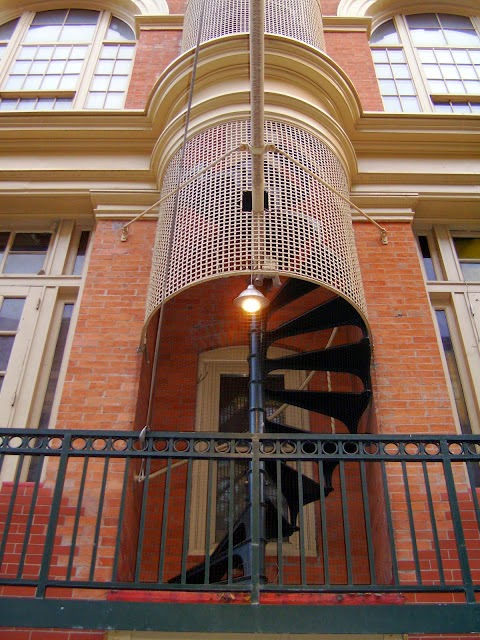
Because the Ecksteins--a family of eight--lived on the uppermost floor, Schroff was tasked by law with providing a fire escape.  His problem was how to incorporate the escape without ruining the design of the façade.  His solution was a spiraling cast iron staircase which he disguised behind an unusual basketweave cylinder of iron.  Wrapping the top of the mesh tube was a galvanized iron band announcing BUILT MS 1889.  Rather than incorporating Victor Eckstein's monogram into the design, Schroff memorialized his own.

The architect included his own initials in the frieze of the fire escape -- photo by Alice Lum
The meeting halls—known as Eckstein’s Metropolitan Assembly Rooms-- were soon booked.  The German Photographic Society of New York, organized in 1868, held regular meetings here on the second and fourth Wednesday of every month at 8:15 p.m.  And here Leo Zitsmann and his wife celebrated their silver wedding anniversary on Wednesday night, July 11, 1894.  But the hall would be used more by trade unions than for club meetings and wedding receptions. 

Labor unions had been gaining a toehold in America since the end of the Civil War, following the lead of the English movement.  By now unions were firmly established and fought to obtain humane working conditions and a reasonable wage for their members.   In 1893 New York’s waiters were demanding increased wages.  On May 6 The New York Times announced “the International Hotel Employes’ Alliance held a mass meeting yesterday afternoon at 62 East Fourth Street to organize down-town restaurant and hotel waiters.”

Meanwhile, Jacob Becker was a regular at the restaurant.  The Evening World said, on May 12, 1893, “Becker spent much of his time at Victor Eckstein’s restaurant, 62 East fourth street, where he is well known.  He is married, and lives in Fourth street, near First avenue.”  He had been a professional cornet player until a few years earlier; then a scuffle put an end to his career and his mental stability.

“Becker was formerly a good musician.  Several years ago he got into a fight with another musician, who struck him with a bottle, knocking one of his eyes out.  He now wears a glass eye,” explained the newspaper.  “The blow he received affected his mind, and he has since been insane at intervals.”

Becker now made a living selling musical instruments.  His bouts of instability were well known in the neighborhood.  “In one of his crazy spells, some time ago, he startled the neighborhood by hanging a lot of instruments out on a wash line,” said The Evening World.  “One of Becker’s peculiarities was to stand in the street and make faces and gestures at the moon.”

Untreated, Jacob Becker’s spells were sometimes dangerous.  At one point he threatened his wife with a knife; but was disarmed before he could harm her.  “He also wanted to throw her out of the window,” mentioned the World.

The end of his public displays came in May 1893 when he conked a passing woman on the head with a cornet.  Her screams attracted a policeman who, in turn, was knocked on the head with the instrument.  When the policeman tried to arrest Becker, the 37-year old became so violent that a second officer, Policeman Schroeder, had to help.   They finally handcuffed him, but “He broke the nippers which Policeman Schroeder had on him and kicked the officer a fearful blow in the chest.”

It took three officers had to control Becker at the police station until an ambulance from Bellevue Hospital arrived and he was put in a strait jacket.  “He was placed in the insane pavilion at Bellevue this forenoon,” advised The Evening World.

The 54th Regiment Veteran’s Organization used the assembly hall as its headquarters.  The group was formed at the outbreak of the Civil War by German immigrants and was known popularly as Die Schwarzen Jaeger.  The New York Times later said the regiment “served with distinction throughout the campaign.”  When Captain Carl Gerhard Friedrich Wahle died on April 21, 1899, a military funeral was held in the assembly rooms in Eckstein’s building.

On June 15, 1903 Victor Eckstein sold his building to George Ehret.  The real estate operator soon commissioned architects Horenburger & Straub to make alterations; updating the 13-year old structure.

The spiral fire escape was veiled in a basket weave tube -- photo by Alice Lum
Under its new owner the building continued to attract labor unions and political groups.  On April 10, 1904 the newly-organized New York Rent Protective Association went “seeking a hall for their meeting, and finally found one at 62 East Fourth Street,” reported The Times.   In 1912 when 7,000 furrier workers went on strike, they reported here—the meeting rooms now known as Astoria Hall.

It was around this time that the United Cloth Hat and Cap Makers of North America took permanent space in the building.  Organized in 1901, the union would operate its general offices here for years.

By 1914 Astoria Hall had been converted to a theater and music hall.  When a 19-year old actor with one leg was arrested on May 13 for soliciting alms on 14th Street, he grumbled at being detained.  Jesse Skinner was well-dressed and wore a “ring in which three diamonds sparkled...Skinner said he was very much annoyed by his arrest,” reported The Sun, “declaring he was due at Astoria Hall to rehearse his act, which he said was called ‘The Floppers.’”

Still, stage sketches and music would often stand aside for more serious events at Astoria Hall.  In September of 1915 8,000 ladies’ tailors went on strike, crippling not only the dress factories in the garment area; but “all the expensive tailor shops and dressmaking establishments adjacent to Fifth Avenue,” according to The Evening World on September 22.  The newspaper said that all strikers below 14th Street were meeting at Astoria Hall.

On January 9, 1917 the Umbrella Workers’ Union protested to President Wilson against the importation of Japanese umbrellas.  “The union also intends to begin a fight for the eight-hour work day,” advised The Evening World a week earlier.  Union organizer Meyer Abrahamson told reporters “a call has gone out to 25,000 members, mostly girls, for a meeting at Astoria Hall.’

When George Ehret hired architect L. F. J. Welher to do $8,500 worth of alterations to the building in 1918, there was still a restaurant on the first floor.  And for the next few years labor unions would continue to use the upstairs rooms.   In 1918 30,000 workers of the American Men’s and Boys’ Clothing Manufacturers Association were locked out by their employers.  The group held conferences in Astoria Hall on November 12.  The following year it was the International Federation of Lunchroom and Restaurant Employees which held its “mass meeting” here.  (The union complained its members’ 84-hour work weeks earned them $16.)

Among Ehret’s alterations was the conversion of Victor Eckstein’s living space on the fifth floor to additional meeting rooms.  But in 1921 the meetings there were of the shady variety.

“Chicago” was the password that admitted patrons to the illegal gaming hall.  Gamblers staked as much as $300 on a single throw at the craps tables and undercover detectives said they lost $51 within 20 minutes of play—about $625 today.

The patrons’ luck ran out on February 3 when the rooms were raiding and 23 men were arrested.  The New-York Tribune reported “Eighteen of the men were fined $2 each.  Five, charged with being common gamblers, will be arraigned in the Tombs Court to-day.”

In 1956 No. 62 East Fourth Street became the 125-seat Royal Playhouse where live theater and dance was staged for nearly a decade.  Matinees were for children who were treated to live stage performances like “Cinderella.”

Then, on January 21, 1962, The New York Times reported “the other day there was J. I. Rodale announcing that he had purchased the three-story building at 62 East Fourth Street and would turn it into an intimate playhouse, a workshop, and an acting school.”  The Rodale Theater, like the Royal, survived just short of ten years.

While Rodale still owned the venue, beginning in July 1966 through the early 70s, it was concurrently used by the Channel One Video Theater for its “Channel One Underground Television.”  As part of the show, the audience watched black and white television sets that hung from the ceiling.  Called “The Grove Tube” show, it would form the basis for the 1974 movie of the same name.

Biographer Rena Fruchter, in her I’m Chevy Chase…and You’re Not, writes “It was here that Chevy laid the groundwork that took him eventually to Saturday Night Live.”  She quotes an article from the Village Voice “The studio is on the second floor of the building, in what must have been an elegant ballroom.  It is a huge room with grimy gilt trim, dirty crystal chandeliers and faded wall panel paintings.”

It was not only the interiors that had become grimy.  The neglected façade peeled paint and numerous windows were boarded closed.

In the late '70s the deterioration of the building had only just begun -- photograph by Edmund V. Gillon, from the collection of the Museum of the City of New York http://collections.mcny.org/C.aspx?VP3=SearchResult_VPage&VBID=24UAYWQ2RW5Q&SMLS=1&RW=1280&RH=915

Much is currently made of Andy Warhol’s Fortune Theater which briefly made use of the space in 1971.  Widely touted as the artist’s foray into male porn; there is little evidence that no more than a single male “blue film”, entitled Male Magazine, was ever screened here.

The building was home to the New York Theater Ensemble from the early 1970s through 1984, when it became the New Theater from 1985 to 1989.  In 1990 the DUO Theater, a group specializing in Latino music was here and by 2000 it shared the building with the Rod Rodgers Dance Company Studios, which leased the basement and first floor.

In 2000 a massive half-million dollar project was undertaken to restore the building and rebuild the interiors.  The result, completed in 2012, earned the Duo Multicultural Arts Center the Lucy G. Moses Preservation Award, issued by the New York Landmarks Conservancy.
 
The "faded wall paintings" and surviving architectural details were carefully restored -- photo http://www.nyc-arts.org/organizations/60082/duo-multicultural-arts-center

The building houses space for dance, visual art, theater, film and music.  Nearly derelict in the 1990s, the quirky structure with its disguised spiral fire escape (no longer usable by law) has reemerged as an unexpected architectural gem.

photo by Alice Lum