.

Showing posts with label west broadway. Show all posts

Thursday

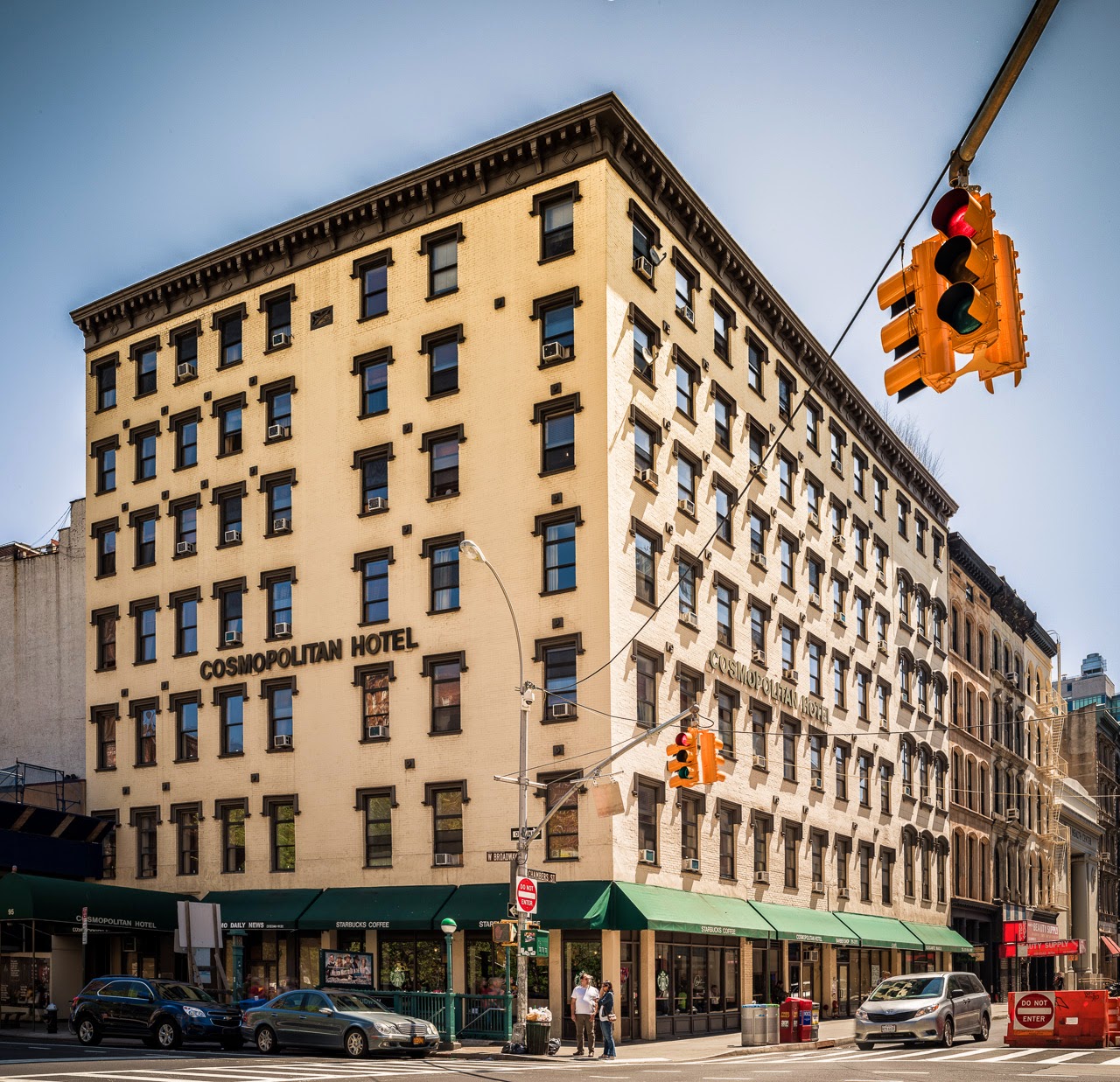
The Cosmopolitan Hotel -- Chambers and West Broadway


photo by Nicolas Lemery Nantel / salokin.com
In 1845 New York City could already offer upscale hotel accommodations to traveling businessmen, tourists and Europeans.  The North American Hotel and the world-class Astor House Hotel were up to date in terms of modern facilities and comforts.  That year another well-appointed hotel opened—the Girard House—at the corner of West Broadway and Chambers Streets. 

It was the new hotel’s location that would set it apart from its rivals.  James Boorman was not only a partner in Boorman & Johnston, a highly successful importer and dealer in tobacco, wine, fabrics from Scotland and ironwork from England and Sweden; he was among the founders of the Hudson River Railroad.  In 1844, as the railroad planned for a depot at Hudson and Chambers Streets, Boorman purchased a 75-foot square plot on Chambers between Church Street and West Broadway.  When his four-story building was completed the following year, it sat conveniently across the street from the planned depot; a guaranteed draw for travelers.

Boorman’s new structure was architecturally up-to-date; a reserved take on Gothic Revival with square-headed moldings above the openings.  Elaborate cast iron porches had already made their appearance in Manhattan—such as those designed by Alexander Jackson Davis in 1844 for Nos. 3 and 4 Gramercy Park.  They would provide the main architectural interest here in the form of an elegant veranda wrapping the second floor.

An early print depicts the 4-story structure with its cast iron veranda and a rusticated stone base.  The railroad depot is at the near right. print Kouwenhoven, Columbia historic portrait
As he waited for the depot to materialize, Boorman leased the upper floors as a boarding house, run by Ann Andrews, with retail shops at street level.  Finally, in the summer of 1852 the railroad station was opened for business and Boorman leased his building to hotelier John A. Davis to be run as a hotel and restaurant.  Davis opened the Girard House in 1853; the same year that James Boorman purchased and demolished the brick house next door at No. 125 Chambers (which had been home to the store of jeweler Charles L. Tiffany) and erected an addition. 

Boorman did not bother to match the architecture when he constructed the addition (right).  Italianate coexisted well enough with Gothic --photo by Nicolas Lemery Nantel / salokin.com

Among the first guests was St. Louis merchant Stephen O. Day who shared a room with his close friend, Louis Fenn. The travelers checked in around January 10, 1853.  The New York Timesreported that “It appears Mr. Day had more or less traveled with this individual for five years, during which time he reposed the most implicit confidence in his honesty and integrity; but, alas, the faith was broken.”

While Day slept, his companion stole his wallet containing $3,000 from his “pantaloons pocket.”  The substantial theft would amount to over $87,000 today.  By the time the thief was apprehended in Philadelphia on January 13 he had managed to spend over $1,300 of the stolen cash.

A bizarre tale played out in 1856 when Dr. James H. Bogardus of Kingston, New York was a guest here.  The doctor, whom The Medical Worldcalled “about 43 years old, of the highest respectability and ranked the first in his profession in the county in which he resided,” had been engaged to Isabella Hamilton for about two years.  On their wedding day, the doctor’s young nephew died and the ceremony had to be called off.  The date was rescheduled and on the morning of that wedding, the sister of the bride-to-be lost a child.  Once again the couple attended a funeral service instead of their own wedding ceremony.

The nuptials were rescheduled, yet again; this time for Tuesday November 25, 1856.  Bogardus arrived at the Girard House on November 17 and the following day had become too sick to leave his bed.  Doctors attended to the patient for several days; and Bogardus told them he was afraid his illness would prevent the wedding for a third time. 

A telegraph was sent to Isabella Hamilton who left for New York at once.  She arrived around 4:00 on Sunday morning, two days before the planned ceremony.  “At half past 2 o’clock the parties were united, and Dr. Bogardus expressed his thankfulness in being enabled to carry out his intentions of marriage to the lady in question,” reported The New York Times later.  But the fated wedding was not to be.

As reported in The Medical World “He then remarked that he felt so much better that he would get up, and at once proceeded to raise himself in bed.  His bride perceiving his efforts to rise, went to assist him, only to discover that he was expiring in her arms.  She instantly sprang to the bell and rang for assistance; but before their friends could reach the room he was a corpse.”

Heat and hot water was provided by a 12-foot long locomotive boiler in the cellar.  Early on the morning of October 1, 1859 plumber John O’Connor was working on pipes leading to the boiler.  With him in the cellar was maintenance man John Collins.  Suddenly, around 6:00 the huge boiler exploded.  The New York Times reported that “the force of the explosion was so great that the tessellated marble floor of the barber’s shop, directly overhead, was upheaved to the ceiling…The furniture of the shop was completely destroyed.”  Damage extended throughout the first floor.  “The glass in the windows of the reading-room, which is directly in front of the barber’s shop, as well as that in the windows of the adjoining room, which is occupied as the office of the hotel, was smashed, and the window frames were forced into the street.  The walls of the reading-room were also cracked by the concussion, the shock of which was felt by occupants of the fifth story.”

Tragically, O’Connor was instantly killed and Collins was severely scalded.

In 1869 brothers Samuel J., Nathaniel and John P. Huggins purchased the Girard House and set about renovating it.  By the time they opened it as the Cosmopolitan Hotel it would accommodate 400 guests and stand six stories tall.  The substantial upgrading would come at a heavy price, however.

On April 9 that year 51-year old carpenter Conrad Beingle was working on the roof.  Somehow he lost his footing and fell to the pavement below.  “The mangled remains were picked up from the sidewalk and removed for an inquest by the Coroner,” said The Times.  The German immigrant left a wife and four children.

Later that year more misfortune occurred.  On October 14 James Nolan, a porter, showed his revolver to 15-year old employee John A. Deyo.  “As Nolan advanced he began fumbling with the weapon, the muzzle pointed toward the boy, when suddenly the pistol was exploded, the bullet entering the boy’s head just above his right eye, and penetrating beyond the reach of a probe.”  Amazingly Deyo was still alive four days later.  Nevertheless, the injury was considered fatal and Nolan was held in the Tombs “to await the result of the wound.”
 
The new proprietors issued advertising cards showing the now six-story hotel (copyright expired)
The renovated hotel featured all the modern conveniences.  For a room costing $1 per day, the guest was promised “The Halls are spacious and airy, and the rooms have been arranged with especial attention to light and ventilation.  They are warmed with steam in the most approved manner, are lighted by gas, and furnished with the best English Brussels carpets and black walnut furniture from the best manufacturers.”

The Huggins brothers intimated that the hotel was brand new; not merely renovated.  “This Hotel is built on the site of the old Girard House,” said an advertising card.  There was indoor plumbing and every floor had a toilet, and there was an Otis Brothers’ elevator.  Guests enjoyed the services of a barber shop, telegraph office, railroad ticket office, billiard room, news office (where tickets for the theaters and “places of amusement” could be purchased), and a “range of Baths.”  (Women’s baths were discreetly segregated on the second floor.)

Like all hotels, the Cosmopolitan had its share of suicides and scandals.  One sordid affair played out in August 1883 when railroad engineer Joseph D. Marone invited the new wife of his friend, William E. Greenleaf, to go to a New York theater.  The New York Times reported, “She consented, but instead of taking her to the theatre he inveigled her, she alleged, to the Cosmopolitan Hotel, and having secured a private room committed an outrage upon her.”  Greenleaf learned of the story and had his friend arrested “for damages.”

Although the Huggins brothers retained ownership of the hotel, they retired in the 1890s, turning its management over to Charles W. Wildey.  John P. Huggins died in September 1902 having amassed a fortune of more than $1 million.  With the death of Samuel J. Huggins in 1912, Wildey’s term as proprietor would draw to a close.

A 1901 menu shows a seventh floor and the loss of the exuberant cast iron -- from the collection of the New York Public Library
The Cosmopolitan was purchased by Joseph M. Weintraub, described by The New York Times as “a real estate operator, specializing in choice sites in the midtown and downtown area.”  He closed the hotel in 1913 for a full year as $250,000 worth of renovations were made.  A substantial portion of the cost—approximately $70,000—was spent in shoring up the 60-year old foundation, weakened by the vibrations of the subway system. 

By the time Weintraub died on June 29, 1935, the Cosmopolitan Hotel suffered from the movement of the hotel district to Midtown.  Its room rates were about half of a typical hotel around Penn Station and the theater district. 

As though the struggling hotel did not have problems enough, 28-year old resident Waldemar Wengorra set fire to the building in November 1937.  The blaze swept through the upper floors as 130 panicked guests streamed onto Chambers Street.  Arriving firemen found hotel guests Chester McAuliffe and his wife trapped in an upper room.  Fire fighters executed a daring rescue by descending by a rope from the roof and hauling them to safety one-by-one.

Before the fire was extinguished five guests were injured, three of them seriously.  Wengorra was later arrested and held on $10,000 bail.

Within three years of the fire the battered hotel was renamed the Bond Hotel and suffered the indignity of a flop house.  Single Room Occupancy rooms were leased to otherwise homeless men and families.  Then, as the neighborhood experienced a revitalization, the hotel was reborn.  Rechristened the Cosmopolitan it was completely renovated and modernized.

The cast iron Gothic drip moldings were copies on each successive floor -- photo by Nicolas Lemery Nantel / salokin.com
The trendy boutique hotel survives as one of Manhattan’s oldest hotel structures.  And considering its long and varied past and many alterations, it is not so worse for the wear.

Wednesday

A Miraculous Survivor -- No. 177 West Broadway


photo by Alice Lum
The block of West Broadway between Leonard and Worth Streets, now lined with loft and commercial buildings, was far different in 1803.  The residential district of the expanding city had reached this far north and attractive brick homes were appearing.  It was around this time, certainly not much later than 1805, that the two-and-a-half story house at No. 177 West Broadway was completed.

Historian Barbaralee Diamonstein-Spielvogel writes that the dwelling was, most likely, constructed by carpenter Lawrence White.  Its Flemish bond brickwork was distinguished by handsome brownstone lintels with layered keystones above the openings.  The completed house with its one or two dormers perched on the simple cornice would have been one of several near matching homes on the block.

Change came quickly to this section of Manhattan and by 1807 the elegant residential neighborhood of St. John’s Park had been developed a few blocks north.  As the city continued to expand, residents fled northward ahead of the tide of commerce.  St. John’s Park was essentially abandoned to business by 1869 and the quaint little Federal homes on West Broadway had been converted for commercial purposes.  No. 177 had, by now, been altered for around three decades.

Commerce in the former house was, perhaps, a bit shadier than that of its neighbors.  The address was reportedly a disorderly house for some time—the polite Victorian term for a brothel.

Towards the turn of the century America was swept with a Colonial Revival fever that resulted in neo-Federal and neo-Georgian churches and homes.  It would climax with stylish mansions like that of Andrew Carnegie, and the high-toned Knickerbocker Club on Fifth Avenue.  It was most likely this architectural trend that resulted in a nearly-seamless full-floor addition.  Sometime around the early 1890s the attic level was raised to a full third floor.  The architect copied the sills and lintels and applied a simple wooden cornice appropriate to the period.  He stopped short of matching the Flemish bond brickwork.

More interesting than the astonishingly-sympathetic alteration is that the little house was still there at all.  Commercial structures had replaced nearly all the Federal homes in the area; but somehow No. 177 clung on. 

For many years Martin Mayer (sometimes spelled “Meyer”) ran his restaurant from the ground floor.  The area now bustled with salesmen, messenger boys, and deliverymen; making it a perfect location for his small business.  It was one of two restaurants Mayer operated in the area.

Martin Mayer’s respected image in the neighborhood resulted in his name being used—inappropriately—by ex-City Chamberlain Charles H. Hyde   He was facing trial for swindling a client in 1911.  Israel Tilden, a law student and clerk, applied for a change of venue, claiming that Hyde was so hated locally that he could not receive a fair trial.  To support his application Tilden presented the court with an affidavit alleging that local businessmen had disparaged Hyde, assumed he was guilty, and called him unflattering names.  Among the men listed was Martin Mayer.

The problem for Tilden and his client was that at least a dozen of the men learned of the affidavit and told reporters they had never made the remarks attributed to them.

On December 27, 1911 a New York Times reporter visited Mayer in his West Broadway restaurant.  The man who previously had not held an opinion in the swindling case had one now. 

“Hyde is like the other crooks that can get away with it.  I never heard of this fellow Hyde until several of my neighbors dropped in to ask me what I knew of the case,” he snarled.  “I am a very busy man.  I have another restaurant to run as well as this one, and my work takes all of my time.  I would not discuss the case with a stranger even if I was familiar with it, and I am sure I would not call anybody the names I am supposed to have called Mr. Hyde.”

Mayer was still operating his restaurant here in the 1920s.  The success of his business was reflected in the amount he pledged in support of a civic improvement project in 1923.  Mayer, along with many of his neighboring businessmen, was firmly in favor of demolishing the Sixth Avenue El in favor of constructing a subway.  He pledged $118,000 that year towards the plan—about $1.5 million in today’s dollars.

photo by Alice Lum
The little brick house survived through the 20thcentury with relatively few changes.  In 1973 the ground floor was converted for “packing and shipping” for a single tenant with offices upstairs.  In 1992 the street level became home to Urban Bird where scores of colorful parrots squawked and bred.  The store’s owner, Nancy Chambers, lived upstairs.

Romance and subsequent parenthood for the parrots came to an abrupt end in March 1993 when the nightclub Renegayde opened in the adjoining building.  The thunderous music and pulsing vibrations disturbed the tender ambiance of the parrots’ love nests and the eggs stopped coming.

“It was immediate—they stopped completely,” Chambers complained to Bruce Lambert of The New York Times a year later.  It was a major problem for the breeder; meaning she was forced to purchase her chicks.

Urban Bird eventually left, succeeded by the pet supply store Pamper Ur Pets which remains there today.  One of the last surviving structures from the 1802-1805 period in Tribeca, No. 177 West Broadway was considered for landmark designation on June 26, 2012.  The building’s owner, Shiloh Company LLC, sent its attorney to oppose the designation.  Valerie Campbell argued that the structure was heavily altered and did not consider the 110-year old third floor addition historic.  The Landmarks Preservation Commission agreed.  Chairman Robert B. Tierney said that the alterations “tipped it away from designation.” 


But formally designated or not; No. 177 West Broadway is indeed a landmark.  A miraculous survivor, it is the last relic of the neighborhood’s residential days two centuries ago.

Tuesday

The Federal Relic at No. 357 West Broadway


The Bayard family not only had immense wealth in Colonial times—they engaged in a tremendous trade with sugar plantations in the Caribbean and owned a large Sugar House on Wall Street—but they wielded significant political power.  The family owned a sprawling estate—referred to as the Bayard or West Farm—north of the city in what two centuries later would be known as Soho.

By the end of the Revolutionary War, however, Nicholas Bayard had fallen on hard times.   The conflict itself had negative financial consequences, and by now the Caribbean sugar economy had all but collapsed.  In 1789 Bayard declared bankruptcy and was forced to sell the Bayard Farm to pay his creditors.  The old sugar house was lost as well.

Although the property was divided into building lots; little development was seen until Broadway was paved and sidewalks laid as far north as Astor Place in 1809.  Although development slowed with the outbreak of the War of 1812; it exploded around 1815 and continued for a decade.  Fine brick residences were erected along Broadway with more modest homes sprouting on the side streets.

It was at this time, around 1825, that the two and a half story house at No. 357 West Broadway was constructed.   A low stoop arose to the parlor floor of the middle class home.  The Flemish bond red brick was trimmed with brownstone sills and lintels.  Two prim dormers with fluted pilasters perched above the cornice.

The neighborhood around No. 357 remained quietly residential through the decade prior to the Civil War.  Then, little by little, handsome homes of Broadway were lost to grand retail emporiums and hotels as commerce pushed northward.  As the century drew to a close, the silk district had engulfed Broome Street one block north of No. 357 West Broadway.   But the little brick building would have a less glamorous fate than housing imported silks.

By at least 1897 the house was no longer residential.  That year it was headquarters of Louis T. Swartz whose self-named company, L. T. Swartz, manufactured ash cans.   The small firm would remain here until 1904, when Cadoo & Co. moved in.  George J. Cadoo was less successful than the ash can maker and his company dissolved just two years later.

J. L. Prouty & Sons, Inc., dealers in animal skins and furs, took the old house as its warehouse when Cadoo moved out.   Prouty used Adams Express for the transportation of some of its goods; an arrangement that cause the firm serious financial loss in 1907.

Twenty-year old William Leonard was a driver for Adams Express and despite his tender age had already served two years and eight months in Sing Sing for grand larceny and another term in the Elmira Reformatory for burglary.   In November 1906 Detective Sergeants Dale and Fogarty happened to notice the door of a vacant store on West 37th Street slightly ajar.  They entered and found the floor littered with paper, string, an invoice of A. Epstein & Co., and a beaver skin.

The detectives went from one fur dealer to another until they “finally found the owner in Prouty & Son of 357 West Broadway, who had been robbed of $5,000 worth of furs.  Then the detectives went to Epstein & Co. and found that the firm had shipped by the Adams Express Company some goods that had never reached the consignee.”

It was soon discovered that Leonard had stolen nearly $30,000 worth of goods; a significant three quarters of a million dollars today.

The New-York Tribune later listed a few of the types of pelts handled by Prouty & Sons.  “Fisher, Hudson Bay sable, cross fox, silver fox, mink, mole and muskrat,” as well as marten, Russian sable, beaver, krimmer, red fox, and weasel.

In the years just prior to World War I No. 357 had become more industrial.  Benjamin Levi ran his tool and die operation here in 1915, advertising “Special electrical and mechanical devices built to order.  Models, Tools, Dies.”

The massive brick, stone and cast iron loft buildings in the area suffered major abuse during the second half of the 20thcentury.  Neglected and deteriorating they housed mostly small factories and businesses.  No. 357 was not immune.  At some point, probably around mid-century, the parlor floor was removed and the basement floored over.  The doorway was moved to sidewalk level and an industrial opening was broken through.  In the early 1970s the grimy little building was being used as a garage.

The beautiful paneled lintels, now painted, and the dentil molding of the cornice survive after nearly 200 years.

Then, in 1992 as the Soho area was rediscovered, No. 357 received a make-over.  The garage area was converted to a restaurant-bar and the upper floors made into offices.   Today the remaining façade has been restored.   The brownstone has somewhat unfortunately been painted white; but the wonderful lintels survive intact.  It is a surprising reminder of a time when West Broadway was lined with tidy little homes like this.

photographs by the author