.

Showing posts with label gamaliel king. Show all posts

Sunday

The 1862 Washington Square M. E. Church -- 133 W. 4th Street


photo by Alice Lum
Washington Square had transformed, by 1842, from a potter’s field to an exclusive residential neighborhood bordering what was now an elegant park.   That year the congregation of the Sullivan Street Methodist Protestant Church just to the south decided to disband and sell its property.  Oliver Loveland, a young and prominent member of the Bedford Street Church, admired the structure and convinced other members to purchase the old church.   Then, just as the papers were to be signed, several of the major supporters backed out, fearing the project would fail.

Loveland was undeterred, however, and “Almost alone, assisted only by Dr. S. A. Purdy, he purchased the property for the stipulated price, the two becoming personally responsible for its payment,” reported The New York Times.  It was a risky move.  Neither of the men was financially able to maintain a new church organization, let along the mortgage.  “Both of the new owners were at the time of slender means,” said The Times.

Financial salvation came in the form of Sylvanus Gedney, a member of the old Sullivan Street church whose “love of the old edifice was too strong to part with it.”   On December 12, 1842 the three men founded the Sullivan Street Methodist Episcopal Church with just one other member, Richard P. Berrian.

Within two years the membership had grown to over 200.   The Times later noted that by 1849 “The prosperity of the society had now become assured, and during this year and the following the increase in numbers and wealth was unprecedented.”

In 1859 a “more commodious edifice” was necessary to accommodate the growing, upscale congregation.  The pastor, Dr. Shelling, purchased two lots at Nos. 133 and 135 West 4thStreet, just off Washington Square, and began plans for an elegant new church.

Although often mistakenly attributed to Charles Hadden, the church was designed by architect Gamaliel King and was possibly his first commission after dissolving his partnership with John Kellum.   The white marble building was completed two years later at a cost of $80,000—about $1.4 million today.  A successful melding of Gothic and Romanesque Revival styles, the façade was divided by four slender buttresses, capped by marble finials.   

photo by Alice Lum
Inside, King installed the first galleries in New York to be built with no visible means of support.  The innovative engineering caused nervousness among the congregants andThe Times later reported that “skeptics in the congregation said the galleries would fall down in a couple of years.”  Happily, they did not.

With its new location the church was renamed the Washington Square Methodist Episcopal Church.  The scattered congregation came from Jersey City, Greenpoint, Harlem, Elizabeth, Hoboken, Williamsburg, and “from all parts of the City,” according to The New York Times.

Graceful corbels, a carved balustrade and white marble Gothic finials adorn the building -- photo by Alice Lum
Things went smoothly for the church.  On April 31, 1874 The Times remarked on its quiet existence.  “Since its first inception down to the present time it has been without the slightest event calculated to mar the peace and happiness of its exemplary congregation.  Never has there been a single church trial, or a collision of any kind between Pastor and people—even the most insignificant.”

But that would change.

In October 1884 the church trustees started a thrust to eliminate its $11,100 debt, including a $3,100 mortgage.  Subscriptions were raised and the money was paid to Treasurer Edward F. Stewart.   By December $5,000 had been raised and in March 1885 Stewart noted in the ledgers that the mortgage had been paid.

The problem was that the money went into Stewart’s pockets and not to the mortgagor, James M. Anderson.   “The defaulting treasurer, however, was very careful to pay the interest on the mortgage from his own pocket, so that his rascality would not be revealed,” said the Evening World.

Stewart managed the deception until March 15, 1888 when a notice that an interest payment was due fell into the hands of Pastor John Rhey Thompson.  “The information fell like a dynamite bomb among the officials of the Washington Square Methodist Church, who had looked upon their treasurer as a man of strictest integrity only to find him an ingrate and a thief,” said the newspaper.

Stewart, whom the World said “is a fine-looking man,” was arrested and held in The Tombs.    Several days later, with his wife too scandalized to leave their Brooklyn home, Stewart appeared in the Chambers Street Supreme Court.  The Evening Worldsurmised that “living beyond his income” drove him to embezzle, for it said “He does not look like a man of thieving instincts.”  The newspaper added “Stewart appeared to feel his position keenly.”


Washington Square M. E. Church in 1895 -- Nickerson's Illustrated Church Musical and School Directory (copyright expired)
Years before Stewart began his rascality, 20-year old Englishman Martin George said good-bye to his girlfriend of four years and traveled to California’s gold mines in 1877.   He and Caroline Jenkyn maintained a long-distance romance via mail for over 11 years.  Finally they decided to meet half way, in New York, to be married.

George boarded a transcontinental train and his fiancé set sail on the Gallia from Liverpool.  On May 30, 1889 the Gallia docked in New York and Martin George was there to meet her.

“Miss Jenkyn stood on the deck among a crowd of passengers, and Martin George gazed from face to face until his eye lit upon the form of his ideal,” reported The Evening World.  “Then there was a waving of handkerchiefs and there was even a suggestion of a kiss passing through the air.”

Shortly before 8:00 that evening the couple was brought to the Washington Square Methodist Episcopal Church by John Stevens, an officer of the Gallia.   After almost 12 years and a joint 6,000 mile trip, they left the church as Mr. and Mrs. George.

The Evening World explained that “the only reason why they were separated all this time was that the bride was the pet of her family.”

Nearby on Washington Square sat the noble Gothic revival Asbury Church.  On October 9, 1893 the two churches merged and it was announced that the venerable stone structure on the park would be sold.  The proceeds of the sale would help advance the charitable causes of that both churches supported.  Within two years the church building was demolished.

The handsome Asbury Church on Washington Square was demolished in 1895 -- NYPL Collection
The Washington Square Methodist Episcopal Church, so long recognized for its quiet existence, was about to change its reputation.   The church entered the 20thcentury by plunging headlong into political issues.  It started with liquor.

In 1900 the church was the meeting place for the South New-York Christian Temperance Union.   Two decades later the issue was still on the priority list with the Rev. Andrew B. Wood serving as assistant superintendent of the Anti-Saloon League.    The minister declared that prohibition would improve labor conditions, reduce unemployment and “end some 66,000 deaths annually traced in this country to the liquor traffic.”

photo by Alice Lum
The reverend’s arguments were always impassioned, but not always easy to follow.  In a meeting at the church on May 25, 1919 he asserted “The heart of the anti-prohibition fight, of course, is that there are a lot of people who like to govern but who are unwilling to be governed.”

On May 2, 1942 the church pledged its support of the country’s entry into World War II.    The announcement urged that while peace was always preferable, submission to evil was not a consideration.    Thirty years later the church would take an equally solid stance against the Vietnam conflict, earning itself the long-lasting nickname “The Peace Church.”

By now the Greenwich Village and Washington Square area had drastically changed.  In 1962 the membership numbered only about 50 with nearly no young people.  The population of Greenwich Village was now heavily Italian Catholic, remainders of the great immigration wave at the turn of the century, and it had become the center of New York's homosexual community.  Yet the tiny congregation still embraced its fervent interest in equal rights and political justice.  In 1969 when the National Black Economic Development Conference demanded “reparations” to atone for centuries of white oppression of Negroes in America, the church withdrew $15,000 from its meager $40,000 bank account—the first predominantly white congregation to contribute.

Church members told the press there was little discussion about it.  “It wasn’t anything we had to stew over,” Olga Burkitt told a Jet Magazine reporter.  “We felt very strongly that we had to do it.  There are no conditions attached to the money.”

photo by Alice Lum
The congregation would prove its forward thinking once again when the Rev. Paul M. Abels took the pulpit as pastor in 1973.  Four years later Abels openly declared his homosexuality as he began conducting “covenant” ceremonies for gay couples who were legally barred from marriage.

The admission created a firestorm within the Methodist Church, but not within his congregation.  Fully 100 percent of the letters from church members to Bishop Ralph Ward were in support of Abels; there was not one dissenting voice.  But critics, ignoring Abels’s exemplary service to the community and the church, turned instead to a biblical admonishment against homosexuality.  They called for his dismissal.

When the regional  New York Annual Conference voted in favor of the minister, the bishop appealed to the national Judicial Council, the highest court in United Methodism.  In 1979 it ruled that Abels was in “effective relation” and “in good standing” and should remain as pastor.

Abel would take an early retirement in 1984, but not before he began an aggressive $1.5 restoration fund raising campaign and saw the inauguration of a parent-run day care center, the Harvey Milk School for gay teens, and planned the church’s 125th anniversary.

Abel’s restoration, which began in 1983, was done under the supervision of Andrew Ladygo of the Boston-based Society for the Preservation of New England Antiquities.  Much of the attention was focused on the interior.  “The ceiling is a canopy enclosing the space and the primary, most dramatic feature of the structure,” explained supervising architect Ann Beha.

Not that it would matter much longer.

In the Fall of 2004 the struggling congregation gave up and sold the church it that had been its home for nearly a century and a half.   The developer was restricted from demolishing the building because it sits within the Greenwich Village Historical District.  But within two years the pre-Civil War interiors had been gutted and the church had been renovated into apartments.
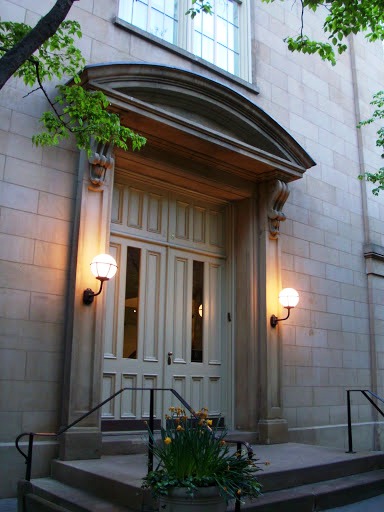
Behind the red paneled door, pre-Civil War interiors were wrenched out, replaced by modern apartments -- photo by Alice Lum
Although landmark status preserved the magnificent white marble façade, it could not stop the architectural and historic sacrilege inside.

Friday

The 1859 Friends Meeting House -- 28 Gramercy Square South

photo by Alice Lum
The Religious Society of Friends, commonly known as the Quakers, fled to America in the 17th century seeking relief from religious persecution.  They were gravely disappointed.

New Amsterdam’s Governor Peter Stuyvestant unabashedly despised both Jews and Quakers.  In 1656 he forbade the citizens of the Village of Flushing to “admit, lodge or entertain…any one of the heretical and abominable sect called the Quakers.”  Quaker worship was outlawed and the sect was forced to meet in secret.

Tolerance slowly surfaced.  By 1681 Quakers were openly worshiping and in 1734 they were granted the same civil rights as other British subjects.  The Militia Act of 1755 exempted the pacifist group from serving in the military.

Ironically it would be dissention from within their ranks, rather than outside influences, that caused the worst problems in the first decades of the 19th century.  A religious fashion swept the nation’s cities that focused on intense study of the Bible.  Traditionally, the Quakers were more concerned with direct inspiration from God than academic Bible teachings.

A difference of religious opinion among the Religious Society of Friends rapidly grew from a crack into a gaping chasm.  One group, led by Elias Hicks of Long Island, stood fast with the traditional Quaker traditions.  Another was open to the new movement.  In 1828 the Society of Friends underwent a quiet and peaceful split, known as the Hicksite Schism.  There were now the Hicksite and Orthodox branches.

Quaker worship, both in liturgy and architecture, was notable for its simplicity and lack of show.  So the Orthodox branch's choice of location for a building lot in 1855 was, perhaps, a bit surprising.  The group purchased the plot at 28 Gramercy Square as the site of its new meeting house.

The Square was two decades old.  Ringing the landscaped park were the brick and brownstone mansions of some of New York’s wealthiest and most influential citizens.  The wide lot at the southeastern edge of the square would place the unassuming Quakers squarely amid the city’s most assuming population.

The land was purchased for $24,000—nearly half a million dollars today.   On it the Friends would erect a chaste two-story meeting house.   The congregation hired the architectural firm of King & Kellum to design the structure with the admonishment that the house have no “useless ornament so as not to wound the feelings of the most sensitive among us.”

John Kellum and Gamaliel King carefully followed that direction.   Construction began in 1857 and was completed two years later.   What resulted was an unsullied Italianate design clad in warm, yellow Ohio sandstone.   Often mistaken for Greek Revival, the meeting house rose to a dramatic peaked pediment, the end returns of which defined the slightly-projecting end bays.
photo by Alice Lum
The unpretentious but elegant structure exemplified William Wistar Comfort’s later description of a Quaker meeting house.  “The meeting house is not a consecrated edifice, and if there is anything holy about it, it must be the lives of the people who meet there.”

Here in the years just before the Civil War, slaves escaping to Canada were reportedly given shelter.

To the mostly Episcopalian population around Gramercy Park, the quiet gatherings in the meeting house—which had no formal ceremony nor designated minister—must have been alien.   Quaker services were marked by “expectant waiting.”  Friends entered in silence and sat wordlessly to experience the presence of the Holy Spirit.  Only when one was moved to speak or sing was the silence interrupted.  Intervals between were often lengthy, and it was possible that no one would speak at all.

Such was the case when The Sun described the funeral of attorney Richard H. Bowne here on May 6, 1881.

“The funeral was plain.  The hearse, followed by about a dozen carriages, arrived at the meeting house door at 4:30 P.M.  The coffin was of solid oak covered with black cloth.  On each side were three silver-bar handles.  On the lid was a floral sickle, crossing a golden sheaf of wheat.  There were no other flowers…After the coffin had been carried into the church there was an interval of silence.  Then the Rev. Mr. Donaldson of the Fort Washington Episcopal Church, where Mr. Bowne usually attended in the summer, read from one of St. Paul’s Epistles, and made some remarks in which he said that Mr. Bowne was one of the men who leave the world better for their having lived in it.  There was another prolonged interval during which no one spoke, after which Henry Dickenson, the minister of the Friends’ Society, offered prayer.  There was a pause, and Mr. Dickenson made an address.”

Thirty-five years before Bowne’s funeral another rift had occurred among the Quakers.  An annual meeting was held in the larger cities, drawing Quakers from far away.  At the time of the meetings it was customary for each city to send friendly letters to the other groups.

In 1846 the annual meeting in Philadelphia was “divided over the question of heresy,” according to The New York Times, and “through motives of policy failed to send to New York and other yearly meetings the usual epistles of brotherly love, exhortation, and admonition.”

The New York Orthodox branch felt snubbed and communication between the New York Friends and those of Philadelphia ceased.

Then during the annual meeting in May 1897, after half a century of simmering bitterness, the first letter from Philadelphia arrived.  The Gramercy Park congregation reacted with expected Quaker decorum and politeness.

Clerk James Woods explained to the assembly about the letter and “asked if the epistle should be read.”

“I feel that God will that we should hear it,” said Sister Ruth S. Murray.

Her pronouncement was met with “It is right to do so,” “I also,” and “It is well we should,” from throughout the hall.  The clerk passed the letter to Assistant Clerk David S. Tabor to read.   “It was filled with sound doctrine and exhortations to all to stand firm in the faith, and for the great cause of universal peace and good will,” reported The Times.

Now the problem was how to respond; or if to respond.  The letter had not been addressed specifically to the New York meeting, but to “all bodies and individuals known as of the Society of Friends.”

Some felt that the epistle, being general, needed no response.  Others felt it was time to heal old wounds.  “Then came a reaction,” said the newspaper.  “Pride came to the fore.  It was displayed chiefly among the older men, some of whom could remember the bitterness of fifty years ago.

“Again the apostles of peace gave voice to the spirit, but in all there was a delicate choice of words, an almost painful care not to hurt the feelings of another or even to seem antagonistic.  It was like a flutter in a dove cote, and yet at the last one elder characterized it as a ‘heated debate.’”

In a decision worthy of Solomon, the congregation agreed to note in the minutes “with what pleasure and benefit the epistle had been received,” and to send a copy to the clerk of the Philadelphia yearly meetings.  And with that small act half a century of bitterness was healed.

It would be another half century before the initial great rift among the Friends would be addressed.

Behind the iron fence of the Meeting house, time seemed to have stood still in 1915 -- photo from the collection of the Museum of the City of New York
The modern views of the Orthodox Gramercy Park congregation was clearly evident by the turn of the century.  On February 20, 1913, a wedding took place; and while the Quaker customs were followed, there was practically no trace of the old Quaker garb.

“From the door to the curb ran a red-striped canvas sidewalk canopy and at 8 o’clock men and women in evening dress began to file in,” reported The Times.  “It was such a gathering as one might see at any evening wedding, groups of kindly old folk, nodding their heads as in benediction, hosts of young people, the girls in pretty evening gowns, and the men in correct evening dress.  In all that congregation only one woman wore the Quaker dress.  Friend Sarah Collins, sitting in the row, facing the meeting, reserved for the ministers, wore the plain Quaker Cap.  Time was when the meeting house was new and the three front rows of seats would have been filled with those clothed soberly in the Quaker gray.  But that was years ago, when many of the older ones there last evening were young girls.”

At mid century the Friends Meeting House was still going strong.   It was home to a non-Quaker, although pacifist, resident in the 1950s.  A large, dark-shelled tortoise somehow found the verdant yard of the meeting house and made his home there.  Meyer Berger wrote on May 9, 1956 that he “has lived on and off the Square for years, though no one seems to know how many.  Gramercy ladies feed him moistened bread and dainties…In winter, near as anyone can make out, he holes up somewhere in the Friends Meeting House in Twentieth Street.  The sexton knows it’s spring when the turtle stirs from somewhere in the hedges, tests the sun and starts moving across the pavement toward the park.”

That same year The Times reported on movement towards the reconciliation between the Orthodox and Hicksite groups—the latter having built a handsome complex of buildings on Rutherford Place and 15thStreet.  “It seems that for the past five years or so, four-man committees from each of the meeting houses have held a series of sessions with a thought to reunion.”

The newspaper did not hold out promise of a speedy reconciliation.  “They are a patient, unhurried people, strangers to rashness and sudden impulse.”

It did note, however, that a reunion could spell the end of the Gramercy Park meeting house.  “If reunion comes, whether in months or years, it seems fairly certain that the old gray meeting house off Gramercy Park will be leased, or sold, and that the two groups will thereafter meet in Fifteenth Street.”

The photographer who took this shot on October 5, 1965, certainly realized that the building was slated for demolition -- photo from the collection of the Museum of the City of New York
It was nearly a decade before The Times’ prediction came to pass.  On March 29, 1965 a headline read “Quaker Building To Be Razed Here.”   The 106-year old building had been sold to a developer for $500,000 “who intends to build there.”

What he intended to build was a modern apartment building.

When the congregation had moved out six years earlier, the new Landmarks Preservation Commission rushed to designate the structure.  Unfortunately, landmark status in 1965 did not guarantee preservation and the Commission had no legal backing.  Geoffrey Platt, chairman of the commission, used the meeting house to push for the passage of laws.

“The loss of this handsome, unique building is an example of the necessity for the landmarks legislation now pending.”

In the meantime, the Ninth Church of Christ, Scientist was using the building for regular church services.
photo by Alice Lum
Following public outcry at the impending loss of the meeting house, it was purchased from the developer by a foundation hoping to convert it to a performing arts center.  That failed.   It was sold to the United Federation of Teachers, which intended to use if for offices and meeting space.  That failed.

Amazingly, however, the wonderful Italianate structure was saved.  On June 15, 1975 architecture historian and critic Ada Louise Huxtable wrote “After a series of vicissitudes, the Brotherhood Synagogue, formerly located on West 13th Street, and the Friends’ Meeting house, on Gramercy Square, have found each other.  The result is an admirable demonstration of appropriate contemporary reuse of a historic structure through sensitive rehabilitation, and the preservation of a building that is as lovely, architecturally, as it is important to the New York scene.”


Through the turn-overs and grandiose if unworkable ideas, the building had continued to deteriorate from disuse.  Huxtable said “It was structurally sound, but a bad roof and open joints in the solid masonry walls led to leaks and water damage that left the interior ankle-deep in fallen plaster and debris.”

The Synagogue purchased the building for $420,000 then brought in architect James Polshek to renovate and restore it.  Both Polshek and the contractor, Lawrence Held and Son, donated their services.  The sensitive restoration cost around $300,000.  In the words of Huxtable, “The building… meets a universal need to touch base with the past, to savor timeless esthetic excellence, to enjoy an essential and enriching aspect of New York life.  In art and amenity, it is beyond price.”

photo by Alice Lum