.

Showing posts with label sidney v. stratton. Show all posts

Saturday

The 1878 House of Industry -- No. 120 West 16th Street


In March of 1850 a group of approximately fifty wealthy women met in a hotel to discuss the plight of indigent females.  Among them was Catharine Beecher who urged that the best way to help these women was not to dole out money which would soon be spent; but to train them to earn their own income.  She advocated the establishment of sewing classes.

“Where is trained handicraft more important than in making, mending, and preserving the clothing of a family?” she asked. 

From this meeting the House of Industry was founded.  It was a startling concept.   Society women at the time tended to donate their time and money to religious outreach projects in an attempt to relieve the poor.  Charities that focused on the training and education of the poor would not become widespread until the social reform movement late in the century.

The idea of needlework classes for impoverished women trying to improve their lot worked nicely for the founders, as well.  It conveniently kept their hands unsullied by those other uncomfortable social problems: prostitution and drinking.

One of the original leaders of the institution was Catharine Maria Sedgwick, an author.  After she published a moving appeal for donations, money poured in.  The charity touted its noble cause “to afford to infirm and destitute females employment in needlework” and to “lighten the burden of poverty and to lessen the chances of vice.” 

By the end of April 1851 the group had enough money to rent a small wooden house at 120 West 16th Street.  The owner, Samuel Shaw Howland, offered to sell the house for $7,000 or to rent it at $450 a year.  The women chose to rent; however they had to find a man to lease the house for them.  Howland was unwilling to contract business with a “society of mere women,” so the House of Industry was forced to sublet.

Later that year the House of Industry was incorporated and by 1852 had accumulated $20,000 in donations—nearly half a million dollars by today’s standards.  No doubt with no small amount of satisfaction the women purchased the house from Howland for about $16,000 two years later.

The House of Industry was not merely a training place.  The needy women were actually employed by the school.  Once they were adept at their needlework, they became part of the workforce of the institution and received money for what they produced.

Realizing that bulk orders would bring in more income, the managers regularly knocked on the doors of hospitals, asylums, schools and other institutions that required bedding, uniforms, gowns and related items.  Because the goods could be obtained at a significantly lower price than commercially-manufactured goods, they were especially attractive to the buyers.  An in-house store was initiated for “every article from an iron holder to a woman’s dress or a man’s wrapper,” according to a later annual report.

In addition to this “house-work,” the more proficient sewers were given “fine ordered work” to do.  Orders were taken for embroidery, braiding, bridal ensembles, quilting and other more intricate work.

Not everyone who applied was accepted into the school.  If a women was deemed able to work for “service,” in other words as a maid or cook, she was denied. 

The Chelsea neighborhood around the school at the time was populated with respectable middle class families, not all of whom appreciated having the waifs and scruffy women going to and from the institution along their street.  In 1871 the Girls’ School counted 203 children on the roll with an average attendance of 75 per class.  The New York Times reported on November 28 of that year, however, that the school “has experienced great opposition on the part of bigoted persons in the neighborhood, but has, notwithstanding, been very useful and shows a larger attendance than ever before.”  The article went on to say that the female benefactors “have contributed much to the happiness of the children.”

John Francis Richmond a year later praised the work of the socialites, perhaps exaggerating their emotional involvement just a little.  “The benevolent ladies who projected this Institution, and have nobly sustained it during twenty years, often amid difficulties that have caused them nights of sleepless anxiety, have performed a noble work that will never be forgotten.  They have raised the fallen, cheered the faint, and covered the naked with a garment.  They have carried bread to the homes of the famishing and the fatherless, and many times assuaged the sorrows of her who was ready to perish.”

By 1873 it was apparent that the bold experiment in raising indigent women to their feet through training and employment worked.  That year’s Annual Report noted that 250 women were working in their homes, assembling garments and other items from already cut goods.  The “fine ordered work” department had 35 expert sewers and the women took home over $4,000 combined income that year.

That year the Sewing School had an enrollment of 125 girls ranging from 6 to 16 years of age who met for classes twice a week.  Here they learned rudimentary sewing skills. 

By now there was also an Infant Industrial School for about 170 boys and girls whom the Annual Report termed “ragged, dirty and ill-fed.”   John Francis Richmond  in his “New York and its Institutions” remarked that  “A comfortable dinner is provided for them, and it is hoped that, by thus surrounding them for a few hours each day with elevating influences, they will be stimulated to self-help and self-respect.”

The Infant Industrial School was a constant financial drain on the House of Industry, however.  In 1877 the group approached the Children’s Aid Society for additional funding for the school.  After months of talks, Charles Loring Brace agreed to subsidize $1500 yearly on the condition that the school would garner subscriptions or donations of at least $700 a year.

By 1878 the House of Industry was among the favored charities of New York’s most elite socialites.  That year Mrs. Minturn proposed that Marion Anthon Fish, familiarly known as Mamie, be accepted to the Board of Managers.   One of the queens of Manhattan society, Mamie Fish was unanimously approved.  Her esteemed name was added to a membership list that read like a roll-call of the upper echelon of New York money:  Astor, Van Rensselaer, Livingston, Gracie and DePeyster among them.  Membership required more than money, however.  All the women were obligated to donate their time as well.

That year it became obvious that the old wooden house was no longer adequate.   Mrs. John C. Green donated $15,000 for the erection of a new building.   Before the year was ended, the old house had been demolished and a new up-to-the-minute brick structure built.

In 1884 Century Magazine published a sketch of the building, including one woman on her way to work (copyright expired)
Architect  Sidney V. Stratton designed a picturesque structure in the Queen Anne style that was just appearing in New York.  Because Stratton’s design is distinctly divided into two sections, at a glance it appears to be two separate buildings.  Just two stories tall over a shallow, stone basement, it oozes architectural charm.  The great, two-story stone oriel window of the eastern section steals attention from the more modest western half.  Stratton employed all the aspects of the new style:  terra cotta panels, multi-paned windows, a fish-scale slate roof and quaint pseudo-balcony.

The Sun described the new building as “quaintly designed” and “arranged with the especial view of facilitating the work of the house.”

Above two intricate brick-and-terra cotta panels, a carved stone tablet announces the name of the building and date of construction.
By 1887 the House of Industry was teaching over 100 youngsters in the sewing school.   There were about 150 women employed making over 12,000 garments a year including, according to The Sun, “jumpers, shirts, drawers, aprons, undergarments, calico dresses and wrappers.”  The fine-ordered department that year produced what the newspaper termed “some of the finest needlework in the city.”  “Many a fashionable bridal trousseau has been enriched by it,” the article said.

Obviously impressed with the work of the House of Industry, the Sun’s writer called it “An institution for the alleviation of the condition of the slaves of the metropolis.”
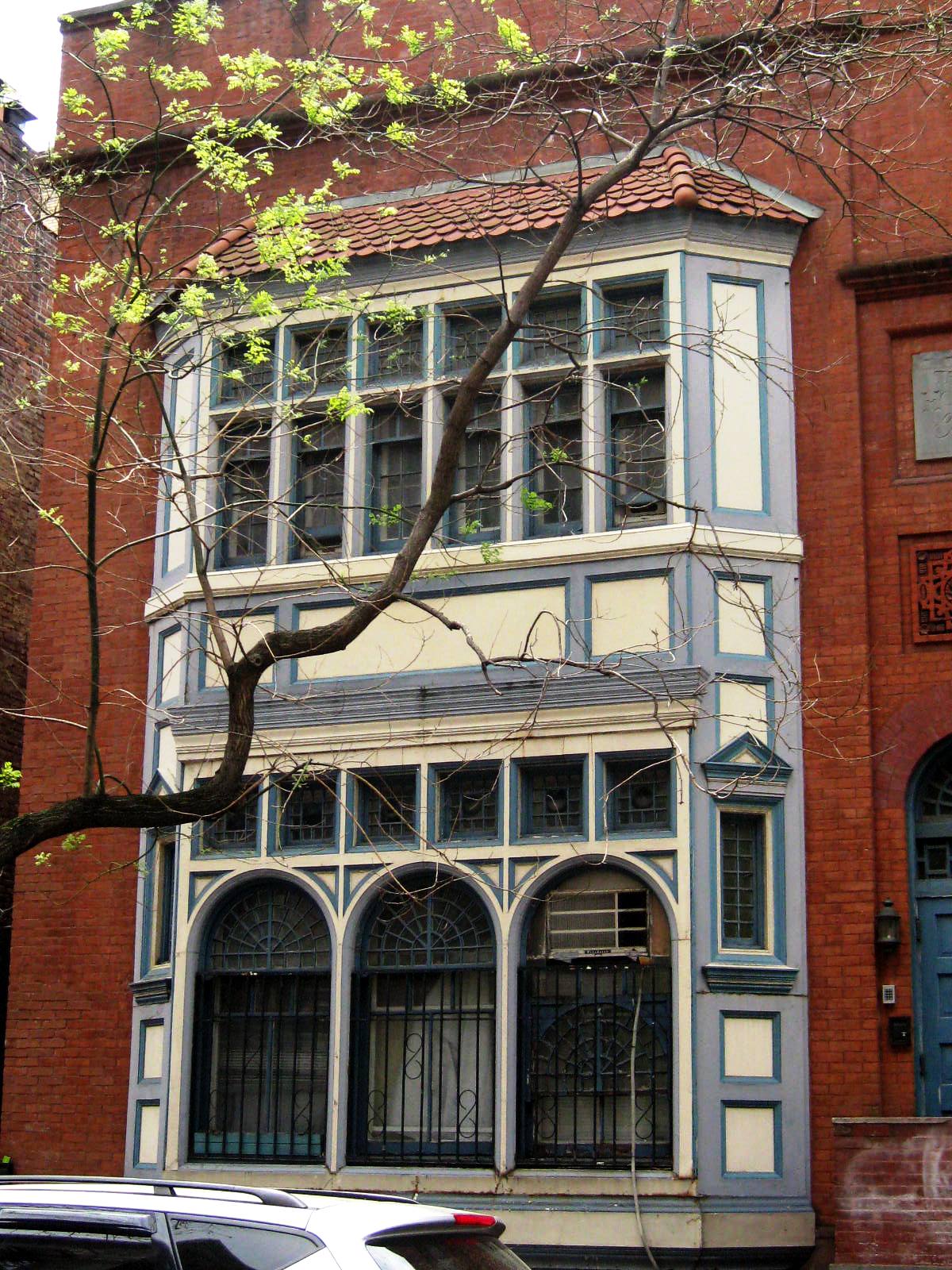
Today the two-story oriel with its fish scale tile roof and interesting angles and quirks still demands all the attention.
For a full century, until 1951, the House of Industry continued its mission at No. 120 West 16th Street; what William Howe Tolman called in his 1902 “The Better New York,” “…not to give charity, but work.”  That year the institution merged with the Greenwich Village settlement house, Greenwich House and its focus changed to the needs of aged residents of Chelsea and Greenwich Village.

A Jewish charitable organization purchased the building in the 1950s.  In 1977 it leased it to the State of New York which subsequently purchased the property a decade later.  Today the New York State Office of Mental Retardation and Developmental Disabilities operates a residence for the not-for-profit Young Adults Institute here.  The YAI Network provides opportunities to people with developmental disabilities and their families—continuing the original purpose of the remarkable Queen Anne style building:  providing hope to the less fortunate of New York City.

non-credited photographs taken by the author

The 1902 Breese Carriage House -- No. 150 E 22nd Street

photo by Alice Lum
The wealthy Breese family traced its roots in America to English-born Sidney Breese who died in 1767 and was buried in Trinity Churchyard.  Eloise Lawrence Breese could count among her ancestors Judge Breese, who served in the Continental Army.  Her mother, the former Mary Louise Parsons, was a cousin of Hamilton Fish.

Eloise inherited her mother’s unconventional independence.  In 1893 the New York Timesnoted that only two women “in this part of the country” were eligible as yacht owners.  One of them was Mrs. William L. Breese “who owns the sloop Eloise.”

The Breese family lived in a wide, comfortable home at 35 East 22nd Street in the fashionable Madison Square neighborhood.  Next door at No. 33 lived Mrs. Elizabeth B. Grannis, a self-appointed combatant against sin.  Mrs. Grannis was president of the Woman’s Social Purity League as well as president of the National League for the Protection of Purity.  In December 1894 her search for sin would place her squarely in the social territory of Eloise Breese.

The unmarried Eloise—she preferred that the press referred to her as Miss E. L. Breese—took her own box at the Metropolitan Opera house.   Her Grand Tier box, number 43, was near those of Isaac Fletcher, Joseph Pulitzer and Charles Gould.  Women’s evening fashions in the 1890s included elegant off-the-shoulder evening gowns with plunging necklines.  Known as décolletage, the French fashion was shocking to some Victorian minds.

Virginie Amelie Avegno Gautreau posed in decollatage for John Singer Sergeant's portrait titled "Madame X" --http://www.metmuseum.org/Collections/search-the-collections/20012492

The Evening World reported on December 1, 1894 that Mrs. Grannis lately “has been engaged in seeing for herself just how wicked New York really is.”  Having visited (escorted by her brother, Dr. Bartlett) “nearly all the dance and concert halls, theatres, joints, missions and dives in this city,” she turned her focus to the Metropolitan Opera and its wealthy patrons.

Mrs. Grannis took an Evening World reporter in tow and explained the Purity League’s plans to abolish the décolleté dress.  “What we want to do is to call public attention to the evil, and by this means to shame people into dressing differently.”  She admitted,when the reporter said that judging from the Metropolitan audience “Mrs. Grannis’s idea cannot be said to have borne much fruit,” that it would take time.  She blamed the absence of social purity on two forces.  “One reason is the décolleté dress; the other and greater is the round dance.”

Mrs. Grannis approved of “a modest square dance like the lanciers or the minuet,” but waltzing “and every other form of round dance is, per se, sinful.”

The equally strong-minded Eloise Breese disagreed.  And the two women would make their differences known repeatedly.   While the social reformer railed against the high fashion of the young socialite and her wealthy friends, Eloise frequently complained to authorities about “smells” coming from the Grannis home.

Following her father's death and her mother's remarriage and move to England, the independent Eloise was a marked feature among New York society.  In 1901 she commissioned Sidney V. Stratton to design a private carriage house at No. 150 East 22ndStreet, a few blocks to the east of her home.   Private stables were as much a reflection of one’s social status as his home and carriages, and Eloise’s would not disappoint.  Stratton designed it in the Flemish Revival style that had been popular, especially on the Upper West Side for over a decade.
The stepped gable harkened back to Manhattan's Dutch roots -- photo by Alice Lum
The style reflected New York’s Dutch beginnings and the Breese structure featured the expected stepped gable.  Stratton placed the two-story structure on a limestone base and trimmed the warm Roman brick with limestone.  A spreading peacock tail of oversized voussoirs highlighted the double carriage doors and the three upper openings visually became one by the introduction of an encompassing, limestone trimmed blind arch.

Like her mother, Eloise sailed her own yacht.  The Elsa flew the burgee of the New York Yacht Club—a highly unusual accomplishment for a woman at the time.   Although Eloise summered mostly in Tuxedo, where she maintained a sprawling mansion, the Elsa was often found moored below the cliffs of Newport.  Captain C. M. Toren skippered the craft for years.

As Eloise’s carriage house was being completed, she sailed the Elsa to Newport to participate in the July 30, 1901 harbor fete in honor of the North Atlantic squadron.  Admiral Higginson’s fleet was assembled in the harbor and a full day of activities—including a exhibition of the submarine torpedo boat Holland—was planned.

The New-York Tribune noted the following day that “the principal event was the illumination in the evening…The most picturesque sight was in the harbor, where the illuminations were on a most gorgeous scale.”  The yachts were all lit “brilliantly” and the newspaper pointed out that the Elsa was one of “the most attractive ones.”

A dramatic sunburst of voussoirs caps the carriage entrance -- photo by Alice Lum

In 1902 Eloise L. Breese had had enough of her pious next-door neighbor and she purchased the Grannis house “with the understanding that it was to be pulled down,” said The Sun.   But she had second thoughts and once the social reformer had moved out “the temple of social reform and universal peace has been turned into a boarding house,” reported the newspaper later.

The rooms where Mrs.Grannis had held meetings of other virtuous women and church leaders were now decorated by Eloise “in the highest form of boarding-house art with bows and arrows of primitive peoples and the heads of savages in war paint.”

But she wasn’t done yet.

In May 1903 Eloise sued Elizabeth Grannis for $249 saying that “when she moved out, [she] took with her a bathtub and the chandeliers.”

Mrs. Grannis appeared baffled and unruffled.  “How silly,” she told reporters.  “Think of going to court for just one little bathtub.  It is my personal, individual tub.  Of course I took it with me.  I told  them I was going to, but offered to sell it to them with the chandeliers.”

The reformer complained that the Breese family had always been a problem.  “What a flibberty-gibberty commotion it is.  I lived beside the Breeses eighteen years and never met them, but they were forever sending in to complain of smells they thought they smelled and to see if there wasn’t a fire or a leak or something in my house.”

The feud between the former neighbors would eventually die away.   In November 1906 Eloise married Adam Norrie.  Upon her death on January 28, 1921 she added significantly to the collection of the Metropolitan Museum of Art by bequeathing two important paintings, one by Rousseau and another by Corot (his “The Wheelwright’s Yard on the Bank of the Seine”).  Even more importantly, she left the museum the incomparable 17th century Audenarde tapestries representing the history of the Sabines.

The Breese carriage house, no longer needed by Eloise after her marriage, was converted almost immediately into the headquarters of the New York Association for the Improvement of the Poor.  It underwent another renovation in 1923 when it became a bakery.

A decade later, with horses having been replaced by motorcars, the building was once again converted.  Still owned by the Breese Estate, it now had an apartment on the upper floor and “storage for four cars” at ground level.  In February 1935 Raymond C. Phillips leased what The Times called “the modern two-story garage” from the estate.

In the mid-1940s retired police officer Thomas A. Smith lived upstairs.  On July 24, 1948 the 63-year old was driving along West 25th Street when a 7-year old girl, Gloria Maracamo, darted into the path of his car.  The driver was so upset that as he tried to tell police what had happened thirty minutes later, he collapsed with a fatal heart attack.

By the second half of the 20th century the carriage houses along the block had been demolished for apartment buildings—except for Eloise Breese’s.  In 1965 the anachronistic little building was being used as an “architect’s fine arts studio and office” along with parking for two cars on the ground floor, and a one-family apartment above, according to Department of Buildings records.

A single-family, glass-walled mansion incorporates Eloise Breese's carriage house remains into its facade.  (The early 20th century apartment building next door mimics the old roofline.) -- photo by Alice Lum
Then in 2006 change came to No. 150 East 22ndStreet.  The rear wall was shaved off and a modern, glasswalled residence constructed behind.  The 5,200 square foot single family house preserved the façade of the Breese stable; but at a significant cost.  The AIA Guide to New York City called it a “nice deal for the developer’s bank accounts; lousy deal for landmarks preservation.”