.

Showing posts with label new york church. Show all posts

Monday

The 1876 Christ & Saint Stephen's Church -- 129 W 69th Street


When the Church of the Transfiguration, fondly called The Little Church Around the Corner, commissioned William H. Day to design an uptown chapel, the architect obviously took inspiration from Transfiguration’s charming 1848 building on East 29th Street.

That structure, designed by F. C. Withers, was described by some as “a holy cucumber vine.” It’s low, country architecture recalling a rural English parish church. Likewise, while perhaps not quite as picturesque, Day’s Transfiguration Chapel, sitting back on a broad lawn, presented a pastoral image oddly out of place on busy West 69th Street.

Completed in 1876, Transfiguration Chapel was intended to serve the church’s parishioners who moved northward, out of the Murray Hill area. The long, low building with its many peaks and gables, its clay tile roof and unassuming bell tower was an obvious extension of the Little Church Around the Corner downtown.

Although the chapel was successful, by 1897 Transfiguration sought to sell its uptown outpost. On March 17 The New York Times said “Various reports have been circulated recently as to the future of Transfiguration Chapel, at the Boulevard and Sixty-ninth Street, and Protestant Episcopal church circles in the diocese are wondering what will be the future of this interesting adjust to the up-town work of ‘The Little Church Around the Corner.’”


The article mentioned that St. Stephen’s Church on 46th Street was interested in the property, valued at around $60,000. St. Stephen’s congregation had outgrown its building; yet there were stumbling blocks to be overcome. The parish of Transfiguration Chapel ardently wished to keep their home and was attempting to raise the money to purchase it from the mother church. In addition, the neighboring Christ Church, two blocks away, was defiantly opposed to the sale to St. Stephen’s.

“It is contended that there is not room in that district for two churches of the same type of churchmanship,” said The Times. “Both are classed as exponents of the Low Church wing, while the present Transfiguration Chapel belongs to the High Church order, and would, naturally, draw to itself only people of its own way of thinking in the neighborhood.”

The bickering between the church groups was closely followed by the press for weeks, until at last St. Stephen’s won the right to purchase. The congregation hired architect J. D. Fouquet to carefully remodel the building with respect to Day’s original design. Their first service was held on October 3, 1897.

Relations between St. Stephen’s and its neighbor, Christ Church, remained strained and in 1905 Christ Church sued St. Stephen’s for infringing on parish boundaries. The suit was dismissed and the two churches continued in their tense coexistence.

Ironically, it was hard times that brought the two groups together in the 1960s. When John D. Rockefeller III built Lincoln Center, he used eminent domain to demolish seventeen residential blocks, displacing over 7000 families. At the same time maintenance costs for the church buildings increased. With decimated congregations, higher overhead and reduced income, the two parishes realized the necessity to merge.

In 1975 they became Christ & Saint Stephen’s Church. After nearly a century their uneasy truce became a marriage.

Structural deterioration resulted a ceiling collapse in 2004 which necessitated a total demolition of the ceiling. A complete restoration of the interior then ensued. In the process, original 19th Century stenciling was discovered which was restored in sito and replicated elsewhere in the interior.


The quaint little church still sits behind its low stone wall like a slice of English countryside dropped among Manhattan high rises; a picturesque and surprising treasure at 129 West 69th Street.


Tuesday

Richard Upjohn's 1851 Trinity Chapel -- The Serbian Cathedral of St. Sava

Photo OrthodoxHistory.org

It was, as The New York Times called it in 1914, “distinctly fashionable to be married there, it was eminently respectable to be buried from there.

Here were married Rhinelanders and Gardiners. Edith Wharton walked down the aisle here. Between 1887 and 1895 there were three Astor funerals – Mrs. John Jacob Astor, William Astor and Mrs. William Waldorf Astor.

When former senator Roscoe Conkling died from exposure, having gotten lost in the Great Blizzard of 1888, the church was filled with United States Senators for his funeral. Six years later esteemed justices filled the pews at the funeral of John Jay.

Indeed, the Episcopalian Trinity Chapel on West 25th Street near Broadway was both fashionable and respectable.

The church was designed in 1851 by Richard Upjohn who, by now, had established a lofty reputation in New York with his Church of the Ascension and the rebuilding of Trinity Church starting in 1839. Pleased with his work, Trinity called upon Upjohn to produce a northern outpost – a “chapel of ease” - as the population spread from downtown. George Templeton Strong noted in 1848 that “The tide of uptown emigration has left the church and its present chapels almost bare of parishioners.”

Spending $30,000 on land, the church provided the architect with a plot extending from West 25th street through to West 26th Street; the scope of which he used tofull advantage. Upjohn’s Gothic Revival chapel filled the site, resulting in an interior space of unusual and impressive length of nearly 180 feet. The architect was responsible for the interior decoration as well – the stained glass windows, the polychrome tile floor, intricately carved beams and knee brackets. Light-colored French Caen stone faced the walls and touches of color outlined the truss work above.

"Chanel of Trinity Chapel, New York" by John William Hill, 1856.  Metropolitan Museum of Art

In 1866, Jacob Wrey Mould designed the enchanting Parish House in the rear at 16 West 26th Street and, in 1870 the Trinity School was erected next door. The buildings created a picturesque and romantic complex.


In the late 19th Century the interior was slightly redecorated to include color – 80 feet above the floor, a blue ceiling with gold stars was painted and the chancel walls were intricately decorated. But as the turn of the century passed and the gentry moved further up Fifth Avenue, the congregation waned. Richard Upjohn's magnificent St. Thomas Church with its breathtaking interior by John LaFarge at 5th Avenue and 53rd Street sat conveniently among the brownstone mansions.

In 1914 it appeared that the chapel would be deserted and, quite possibly, demolished.


On January 25, Dr. William T. Manning, rector of the chapel, announced that “The population that the chapel served in the past is moving away in great numbers, and it is no longer possible to carry on efficient church work at this point.”


The New York Times reported that “Probably no tears will be shed over the abandonment of Trinity Chapel.” The newspaper was not being cruel, but frank. “For many years Trinity Chapel was the centre of parish activities and a factor in the development of social New York. But it has long survived its usefulness.”

Although The Times was not enthusiastic about the architecture, saying “it has never been regarded by architects as an interesting or attractive church structure” and projected that Upjohn “probably never thought of making a chapel so far uptown a notable architectural work;” it lamented the potential loss.

Photo by Frances Roberts for The New York Times


“Nevertheless, the abandonment of Trinity Chapel justifies one more sigh over the mutability of earthly things. Why must we go on year after year tearing down our famous old buildings? Are we never to cherish sacred associations?”

And yet the chapel staggered on.

With its limited income, the church made few alterations to the interior until, on April 29, 1940, fourteen murals depicting the life of Christ were dedicated. The work of Rachel M. Richardson, the paintings took ten years to complete.

Yet two years later Trinity Church finally put the building complex up for sale. In 1943 the Serbian Orthodox Church purchased it, establishing the Cathedral of Saint Sava. On March 7 of that year, Rev. Doushan J. Shoukletovich, the rector, conducted the first service for the congregation in their new home. A few years later the exiled king of Yugoslavia, would begin worshipping here.

In 1962 a beautiful oak iconostasis, carved in a Serbian monastery was installed.

Meanwhile, the Communist Party of the United States established their headquarters at 23 West 26th Street, next door to the complex. Anti-Communist terrorism resulted in no fewer than six bombings in the building between 1964 and 1972. One, on September 4, 1966, was powerful enough to blow out the 115-year-old stained glass windows in the apse of the church.

The Cathedral commissioned replacements in the Byzantine style, more appropriate to the Eastern tone of the religion.


By the 1990s, the structure suffered from lack of maintenance. Serious roof leaks resulted in the dissolving of the interior Caen stone walls in some areas and the misalignment of the roof framing. Historic conservator William Stivale was hired to oversee the multi-million dollar restoration.

The Historic Properties Fund of the New York Landmarks Conservancy provided $475,000 while private donations accounted for most of the balance.


The buildings today are a remarkable collection of Gothic Revival architecture. Upjohn’s interiors are nearly untouched, despite their sometimes rocky past.

Thursday

Le Brun's 1887 Church of St. Cecilia --120 East 106th Street


phto st. cecilia parish.com
In 1863 Cardinal McCloskey purchased the plot of land at the northeast corner of 2nd Avenue and 105th Street on which he intended to build a new church. As more and more urban pioneers ventured to the northern end of Manhattan, this Harlem neighborhood was in need of another Catholic parish.

The Civil War interrupted the Cardinal’s plans until a decade later when, in 1873, he appointed Rev. Hugh Flattery to organize the parish of St. Cecilia.  Half a century later “The Catholic Church in the United States of America” would recall that “Father Flattery found the number of his parishioners small and scattered.”

Nevertheless, the priest had a wooden church erected on the land the Cardinal had purchased earlier. On August 230, 1873 the new building, built at a cost of $10,000, was dedicated. The little building served the growing parish for six years until Fr. Flattery resigned.  His successor, Rev. William Flannelly, recognized the need for a more spacious structure and in March 1881 purchased four lots on East 106th Street from Addison and Mary Brown. The residential-sized lots cost the church $25,800; about $565,000 today.

Architects Napoleon Le Brun & Sons were commissioned to design the new structure. Having moved to New York from Philadelphia around 1861, Le Brun busied himself not only with designing several other churches but with the fire houses of the New York Fire Department for which he was official architect.

Progress on the new church, however, crept along. The cornerstone was not laid until September 1883. In an unusual agreement with the pastor, Rev. Michael J. Phelan, (Father Flannelly had unexpectedly died in 1884), Le Brun & Sons drafted the overall designs and ornamental details and laid out the specifications for the construction; however the architects were not to be involved in the construction.

Father Phelan, who would earn the nickname “The Builder of Churches,” insisted on acting as general contractor. He personally contracted the bricklayers, plasterers, carpenters and other builders and oversaw the project. Phelan’s extraordinary ability to handle complex building projects reduced the cost substantially.

Once the basement of the new structure was completed, services were held there until the upper church was finished in 1887. The original frame church had been donated to the parish of the Holy Rosary and was moved to East 119th Street.

The completed church, costing $150,000, is a Romanesque Revival style basilica of textured brick with terra cotta accents. A projecting, triple-arched portico with ten granite columns extends to the sidewalk , above which are seven stained glass windows. Above, is an enormous terra cotta high-relief sculpture of St. Cecilia (the patron saint of music) playing the organ.

Polished red granite columns support the arched portico with its exuberant terra cotta ornamentation -- photo st. cecilia parish.com
Le Brun added to the medieval Italian feel of the church by adding two octagonal towers on either end. Inside the church could accommodate 1,400 worshipers

As the New York subway extended into Harlem in 1900, accessibility to the neighborhood was greatly simplified. By 1914 the parish listed 6000 members and the complex included the church, rectory, a school and convent.

A large terra cotta relief of St. Cecilia playing an organ graces the main gable -- photo st. cecilia parish.com

In 1939 the Redemptionist Fathers took over administration of the church and its facilities who continue to staff it.

Throughout the decades the demographics of the East Harlem neighborhood have greatly changed. Today the population is mainly Puerto Rican and Afro-American. As the parish changed, the church of St. Cecilia has remained an anchor to the neighborhood. The parish website notes that “…although this has been a somewhat transitory neighborhood at times, there have been dramatic and inspiring changes, much of it promoted and spurred on by churches such as St. Cecilia’s, which serve not only as religious body and educator but as a focus for community action as well.”


photo st. cecilia parish.com
The parish has maintained the building, which was landmarked in 1976, in exceptional condition and Napoleon Le Brun’s exuberant brick and terra cotta church looks much as it did when Archbishop Corrigan dedicated it on November 27, 1887.

Monday

The 1903 Church of St. Veronica -- No. 153 Christopher Street


photo by Alice Lum
In 1796, about three decades before the rural village of Greenwich would explode in a flurry of development, the imposing Newgate State Prison was opened at the foot of Christopher Street.  The institution would be abandoned by 1829 and slowly demolished; but the area would little improve.

Further away, respectable Federal-style brick rose along the twisting streets of the Village and on 6th Avenue the elegant Greek Revival St. Joseph’s Roman Catholic Church was erected in 1834 to serve the expanding community north of the city.   But as the century progressed, the neighborhood along the riverfront filled with less comfortable residents.

Irish immigrant laborers were drawn to the area by the low-paying but readily available jobs on the docks and in surrounding businesses.   In 1845 Nash, Beadleston & Co. opened a brewery in part of the old prison, a coal yard appeared on nearby Charles Street along with an iron works, a soap plant and a lime shed.    In stark contrast to the prim homes of the middle class nearer to St. Joseph’s, these families settled in cheap tenement houses.

In the 1880s, as the population continued to increase, the neighborhood was at best seedy and, at worst, dangerous.  At the foot of Christopher Street was Mulqueen’s tavern, opened in 1883 where dockworkers and sailors gathered for stout and malt liquors.  The New York Police Department would later describe the area as “the resort of outcasts, drunkards, dissolute people, and a dangerous class of depredators and petty highwaymen.”

The situation drew the attention of Archbishop Michael A. Corrigan.  St. Joseph’s Church was already overcrowded and the riverfront area was teeming with poor Irish workers.  In January 1887 he created the parish of St. Veronica’s to serve the “6,000 souls” estimated to live there, covering the area bounded by West Houston, Bank and Hudson Streets.

Father John F. Fitzharris, who had been first assistant pastor at the refined St. Joseph’s, was reassigned to lead this new flock in the much less refined neighborhood.   Four months later, on Palm Sunday April 3, the first services were held in what The New York Times called “a temporary chapel in Washington-street.”  The newspaper noted that the “chapel was crowded at all the services.”

The “temporary chapel” was a warehouse-stable building.  Father Fitzharris faced a significant financial challenge in establishing his parish.  He started out with $626 collected from among the St. Joseph’s worshipers on March 27.  Adding to the funds would be an uphill journey.

The old warehouse and stable was costing Father Fitzharris $2,000 per year and he spent $6,000 to convert it into what resembled a church.  The priest elicited donations not only from the neighboring churches—St. Bernard’s, St. Joseph’s and St. Francis Xavier’s; but from as far away as St. Peter’s Church downtown on Barclay Street.

The unrelenting priest collected enough that a year later he was able to purchase property on Christopher Street, between Washington and Greenwich Streets for $69,500.   The cornerstone would not be laid until March 16, 1890, however.   With the impoverished parishioners giving what they could to the building fund, it would be a slow process.   At a time when churches and other substantial buildings were being erected within a year or possibly 18 months, it would be another 13 years before the church was completed.

The congregation worshiped in the basement throughout this time as construction plodded along above their heads, sometimes halting for a year or more while funds were gathered.  The architect chosen for the project was John J. Deery whose home office was in Philadelphia, but who divided his time between there and New York.  Deery had started out in 1875 working under Edwin F. Durang who almost exclusively designed Catholic church projects.   By now Deery worked on his own and, like his mentor, concentrated on ecclesiastical projects—although he would also design the baseball fields for the Philadelphia, Boston and Chicago teams.

Deery’s design for St. Veronica’s would result in a somewhat bulky Victorian Gothic structure of brick and limestone.   What it lacked in ethereal grace it made up for in stocky solidity.  

photo by Alice Lum
Four years after starting his project, Father Fitzharris died, never to see his completed church.  His successor Father Daniel J. McCormick would not live to see the structure either; dying in January 1903.  Finally, on June 7 of that year, sixteen years after the parish was founded, the Church of St. Veronica’s was opened.  The parishioners had good reason to be proud.   Despite having little money, they had raised enough to build a substantial church building.

Much of the money had come from two parish fairs staged by the women—events that often lasted a week or more and included carnival-like festivities like games of change, refreshments, music and entertainments and home-made gifts to purchase.   At one, held in 1880, a featured prize was a full set of bow and arrows and a tomahawk said have once belonged to Rain-in-the-Face, an Indian from the Camp of Sitting Bull.  The two fairs alone had raised over $33,000.

Tenement buildings crowd in against the church building in the early 20th century -- NYPL Collection
The priests of St. Veronica’s would deal with much in the impoverished and mostly illiterate parish.  In 1908 the Greenwich House Papers reported that nearly 50 percent of the fathers of St. Veronica’s students were unemployed.    Alcohol and violence often resulted in tragedy.

57-year old Frank Van Heck lived at No. 76 Morton Street and often visited neighborhood saloons playing his accordion.  On the evening of July 7, 1901, however, he visited friends in the building--Peter Gilleyn and his wife, Mary.  There were also two men there whom Van Heck did not know.  “They were all drinking and having a lively time in Gilleyn’s apartment,” reported The New York Tribune the following day.  Then things turned ugly.

Gilleyn asked Van Heck to play his accordion.  He refused.   The host said “Well, if you don’t do it right quick, I’ll make you.”  To prove his point he produced a club and knocked Van Heck down. Within seconds there was a melee.  The two strangers wrenched the club from Gilleyn while his wife grabbed a pair of scissors and joined in the skirmish. 

When Van Heck saw Gilleyn heading for him with an axe, he bolted out the third floor window.  Father Horrigan of St. Veronica’s rushed to the scene where the man who refused to play the accordion lying on the sidewalk with a broken skull and jaw.   While the two strangers fled, police took Peter and Mary Gilleyn into custody.  Father Horrigan administered last rites on the pavement.

Irish priest John J. Brady was assistant rector of St. Veronica’s in 1916 as the United States’ involvement in World War I seemed imminent.   He left his position to join the Navy, taking a berth on the battleship Arkansas.  Almost immediately after the U.S. entered the war he asked for a transfer to the Marine Corps.   He became the first Catholic chaplain to land with the first American troops in France.

The feisty priest did not wait behind the lines for the injured to be brought back.   He would later be awarded the Distinguished Service Cross for manifesting “utmost disregard for personal safety during the attack of June 6, 1918, in the Bois de Belleau, exposing himself fearlessly throughout the attack, passing up and down the front lines, cheering the men and caring for those who were wounded.”

Fourteen days later he was at it again.  On July 18 at Chateau Thierry he made “two complete tours of the front lines under severe fire and administered to the men under unusually trying circumstances.  He continued to expose himself to mortal danger to carry cigarettes to the men in the line who had no other opportunity to get them.”

Father Brady, a true man of the cloth, did not restrict his attentions to the Allies.  “Chaplain Brady knew the Germans in opposite trenches would need last rites soon,” reported The Sun.  “He assisted in carrying wounded to first aid stations and gave the last rites to the desperately hurt not only of his own command but to dying Germans on the field as well.  It is said that he gave consolation to thirty Germans, but as a patriotic Yankee he drew the line at carrying them off the field.”

On St. Patrick’s Day, 1918, Brady was riding in a jeep with three French soldiers when a shell hit the car.  Everyone except the priest was killed.  In a letter to his mother, Father Brady said that “the blessed Irish Saint” must have been with him.


For some reason the red brick has been painted red and the white limestone has been painted white.  photo by Alice Lum
On the morning of September 19, 1926, the new Bishop John Mitty celebrated his first pontifical mass.  He did so in the Church of St. Veronica’s.  Mitty had attended church here as a boy and then, having become a priest, celebrated his first mass here.  He felt it appropriate to begin his elevation in the friendly surroundings of his old church.

Among the messages of congratulation was one from Gene Tunney, challenger for the world’s heavyweight boxing title.  “The message expressed Tunney’s regret at not being able to attend the services,” reported The New York Times.   The Irish fighter was a member of the congregation and had graduated from its school in 1911.  The parish was proud of its newly-famous member, although the pastor, Rev. Patrick H. Drain, had to tip-toe around the prize-fighting issue.

“No, the Catholic Church is not opposed to prizefights as long as they are conducted in a legitimate way,” he told a reporter.  “Pugilism in the past was conducted in a ‘rough-neck’way, but now it is becoming elevated by Gene Tunney.  He is a man of high moral character.  He is a good Catholic.  He often comes to mass here on Sunday when he is in town.  He likes to be known as a ‘Greenwich Villager.’”

Tunney’s prizefighting was also a potential source of revenue.
There was still a substantial debt owed on the church building in 1926 and, therefore, it had never been consecrated in its 23 years of existence.   Father Drain was determined to erase the $279,000 mortgage and in his fund-raising sent a letter to Tunney asking if he would care to help the parish.

Just before Tunney’s reply came late in September 1927, the money had all been raised.    When Father Drain opened the envelope from the prize fighter, he found a check for $1,000 “to help the church in any way you see fit.”  With the mortgage paid, the priest decided that “what would help the most just now was to paint the rectory inside and outside,” said The Times.

With a new paint job supplied by Gene Tunney, the Church of St. Veronica’s was finally consecrated by Cardinal Hayes on November 27, 1927.   The cardinal reflected on the 12-year effort to erase the debt saying “I want to say publicly that this is an accomplishment which will go into the records of this archdiocese and that it will be recorded in letters of gold.”

In April 1930 a memorial tablet was unveiled in honor of the deceased war veterans of the parish.  It was a gesture that would hauntingly foreshadow another memorial decades later.

photo http://catholicmanhattan.blogspot.com
By the 1970s the neighborhood that had once been home to poor, hard-working Irish immigrants was the center of New York’s gay culture.   Christopher Street was synonymous nation-wide with the Gay Rights movement and bars and shops catering to homosexuals lined the street from 6th Avenue to the Hudson River.    The congregation of St. Veronica’s was now a broad mixture of ages, races and sexual orientation.   Gay groups met in the basement of the church.

But the AIDS epidemic would change the complexion of Greenwich Village forever.

As more and more men became ill and died, the light-hearted atmosphere of Christopher Street plunged into despair and fear.    By the mid 1980s hundreds of Village residents were dying every year and the Catholic Church was viewed by many as an enemy.   Cardinal John O’Connor declared that there would be no talk of condoms in his “jurisdiction,” although it was widely known that the use of condoms would prevent the spread of AIDS.  At the same time he ousted the gay group Dignity from a Manhattan church where it held its weekly masses.

O’Connor was confused when he gave AIDS patients “the smile I am told does wonders on television,” only to be turned away.   But when it appeared that the cardinal was blind to the needs of one part of his flock who felt shunned by their church he did a remarkable thing.

O’Connor reached out to Mother Teresa for help.   The nun sent a staff of her Missionaries of Charity to New York to establish the Gift of Love Hospice in their converted rectory of St. Veronica’s.   The nuns, in their iconic blue-and-white habits, became a comforting and familiar presence along Christopher Street.   The small house could shelter only 15 AIDS victims, but the nuns worked tirelessly caring for the dying men.

In June 1993 the AIDS Memorial in the Village was installed in the balcony of St. Veronica’s church.   It consisted of brass plaques with the names of Villagers who had succumbed to AIDS.   There are over 1,000 of them.  Every year during Gay Pride week, St. Veronica’s holds an interfaith service to remember the victims of the devastating epidemic.

photo by Alice Lum
The Archdiocese of New York converted the church to a chapel of Our Lady of Guadelupe/St. Bernard’s Church on West 14th Street in March of 2006.   Now formally titled the Mission of Our Lady of Guadalupe, no one calls it that.   To New Yorkers and, particularly, Greenwich Villagers, it will always be St. Veronica’s.

Sunday

Mary, Help of Christians Church -- 440 East 12th Street

photo by Alice Lum
On April 21, 1931 a solid silver casket which the undertaker said had cost $15,000 was removed from the penthouse home of Giuseppe Masseria at 15 West 81st Street.  Sixteen automobiles were necessary to transport the floral tributes and 69 cars followed the hearse in the funeral cortege.  The shining black cars moved through Manhattan from the ritzy Central Park neighborhood to the humble streets of the East Village and the Italian church of Mary, Help of Christians.

Masseria was best known as “Joe the Boss,” an underworld kingpin who had been shot down in Coney Island a few days earlier.   Undercover detectives mixed in with the mourners inside the church.  Three priests celebrated a solemn requiem mass in the sanctuary laden with flowers – most of which were from anonymous donors.  One exception was a heart of roses with a silk ribbon bearing the initials A. C.   It was from Alphonse Capone.

The church was not an overly-ornate one, nor was it a high-profile, important church among the New York Roman Catholic parishes.  It was however, integral to the Italian community.

As the turn of the century approached, the Lower East Side was filling with Italian immigrants.  In 1898 Archbishop Corrigan, cognizant of the need for increased spiritual guidance for the Italians, invited three Salesian Fathers from Italy to come to New York.  Initially they took charge of St. Brigid’s Parish.   But by 1906 the burgeoning Italian population required an additional parish.   Two houses on East 12th street were purchased; one to be used as a rectory and Sunday school, the other as a chapel.

On July 8, 1908 the mission was elevated to the parish of Mary, Help of Christians.  A new church was now necessary in the midst of the Italian community.

The Catholic Church already owned land in the area.  It was the Roman Cemetery of the old St. Patrick’s Cathedral.  Among the 41,016 graves here was, oddly enough, that of Lorenzo da Ponte, Mozart’s librettist who was responsible for “Don Giavanni,” “Cosi fan Tutte” and “The Marriage of Figaro.”  Da Ponte had come to the United States in 1805, fleeing debtors, and was buried here on August 20, 1838.

The coffins in the Roman Cemetery were exhumed in 1909 and reburied in Calvary Cemetery.  There was now land for the new church.   In 1910 the basement was excavated.  Six masses were celebrated here every Sunday and one in the chapel.

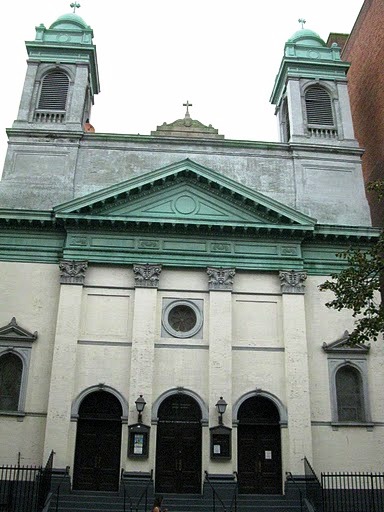
Plans for the new church were filed by Domenico Briganti in 1911.  It would be a Florentine-inspired structure, nearly flat-faced, with two short towers on either end capped by domes.  Four shallow Corinthian pilasters would separate the three arched entrances and support a classical closed pediment.

Despite the enormous number of Italians being served by Mary, Help of Christians—according to the 1914 “The Catholic Church in the United States of America” there were 20,000 congregation members (“mostly Sicilians”)--it would not be until six years later, at 4:00 in the afternoon on July 15, 1917, that the cornerstone was laid for the new structure.  Mgr. Michael J. Lavelle, rector of St. Patrick’s Cathedral, officiated the ceremonies.

The zealously religious Italian congregation nearly caused a riot in September 1923 when they were refused permission by police to process through the streets with a statue of St. Rosalia on her feast day.  The New York Times reported that about 2,000 Italians “then marched to the rectory in Twelfth Street, near Avenue A, to demand that the church get them a permit.”  The newspaper related that the police arrived “just in time” to prevent a melee.”

A young man parks his impressive-looking car across from the church in 1920 -- NYPL Collection

Three years before Joe the Boss would be buried from Mary, Help of Christians, the gangland funeral of 21-year old Charles de Luco was held here on July 18, 1928.    Police watched vigilantly for the racketeer’s brother, Dominick de Luco, who failed to appear.  Nonetheless The Times reported that “gangdom was well represented at the funeral.”

The church was always much more than merely the movie-like scene of gangster funerals.  It was the spiritual home to a multitude of pious immigrant families.   On the feast day of Mary, Help of Christians in 1933, “several thousand residents of the east side Italian colony participated in ceremonies,” as reported in the newspapers.

On March 19, 1935 the parish had a scare when the church caught fire during mass.   Most of the worshipers were women and many had knelt before the altar of the St. Joseph’s Chapel prior to services to light candles.  Father Peter Pelegrino was serving communion later to 50 persons and the heads of the other parishioners were bowed in prayer.  No one noticed the lit candle fall from its holder in the chapel.

By the time sexton Jack Gulino noticed the blaze, it had engulfed the tapestries and embroidered altar cloths.  The flames caught the wax flowers that wound around a five-foot wooden arch that framed the statue of St. Joseph.  The flammable wax melted and spread the flames fifteen feet upward.

While Gulino and ushers attempted to beat the flames with their bare hands, the pastor, Father Paul Zolin instructed the women in their pews to remain calm.   The priest then helped pry the wooden frame loose.  Gulino and the ushers hauled the flaming arch to a backroom to stamp it out.  The statue of St. Joseph crashed to the floor and smashed.

Father Zolin again instructed the 200 women who were clustered around the chapel to return to their pews.  Services continued outside.

One of the interesting congregants of Mary, Help of Christians was “Mr. Valentine.”   His profession was collecting sounds for photograph records, Broadway shows, motion pictures and such.  When Lord & Taylor Department Store needed church chimes for their Christmas window display in 1940, Mr. Valentine obliged.   “I could have used Trinity or one of the big churches, but I’m loyal to my own parish.  The Lord & Taylor bells you heard were the chimes from Mary, Help of Christians Church on Twelfth Street,” he told a reporter.

By mid-century the Italian population was thinning out in the 12th Street area.  The four-story convent on East 11th Street, no longer necessary, was converted into apartments.  But it was not the end of the line for the church.  Not yet.

In 1953 Sara Delano Roosevelt, granddaughter of the late President Franklin D. Roosevelt was married.  She had fallen in love with Anthony di Bonaventura, the son of a 17th Street Italian barber.  The couple chose not to be married in a society church, but in di Boneventura’s family parish of Mary, Help of Christians.   Although the ceremony was small with only a few friends and relatives invited, East 12th Street was crowded with over 2,000 people from the tenement buildings who longed to get a glimpse of the unlikely couple.

The New York Times said the newly-weds posed for photographs “on the steps of the dingy, old-fashioned brick church, as the air rang with cheers and flurries of torn paper were flung from windows, fire escapes and roofs of the tenement façade opposite.”
By the 1970s the neighborhood, never an upscale one, saw an increase in crime.   The church was broken into three times within three months in 1973, the thieves taking the money from the poor boxes.  The neighborhood was also luring artists and poets.   In his “May Days 1988,” poet Allen Ginsburg described his view of Mary, Help of Christians from the window of his tenement apartment across the street.

In January 2007 the Archdiocese announced that the church of Mary, Help of Christians would be closed.  In an odd statement in his press release, Fr. James Heuser wrote “Communities and institutions, like persons, have a lifecycle.  By all accounts, Mary Help of Christians Parish has had a good run.”

Josephine Ruta and her sister Margaret, doubtlessly disagreed.    The women had lived in the same tenement building for over 80 years and had known only one church:  Mary Help of Christians.

But the "lifecycle" of the church had run its course and on May 20, 2007 the last mass was celebrated.  The lights were extinguished and the doors locked.  Inside, where Mafia funerals and a Roosevelt wedding had taken place, dust settles on the altar and pews.

photo by Alice Lum

The church sat vacant for six years.  Then early in 2013 the property was purchased by developer Douglas Steiner of Steiner Studios as the site of a luxury residential and retail structure.  Concerned local residents and preservationists appealed to the New York City Landmarks Preservation Commission to intercede.  Despite the historic significance of the church, the 150-year old rectory and the 90-year old school building, the Commission declined.

The developer, simultaneously, refused to consider recycling of the venerable structures.  Andrew Berman, Executive Director of the Greenwich Village Society for Historic Preservation pointed out "A smart developer would recognize that by preserving and re-using these historic buildings and b uilding on the large adjacent yard, he would not only be doing a good deed, but creating an infinitely more unique and valuable development than simply bulldozing the entire site and starting anew."

In May 2013, even as demonstrators rallied outside the church steps urging its preservation, another historic fragment was uncovered in plain sight.  An ancient stone wall, typical of those the protected early New York burial grounds runs between West 11th and West 12th Street; quite possibly the surviving wall of the old Roman Cemetery that predated the church.  It is yet another historic structure that would be erased by the planned development.

Although the dignified façade of Mary, Help of Christians, looks as fresh and maintained as it did a century ago, its future is uncertain.  Even in a time of improved architectural and historic appreciation, this integral page in the history of the Italian community in Manhattan may soon be obliterated.

Saturday

The First Hungarian Reformed Church - 344 East 69th Street


Not until after the unsuccessful Hungarian Revolution of 1848-1849 did the first Hungarians immigrate to New York City. This new addition to the city's diverse population heartily welcomed the revolutionary Louis Kossuth when he visited Manhattan in December of 1851 to rally financial and political support for his cause.

In the 1870’s, however, over 10,000 Hungarians had settled in Manhattan in, for the most part, two 2nd Avenue neighborhoods: between 1st and 10th Streets, and between 55th and 72nd Streets. New York historian Konrad Bercovici wrote “The houses of the Hungarian district in New York are more or less of the modern tenement type...It is within that the homes are different from the houses of the people of other nationalities...It is in the kitchens of these houses, spick and span, [that] one can notice the differences of national character. Love of good food, spicy and tasty, is one of the characteristics of the Hungarians."

Thousands more crushed into the Hungarian neighborhoods and by 1910 estimates of the population ranged from 76,625 to over 110,000.

In 1895 a small group founded The First Hungarian Reformed Church, or New York-i ElsÅ‘ Magyar Református Egyház. Their charming three-story edifice with central bell tower at 121 East 7th Street was reminiscent of a rural church.

As the Lower East Side became increasingly congested, more and more Hungarians migrated north to the Yorkville section of the city -- of which Random House's Depression era "New York City Guide" would write "The Hungarians, in the upper seventies, aid in giving Yorkville its Central European atmosphere.  The Hungarian daily, Amerikai Magyar Nepszava, is found on the newsstands in this vinicity; Tokay wine is featured in the liquor stores; and in the delicatessens are sold goose livers and the famed Hercz, Pick, and Drossy salamis from Budapest.  The Hungarian cuisine is noted for its variety and savory sauces; in this neighborhood, particularly on East Seventy-ninth Street between First and Second Avenues, are many restaurants whose specialities are chicken paprikas, rostbraten, and strudel."

In 1914 the congregation opted to build a new church on a plot purchased at 344 East 69th Street. Hungarian-born architect Emery Roth was commissioned to design the structure.

Roth would go on to design some of Manhattan’s most memorable Art Deco apartment buildings; however for The First Hungarian Reformed Church he drew his inspiration from his homeland. Combing traditional Hungarian styles with Vienna Secessionist touches he created an unpretentious but strikingly unique facade. Completed in 1916 at a cost of $22,000, the facade incorporates brick, tile, stucco, tile and limestone. Dramatically punching through the deeply overhanging eaves is an 80-foot bell tower.


The First Hungarian Reformed Church, while quaint and charming, was home to no-nonsense worshippers with a decided purpose. Reverand Zoltan Kuthy, the pastor who dedicated the new structure, would go on to be one of the most active and influential figures in Hungarian-American Protestantism. A successor, Reverand Laszlo Gerenday, became pastor after having served with the French Foreign Legion; and later the Reverand Imre Kovacs would lead fervid demonstrations against the Communists, protesting Soviet control over Hungary and the loss of basic human rights in his homeland. On July 9, 1944 the congregation held a special service exclusively to protest the treatment of Jews in Germany.

At a rededication ceremony on December 31, 1930, Hungarian sculptor Janos Horvay presented the church with three bronze tablets that were originally to be installed in the Kossuth monument on Riverside Drive.

Although the population of the Yorkville neighborhood is no longer predominantly Hungarian, the services at the First Hungarian Reformed Church are still conducted solely in the native language. The building was listed on the National Register of Historic Places on August 31, 2000.

Thursday

The 1887 Knox Chapel (St. John the Martyr Church) -- 259 E. 71st Street


In March 1887, the Knox Presbyterian Church moved into its new chapel and Sunday school room.  The new congregation – only two years old at the time – was moving swiftly to erect a formidable church building at the corner of 72nd Street and 2nd Avenue and the new chapel was the first completed step.

The group intended to make a splash with its projected church structure.   It commissioned the highly-popular architect Robert Henderson Robertson to design the building and spent $65,000 for the valuable corner lot.  Robertson was widely-known for his Romanesque Revival works which were currently all the rage.

Robertson’s sketches laid out a complex of connected buildings with a delightful jumble of roof peaks and angles.  Heavy stone arches of rough-cut brownstone would be supported by polished granite columns and an eye-catching 125-foot bell tower would dominate the corner.  A handsome roof of “red Akron tiles,” would cover the entire complex, as reported in The Real Estate Record and Guide.

Robertson's sketch for the church and chapel, as published in 1888 in American Architect and Building News
The completed chapel and classroom building was finished at a cost of $25,000, not counting the $40,000 lot, and was, as The New York Times reported on the day after opening, “paid for.”  In addition to the chapel area, there was a lecture room, library, and class rooms; all “furnished in hard wood and well arranged.”   The little chapel could comfortably seat only around 700 worshipers.

For some unknown reason, the arrangement of the chapel and Sunday school building were flipped from Robertson’s original sketch – like a reversed photo negative.

A year later hopes were still high that construction on the main church would be moving along.  The Times reported on February 27, 1888 that “It is expected that the church will be built and ready for use some time next year.”

It was not to be.

Another year passed and on March 10, 1889 the Rev. Dr. David G. Wylie, pastor of Knox Presbyterian, praised his congregation for their work and reminded them of their growing numbers which now amounted to 300 members.  “The Pastor made a strong appeal for a new church edifice,” said The Times.

Yet the new edifice would not be built.  The popular Dr. Wylie left Knox Presbyterian in 1891 and turmoil among the members regarding his replacement resulted in a schism.  A meeting on April 29 in the lecture room was called by The Times “a crowded and stormy one.”  The tone of the meeting was summed up in the newspaper’s relating “Dr. Moorhead then took the floor and poured hot shot at the committee until the Moderator compelled him to keep quiet.”

A substantial number of influential congregants resigned and the new church building which once seemed so close to realization was again tabled. 

The church struggled on, although by 1903 the physical appearance of the chapel was less than pristine.  The New York Times noted on July 20 that “from its battered front one would suppose religion were unpopular in that neighborhood.” 

The church was finally sold in 1904 for $39,000 to the newly established St. John the Martyr’s Bohemian Catholic church.  The parish had been established in 1903 and had been worshiping in a house on East 71st Street purchased by Archbishop John Cardinal Farley.  The neighborhood had earned the nickname “Little Bohemia” by now as middle-European immigrants settled in the area.

In celebration of its new home the church received impressive gifts.  The Maschek von Masburg family donated a set of 10 bells; a painting, “St. John Nepomucine,” by Alphonse Mucha was valued at $50,000; another, “Three Martyrs,” by Zimmerman was priced at $40,000.  Another painting, “Mary Magdalen,” by Albert Marx had won first prize at the Vienna Exposition of 1875 and was on its way from Prague and cost the donor $100,000.

At the dedication and blessing of the bells in December, Monsignor Lavelle commended the Rev. Father Prout, pastor of the new parish for “making a beautiful church out of one which only two months ago was a Presbyterian Church.”

Also given to the church were more than 60 holy relics donated by priest who had obtained them from “a noble family in Rome.”  The supposedly miraculous objects were said to include a fragment of the cloak worn by St. Joseph; pieces of bone from 55 saints including St. Stephen the Martyr, St. Patrick, St. Anthony and St. John the Baptist; a piece of the true cross; small splinters of the table from the Last Supper; parts of the sepulcher in which Christ was laid; and a piece of the rope from the scourging of Christ.

Scandal ensued when the relics, some of which were housed in gold cases, were loaned by Father Prout to Msr. Lavelle in 1911.  The relics were reported to have been the cause of “some wonderful cures” in January of that year.  “Sores were healed, swellings reduced, deformed limbs made normal, and weak eyes made strong, and so the people set great store by them and came to the church in large numbers to worship while they were there,” said The Times.

Unfortunately, over a year later, St. John the Martyr’s still did not have its relics back.    The parishioners began demanding an explanation and when reporters questioned Mgr. Lavelle he replied “It is none of the public’ business.  I will say nothing, I tell you.  I insist on being excused.”

Despite the loss of the valued relics, the parish continued.    In 1913 there were 408 baptisms and 165 weddings.

In 1921 Thomas Capek in his “The Cech Bohemian Community of New York” said “The Catholics attend the Church of our Lady of Perpetual Help, 323 E. 61st Street, and the St. John the Martyr’s, 254, E. 72nd Street.  The congregations in both churches are mixed (Cech-Irish).”

On January 29, 1949 an unlikely and potentially tragic event unfolded while 37-year old Rev. Vincent J. Campbell was hearing confessions.  As about 20 parishioners waiting in the pews for their turn, a man suddenly stood and drew a rifle from a paper covering and shot through the confessional booth.

The priest was only slightly injured in the leg and the next day the assailant was captured after a gun battle at his $5-a-week room on 69th Street.  Elmer Stanford, whom newspapers described as a “gaunt, haggard man in his middle forties,” was removed “babbling incoherently under the stress of religious mania.”

Robertson's chapel and parish house, with their rough-cut brownstone blocks, are flipped from the original designs.
Little Bohemia is no longer.  As with most ethnic neighborhoods of Manhattan, the concentration of Bohemian residents has been diluted as new generations move on.  But St. John the Martyr’s Church still survives strongly in the chapel of the grand church that was never to be.

non-credited photographs taken by the author