.

Showing posts with label east 20th street. Show all posts

Wednesday

Billy the Oysterman -- No. 11 E. 20th Street


When William Brady began construction of the three-story Italianate rowhouse at No. 11 East 20th Street in 1852, he was a little late to the party.  By now businesses were infiltrating the residential neighborhood between Madison Square and Union Square along Broadway.  No sooner had the brick-faced house been completed in 1853 than tax documents reveal that it housed small shops.

In 1865 the firm of Locke & Craige owned the building.  A year earlier U.S. Congress House Documents documented that the government had paid the firm $721.10 “for a site and building for a post office in the city of New York.”  With the money from selling its building, the company apparently bought No. 11 East 20th.

At some point around 1870 the building got a facelift with neo-Grec lintels over the openings, a pedimented cornice, and a two-story shop front.  By 1900 the neighborhood had become a major shopping district.  That year owner Sarah Hale Witthaus hired contractor James Waddell to install a modern storefront with expansive windows at the second floor.  It attracted a new tenant, furrier Robert Arnold.  On July 1, 1902 Fur Trade Reviewnoted “Mr. Robert Arnold, importing and manufacturing furrier, has removed to exceptionally desirable premises at 11 East Twentieth street, near Broadway.”

The building was sold in 1906 to “an investor.”  Soon Arp Laue signed a 15-year lease on the building for an aggregate rental of $75,000.  The quiet existence of No. 11 East 20th Street was soon to change.

The following year, next door at Nos. 7 and 9, Holtz & Freystedt built an impressive 12-story Beaux Arts building.  The restaurateurs reserved the lower two floors for its French-inspired restaurant. 

In the meantime, German immigrant William T. Ockendorf ran his own restaurant on West Third Street.  Known as “Billy the Oysterman,” he started out small, opening an oyster stand in a basement at Wooster and West Third Streets.  Oysters sold for “a cent a-piece.”  Later he moved his restaurant with its sawdust-covered floors upstairs on West Third Street.  Later The New York Times would reminisce “’Billy the Oysterman’ became an institution known throughout the city.”

In 1910 the man who had started his new life selling oysters for a penny personally walked into the Albany Statehouse to incorporate his business.  He had big plans. 

A year earlier Holtz & Freystedt expanded its restaurant, breaking through the wall to No. 11.  The plan would be short lived, however.  By 1912, with business failing, Holtz & Freystedt abandoned the expanded space.  A year later it closed its doors for good.

As quickly as Holtz & Freystedt evacuated No. 11, Billy the Oysterman moved in.  The New York Times said “The present restaurant of ‘Billy the Oysterman’ offers a sharp contrast with the saw-dust covered floors of the earlier places  It has tiled floors, mounted fish on the walls and expensive furniture.”

The by time Billy the Oysterman moved into No. 11 (lower right) it was already squeezed between towering buildings.  The wall of windows at the second floor and the centered doorway can be seen.  photograph by Wurts Bros from the collection of the Museum of the City of New York http://collections.mcny.org/C.aspx?VP3=SearchResult_VPage&VBID=24UAYWW7A9LU&SMLS=1&RW=1366&RH=631

Billy the Oysterman took up the lower two floors and the top floor was leased to various businesses throughout the years.  Katz & Co., owned by Phil Katz, was here in 1915, according to The American Cloak and Suit Review; and Baumann-Marx Realty Co., Inc. had its offices in the building in 1918.

William T. Ockendorf died on January 20, 1914.  He had amassed an estate equaling over $1 million today “mainly accumulated in the oyster business,” said The Sun on February 1.  Ockendorf left the business to his three sons, George, Harvey and William. 

George Washington Ockendon, the eldest son, took on the sobriquet of Billy the Oysterman.  Like his brothers, he had a public school education and learned the business first-hand.  Despite his sometimes rough-edged demeanor, he was a consummate host. The New York Times remembered on December 11, 1928 “With his brothers, he would personally greet the prominent guests.  Among those who came frequently were Governor Smith, Jack Dempsey, Gene Tunney and leaders of sport, politics and the stage.”

Business flourished, requiring additional staff.  On a single day in 1918 two advertisements appeared in the New-York Tribune.  One read “Kitchenmen Wanted—No Sunday work,” the other simply said “Oysterman—No Sunday work.  Billy the Oysterman.”

George Ockendon not only had a large personality, he had a large physique. The Sun took the opportunity to poke fun at Ockendon’s girth on April 5, 1919 following the auction of actress Marjorie Rambeau’s furniture.

“The big thud on Broadway’s consciousness occurred when Billy the Oysterman, who looks as though he carries a large part of the stock of his restaurant on Twentieth street concealed on his person, bought a huge mahogany chair, formerly the property of Grover Cleveland, with compartments that might be useful before prohibition sets in.  It was whispered that Billy went to the chair—or vice versa—not because he bid $23, but because he was the only one present who could fit its dimensions, Billy breaking the scales at something like 300 pounds.”

The newspaper’s mention of hidden compartments and Prohibition was somewhat foretelling.  The Ockendon brothers had no intention of letting Prohibition put an end to their selling alcohol.  The restaurant’s first brush with dry agents ended with a lucky break.  On April 23, 1921 The Times reported that “Policeman George Chaffers of the East Twenty-second Street Station said he had found three sealed bottles of whisky in a handbag in the apartment of Ockendon at the East Twentieth Street address.”

The policeman did not have a search warrant and Judge Thomas J. Nolan begrudgingly discharged George Ockendon.  Nolan was not happy.  “This testimony opens up another angle of the situation.  The policeman acting under orders is not to be criticised, but the orders seem to be absolutely contrary to law and repulsive to the Constitution.”

Jacketed waiters serve in the handsome downstairs room.  The staircase to the second floor dining room can be seen behind the oyster bar.  photograph Gas Logic magazine, June 1918 (copyright expired)

Billy the Oysterman would not continue to be so lucky.  George used the third floor and basement to warehouse liquor and established a “private bar” in his office for trusted patrons.  On October 24, 1922 Prohibition agents purchased drinks served by waiter Otto Seidt.  The following day they returned, this time with a search warrant.

Eight agents descended on Billy the Oysterman at noon and swarmed over the restaurant.  According to The Evening World later that day, “They discovered ten cases of whiskey and several barrels of bottled beer and ale of unauthorized but strongly verbalized authority.”  The New York Times reported “The total value of the seized goods at the current bootleg prices was given at $5,000” and increased the number of cases of whiskey to 25.

When the agents crashed into the private bar, according to The Times, “A patron…was about to place a glass of whisky to his lips.  The agent snatched it away from him and placed it with the other seized stuff.”

The Evening World said “The patrons of the place showed strong indignation.  Some were unhappy because ‘so much good stuff had to go to waste;’ others were incensed against the management because they had never learned that forbidden beverages were to be had in the place.”

According to the New-York Tribune “A crowd gathered and watched the agents load cases and barrels on a big warehouse truck.”  The newspaper provided a more detailed inventory of Billy’s stash.  “In the seizure were cases of wines, gin, whisky and cordials.  The beer alone was reported to be worth $5,000.  The liquors, including choice wines, were worth probably $5,000 more.”

By now Billy the Oysterman had taken over the former Holtz & Freystedt space as well.  The brothers--perhaps in part because they ignored Prohibition--were doing quite well for themselves.  The restaurant’s 1921 Profit and Loss Statement disclosed that George was earning $19,500 a year, and his brothers $12,000 each.  Those figures would equal about $240,000 and $150,000 today.  George’s salary was of intense interest to his wife, Florence, who began divorce proceedings in 1922.

Despite Federal raids, Billy the Oysterman continued on with relative normalcy.  The same year that agents made their noon raid, the Upholstery Association of America took over the second floor for its annual elections.  “Following the election of officers a beefsteak dinner and smoker will be provided by Billy the Oysterman,” announced The Upholsterer and Interior Decorator.

The Ockendons would not surrender in their battle against Prohibition. In 1926 the restaurant donated $50 to the Association Against the Prohibition Amendment.  And two years later George’s brother William got even with one government agent.

William was in the restaurant in June 1928 when undercover agents Palmer F. Tubbs and Samuel Kupferman ordered a drink.  When they were served, they identified themselves.  But Kupferman took William Ockendon aside and said he would “fix things up” for $500.  Ockendon paid the bribe.  Then immediately went to authorities.

On August 2 William Ockendon took the stand to testify as a witness for the Government before a Grand Jury.  In return for his testimony against the corrupt agents, he received immunity for the liquor sales.

George W. Ockendon died four months later in December, never to see the repeal of Prohibition.  The hard-edged and feisty restaurateur got the last word at least in one respect.  The divorce initiated by Florence was not yet finalized.  When George’s estate was filed he had cut her out of the will, leaving her a meager $500.

The title of Billy the Oysterman passed to William Thomas Ockendon, now the oldest brother.  The fame of the restaurant only increased.  In 1934 William Ockendon estimated he had sold 41,693,063 oysters; later putting the estimate into the context of a barrel a day—upwards to 1,400 oysters daily.  In 1935 Cole Porter wrote “A Picture of Me Without You.”  The lyrics included Billy the Oysterman:

Picture H. G. Wells without a brain
Picture Av’rell Harriman without a train,
Picture Tintern Abbey without a cloister,
Picture Billy the Oysterman without an oyster

William continued the family’s attention to fresh food and good service.  On November 19, 1934 his passion would nearly require that he be physically restrained.  The following day The New York Times wrote “An ultramarine-finned sailfish and a lean-jawed barracuda, both safely stuffed, stared fixedly last night from the walls of Billy the Oysterman’s…as the Society of Restaurateurs debated the merits of the table d’hote and the a la carte meal.”  The newspaper said “William Ockendon—Billy the Oysterman himself—was regarded as having struck the most telling blow”

The restaurant owners had come to decide whether offering limited menus of ready-made items would save them “from financial ruin.”  The very idea incensed Ockendon.

Standing before the association he said “I am 100 per cent opposed to the table d’hote meal.  I think it’s a joke—“  He was interrupted by an owner who said “It’s no joke; we use the same food for the table d’hote as the a la carte meal.  We—“

Now Ockendon interrupted in what The Times called a roar.  “There was never a roast chicken roasted at 11 o’clock to serve at 12 o’clock, that was good at 2 o’clock.”

When the debate between the two men verged on verbal violence, William Zelser of the White Horse Tavern “struck a conciliatory note.”  He soothed the men saying “There is room for both types of restaurant in this city.”

The Times ended its recap of the evening saying “Finally the echoes of the debate died away and the sailfish and the barracuda stared down upon empty tables and well-filled ash trays.”

Billy the Oysterman opened a second restaurant at No. 10 West 47th Street in 1938.  By now the restaurant was known nation-wide.  Forbes Magazine had commended two years earlier “Billy the Oysterman, like Oscar of the Waldorf, has become a national institution, foodwise.”

In 1938 the New York City Guide, published by the Federal Writers’ Project, listed the prices at Billy the Oysterman as “lunch from 85 cents, dinner $2.00.”  By 1946 when No. 11 East 20th Street was sold by the Fifth Avenue Bank of New York, the 47th Street location had become the main restaurant.  No. 11 was termed “a branch.”  Four years later Billy the Oysterman closed the 20th Street restaurant after nearly half a century of business.  The 47th Street operation closed in 1953.

A 1940s menu from the 47th Street restaurant mentions West 20th Street a "branch"

When William Ockendon died in October 1961 at the age of 80, The New York Times fondly reminisced of his passion for serving good food; and it brought up the heated debate of 1934.  “He once confessed that he himself was not fond of oysters and added that, perhaps, he had seen too many.  He was, however, a champion of the casual manner of dining and once lectured the Society of Restaurateurs on the beauties of the table d’hote and the evils of the a la carte fashions.”

The restaurant tradition at No. 11 East 20th Street continued when Miriam Novalle purchased the building in 1996.  She told a Times reporter ”I just want to be in the tea business.”  With Rhode Island restaurateur Hank Kates, she opened her tea shop, salon and mail order company called T Salon.

The centered entrance created in 1900 was moved to the side before the shop opened later that fall.  T Salon would remain in the space until the early 2000s.  It was replaced by ‘Wichcraft, a trendy sandwich shop that remains there today.  In 2009 owner Tom Colicchio expanded to the second floor, where dinner was now served with waiter service and wine.

Once a destination so well known that Cole Porter’s mention of it was universally understood, the little building at No. 11 East 20th is a bit sorry looking and mostly overlooked today.  Squashed between two towering buildings, it was the home of an important page of Manhattan’s culinary and social history, now forgotten.

photograph by the author

Tuesday

Neville & Bagge's Nos. 42-48 East 20th Street


Although brownstone rowhouses still, for the most part, made up the fabric of East 20th Street between Broadway and Park Avenue in 1895; the residential tone of the neighborhood was doomed.  That year mural artist and set designer E. Hamilton Bell was still living at No. 48; but already neighboring homes had been taken over by dress makers, milliners and, in one case, a basement laundry.

On March 5, 1898 The Real Estate Record & Builders’ Guide reported that “Iron & Todd were the buyers of Nos. 42-48 East 20thstreet, four 3-story dwellings, on plot 88x92, which they will improve.”  Iron & Todd, also known as Seaboard Realty Co., had major plans for the old brownstones. 

The architectural firm of Neville & Bagge received the commission to replace them with an up-to-date store and loft building.  Iron & Todd were well aware that the millinery and apparel districts were inching into the neighborhood; and modern factory and showroom space would be in high demand. 

The architects designed an eight story structure in the popular Beaux Arts style.  Formally symmetrical, every element on its brick and stone façade was balanced by its twin.  Pairs of elaborately carved arched entrances anchored the ends of the two-story limestone base.  The intricate foliate carving of the keystones and spandrels continued even onto the paneled pilasters.  Between the entrances, handsome fluted Corinthian columns supported a copper-clad entablature and separated the large showroom windows.

A dignified row of cast Corinthian columns defined the store front.
Above the second story, which featured engaged columns, festooning and florid console brackets, red brick was interrupted by white limestone pilasters, quoins, balusters and pediments.  Completed in 1899, it was a dignified palace meant to house factory workers.

Visitors and workers entered the building through either of a set of elegant paired doorways.

Among the first tenants was Pierce, Butler & Pierce Mfg. Company which moved in in January 1899.  The company manufactured “everything in heating, plumbing and power for export,” and was headquartered in Syracuse, New York.  The 20th Street space would double as Manhattan offices and showroom for its diverse range of boilers, radiators, bathtubs, toilets, and sinks, among other items.  Sanitary and Heating Age promised on January 21, 1899 that the firm “will soon present a varied line of goods attractively.”

The wide array of Pierce, Butler & Pierce items was evidenced in a single bathroom depiction in Dun's Review in March 1904 (copyright expired)
The first floor retail space was taken by furniture company Palmer & Embury Manufacturing Co.  The Decorator and Furnisher remarked on the firm’s modern take on historic styles.  “Many of the suites are exact reproductions of historical French eighteenth century furniture with all the suavity of line, brilliance of carving, and luxury of covering that characterize the originals.  Many pieces, while based on certain styles, are modernized in design…Many other good things are exhibited in the display of their renowned cabinet makers.  There are Chippendale cabinets in mahogany, inlaid with brass and pearl marquetry; revolving leaf tea tables, inlaid in pearl and brass; Colonial rockers in mahogany, dining chairs in oak and leather, overstuffed suites in saddlebag upholstery and in general examples of the many light and fanciful contributions to the varied wealth of modern furnishing materials.”


The Decorator & Furnisher published sketches of two Palmer & Embury pieces  (copyright expired)
Loft space was quickly rented.  In 1900 the French Art Embroidery Co. took the sixth floor and J. H. Wilson rented the fifth.  An inspector visiting of the French Art Embroidery Company’s operation here the following year listed the workforce.  There were 10 men (all over 18 years of age it noted) and 75 women.  They worked an average of 54 hours per week.

The odd mix of plumbing and garment companies continued when the American Radiator Co. moved in around 1902, sharing the building with firms like the Peerless Pattern Company.   Peerless underwent a bit of a scuffle that year.

On March 21 the board of directors met and elected George A. Newton as president; thereby ousting William H. Hudson as its chief.  A displeased Hudson obtained an injunction restraining Newton from taking over the company.  But the injunction was only valid until April 14.

At midnight the directors and the new president marched into the building to take possession of Peerless Pattern Company.  But Hudson had anticipated such a move and was already there.  He steadfastly refused to unbolt the door until one of the men in the hallway pretended to be a detective and ordered Hudson to let them in.

The minute he opened the door the directors tried to oust him “and then there was a scuffle, to end which Policeman Geary was called in,” reported The Sun on April 15, 1902.  The undignified business ended with Geary arresting the former president.

Behind the handsome facade, workers toiled at machines to produce dresses and trimmings.

Earlier that year, in February, Emily Hopkins purchased Nos. 42-48 East 20th Street for $550,000.  The sizable outlay would translate to about $15.4 million today.

In 1904 Palmer & Embury made a significant policy change:  the furniture manufacturers allowed the public into its showroom.  On October 13, 1904 it announced through Furniture World and Furniture Buyer and Decorator “For the past six years our showrooms have been absolutely closed to all but the dealer, a policy voluntarily adopted by us.”  But now, it said, “On and after this date, our warerooms at 42-48 East Twentieth Street will be OPEN, so that Furniture Dealers and Decorators may bring in their customers.” 

In reporting the new policy, the firm reminded dealers that not only did it manufacture household furniture “in all the important French, English and Italian periods;’ but it imported carpeting.  “Importers of exclusive designs in Aubusson, Belleville and other Tapestries, fine Broches and English Morocco,” said the advertisement.

Palmer & Embury would remain in the 20thStreet location for another twelve years before moving to No. 119 West 40thStreet in 1916.

Although the majority of tenants continued to be in the apparel business, like Herx, Ames & Rau; and William J. Rosenberg (who took 5,500 square feet in February 1910); there were still other firms like McCrum-Howell Company.   Run by the 32-year old Lloyd Garrison McCrum, the company offered a variety of household products like the Richmond Suction Cleaner, guaranteed to “free you from brooms, mops and dusters—and the backaches and drudgery they bring,” and the ingenious “Richmond Suds-Maker” that attached to a faucet and filled the sink with warm, soapy water.

There was one loft in the building still vacant in 1910; but building superintendent James Camac made good use of it.   In his free time Camac, who lived in Bay Shore, Long Island, constructed a boat in the empty space.  The problem he had to address when the 20-foot boat with a 7-foot beam was completed was how to get it out of the building.

On April 10, 1910 The New York Times reported on his solution with a headline that read “Launches a Boat from Lofty Window.”  The newspaper explained that he “launched his new motor boat yesterday with piano movers’ tackle.”  The boat was lowered from the window onto 20thStreet to the amazement of passersby.

For the next few years the building became home to A & C Leather Goods Co., makers of leather traveling bags “and novelties.”  The company employed 40 workers, only three of whom were women (an unusual proportion in a building filled with garment companies that employed women almost exclusively).  Also here was W. J. Rosenberg, “makers of fringes and tassels;” Lorimer & Greenbaum Co., “art linens;” and the Lauer Manufacturing Co.  And, as had been the case since the building opened, there was at least one non-garment related company.  When Palmer & Embury left, Belding Hall Co., manufacturers of refrigerators, took over the first floor showroom.

Apparel firms continued to call the building home throughout the 1920s.  Perfect Boys’ Wash Suit Company took a loft in the building in May, 1921 and two months later the Paramount Neckwear Company signed a lease.  R. Krause & Son manufactured “embossers and ribbons,” and Morris Zuckerman made dresses.

In 1924 Walter Gretsch and William Brenner established the wholesale musical instrument company of Gretsch & Brenner.  Gretsch had been partners with his brother Fred in the manufacture of Gretsch guitars; but now he and Brenner struck out to import European instruments and to represent manufacturers.  Among the instruments that made the firm successful was the Gibson guitar.

After holding the building for two decades, the estate of Emily Hopkins sold it to Henry W. Gennerich in February 1926.

On November 11, 1939 a customer entered the seventh floor office of Herman Mirsky, part owner of a braid and dress trimming company.  What should have been a normal business transaction was anything but that when the man discovered the body of the 45-year old man “with a bullet wound in the right temple,” as reported by The Times.  Police listed the case as “apparently suicide.”

Another long-term tenant would be gone within the year.  The 58-year old musical instrument importer Walter Gretsch died on May 28, 1940 after a long illness.

The attachment tenants had to the building was reflected in May 1946 when a group of them joined together to purchase it.  The New York Times said the move was “to assure continued occupancy.”

Already, however, the Garment District had left the East 20thStreet neighborhood.  For the rest of the century various operations would come and go as the block slowly became more upscale.  In 1995 the former store and showroom space was converted to a restaurant and in 2003 the upper floors, once home to ribbon manufacturers and sellers of suds-makers, became high-end residences.


Through it all, however, Neville & Bagge’s noble exterior has survived remarkably well.  Even the cornice and the street level—always the first victims of “modernization”—remain intact.

photographs by the author

Saturday

Franklin Baylies's No. 36-38 East 20th Street


As the turn of the last century approached, almost all of the brick and brownstone residences on East 20th Street between Broadway and Park Avenue had been converted for business or razed.  In 1899 two more, Nos. 36 and 38, would go.

The two 20-foot wide homes, both owned by the Remsen Estate, were being used by high-end dressmakers in the 1890s.  Additionally the Gramercy Laundry operated out of the basement level of No. 38 in 1895.  But with the millinery and apparel districts inching northward, the potential value of the real estate for commercial purposes far outweighed that of the old dwellings.  On January 27, 1899The New York Times reported that the three-story houses had been sold to the real estate firm of Boehm & Coon.  Only days later, The Evening Post Record of Real Estate Sales noted that the firm had resold the properties “to a builder who will erect an eight-story building on the site.”

The “builder” was speculative developer John Walker.  He commissioned architect Franklin Baylies to design a modern loft and store structure on the site.   Plans were filed in March and the Real Estate Record & Builders’ Guide noted they called for “8-story brick, stone and terra cotta fireproof stores and lofts.”

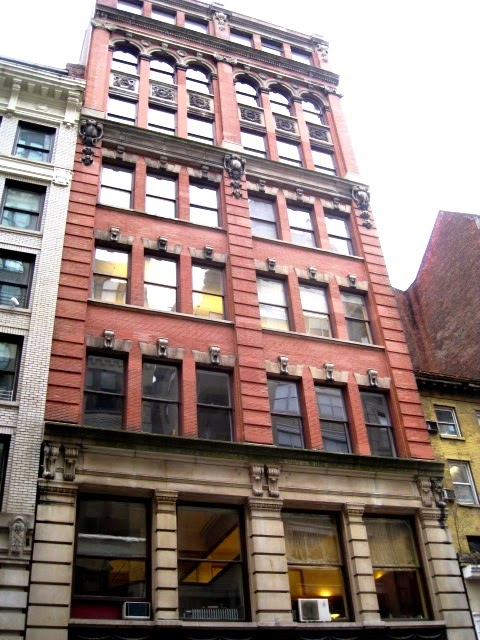
Completed in 1900, the Beaux Arts-style building was as up to date as it was eye-catching.   A two-story base of rusticated limestone framed the first-floor retail space.  Its cast iron storefront featured a bowed show window and exuberant ornamentation of garlands, arabesques and cartouches.   The red brick of the upper floors was contrasted with white limestone courses, lintels, cornices and carvings.  Large, heavy cartouches below the fifth floor cornice matched those of the cast iron store front.  Baylies’s decoration of the topmost floors was controlled and yet sumptuous.

The attractive storefront featured the eyecatching, off-set protruding shop window.
The building quickly filled with apparel-related firms, like Simon Brothers, manufacturers and dealers in furs.   The firm was located on the fourth floor where flammable components like glues were stored.   After employees left for the night on July 8, 1904, something in the shop began slowly smoldering.  After several hours, around 7:00 in the morning, the pile burst into flames.

Fire fighters rushed to the scene, but the intense blaze took more than an hour to extinguish.  Officials estimated the damage to be around $10,000—nearly a quarter of a million dollars today.

Ladies’ hat makers Burras & Griffin moved into the building in 1906.  The semi-monthly journal Men’s Wear called it “a fine hat manufacturing establishment, making exclusive designs in shapes only.”   The company advertised its “high grade ladies’ and misses’ untrimmed hats.”

But not every tenant in the building at the time was an apparel firm.  That same year architect Charles Platt operated from here. 

J. Spencer Crosby & Co. was in the building in 1908.  Forest Leaves magazine, Spring 1908 (copyright expired)

In December 1909 the Cincinnati-based firm of P. R. Mitchell Company leased the store and basement “for a long term of years, at an aggregate rental of $45,000,” as reported in The New York Times.   While the store would cater mostly to women searching for bedding and pillows; the firm was also a wholesale dealer of upholstery stuffings.  Its listing in the American Trade Index the following year noted that it offered “Curled hair ‘Sterilized’ for all upholstering purposes, feathers and down for bedding purposes, turkey quills for duster and millinery purposes, bristles; tickings, denims, cretonnes, etc.; feather dusters; pillows and cushions.”

Housewives shopped for feather-stuffed pillows in the store in 1909 -- (copyright expired)
The building saw a surprisingly-quick turnover in ownership starting in 1913.  Five years earlier Julius Heimann had purchased it.  Now in July 1913 he sold it to the Salisbury Realty Company, which resold it in January 1914 to Minna M. Coester.   At the time the city assessed the property at $240,000.

Changes in ownership apparently did not negatively influence the building’s tenant list.  In May 1915 Pomeranze Bros., makers of cloaks and suits, moved in.  Prior to the move American Cloak and Suit Review made note of the increased space.   “While Pomeranz Bros. are now occupying extensive quarters, they have developed their business so successfully recently that they completely outgrew their accommodations and will have ample room to care for their increased business in their new home.”


The same year Tuttman Bros. & Rosen was organized to produce what The Corset and Underwear Review called “Attractive styles in infants’ and children’s dresses and children’s undermuslins.”  The journal said “They are featuring all white garments, which are being marketed as the ‘Daisy Brand’ line.”

Other tenants in the building in 1917 included P. J. Barash, who advertised “The Big 5 Skirt Line” saying “Come downtown and Save Money at Barash’s;” and Chas. Kafka & Co, manufacturers of dress skirts.  Kafka promised his buyers that year “The last thing I would think of would be to antagonize the buyers whose confidence and good will I value so highly and want you all to know that I am serving your  best interests by marking my skirts as low as possible.”

Eventually the garment district moved northward, past 34thStreet.  As apparel firms moved out, vastly different companies moved in.  In 1933 the store became home to Samuel Wach and Samuel Berger, manufacturers of paper boxes.  Seven years later it was leased to the Chisolm Company, vendors of barber supplies.


Astoundingly, as the neighborhood and the tenant list changed, the exterior of Nos. 36-38 East 20th Street remained unchanged.  Today the ground floor retail space where P. R. Mitchell Company sold feather-filled comforters is home to a trendy restaurant.  Its wonderful bowed show window survives with little alteration, the cast metal store front is intact, and even the three sets of 1901 double doors remain.  And above, Franklin Baylies’s ebullient Edwardian façade deserves a craned the neck from across the street.

photographs by the author